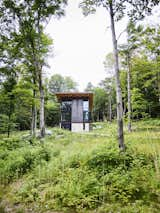
This Cor-Ten Steel Cabin Is a Woodland Escape for the Generations
It’s an image out of Robert Frost. Walter Sargent would take his daughter, Katherine, hiking on the densely wooded piece of land the family owned outside Stowe, Vermont. On their many ambles, they’d pass crumbling stone walls and the foundations of centuries-old root cellars.
"I’ve been coming here my whole life," a now-adult Katherine Barr says. "We would take a turn onto an unnamed dirt road that seemed to go on forever. We’d drive past the covered bridge to the little turnoff after the old cemetery. Then we would park and go walk the land."
The untouched 40-acre property that Katherine and her father hiked until his death in 2000 is still in her family, and it now includes something new: a modern cabin built by Katherine and her husband, Jonathan.
Sitting on a steeply pitched hillside and bordered on two sides by preserved land, the house is worlds away from the couple’s 1907 Victorian in Seattle, where, as Jonathan puts it, neighbors are just "two outstretched arm’s lengths away." Deep in the woods, Katherine, Jonathan, and their two sons, ages 12 and 10, share space only with local flora, like Scotch pines, sugar maples, and ferns.
The untouched forest is exactly the contrast the Barrs hoped to provide for their family when they built the cabin in Vermont. In Seattle, Katherine leads STEM-Paths Innovation Network, an education nonprofit, and Jonathan is a researcher for the Pacific Northwest National Laboratory. They lead busy, urban lives, so the idea of a secluded getaway held great appeal.
"Initially, I really wanted something small—I would have been fine with a tent or a yurt," Katherine says. But she is one of six siblings, many still living in Vermont, and having a place where they could visit together led to a vision of something a bit bigger and more stable.
After being impressed by an Olson Kundig cabin while visiting friends, Jonathan surprised Katherine with a trip to the famed Seattle architecture firm’s studio to work out a design plan with partner Tom Kundig—and they were impressed even more. "In looking at the Olson Kundig portfolio, we were inspired by the way Tom anchors his buildings into a site," says Jonathan.
"My goal was to carry on the client’s family legacy by creating a very special place that took inspiration from the landscape."
—Tom Kundig, architect
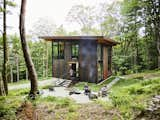
Today, the Barrs call the 1,750-square-foot cabin they created with Kundig their "tree house." Unlike the tent Katherine originally envisioned, the structure is tall and relatively narrow—an "intentionally straightforward and economical cabin that engages with the natural landscape just outside," says Kundig.
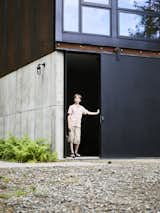
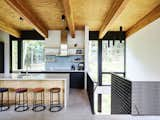
The exterior blends into the surrounding woods with a weathered, rust-colored Cor-Ten steel cladding. Large windows, in a pattern reminiscent of a Mondrian, frame views of the lush Green Mountains and of the Worcester Range beyond. Concrete flooring with radiant heat provides a solid foundation for the open-plan living/dining area on the top floor and for a bunkroom that shares the basement level with the garage/game room. The two bedrooms on the main level feature warm maple floors.
Any Kundig aficionado could easily recognize the architect’s touch in many of the smaller features around the house—the custom door and drawer pulls, for example, and the huge, horizontal-sliding garage door. His vision is also evident in the landscaping, which is understated and unfussy. "Tom’s take was, ‘It’s a forest—it’s beautiful already. Why would you want to put a bunch of plantings here?’" Jonathan says.
And he’s right—the land is perfect as is, both in appearance and in what it provides for the family. Jonathan looks forward to working with the local mountain biking chapter to build trails across the land, while the two boys love making forts in the woods and plowing down the sledding hill they’ve dubbed "the devil’s nose hair."
Shop the Look
For Katherine, the addition of the cabin brings the familial connection full circle. Walking in the woods on a summer day, she can still see those crumbling landmarks she saw with her father. The roads have names now, but the essential character of the forest remains unchanged. "My dad always knew this land was special to me," she says. "He would think it was really cool that we decided to make a home here."
Published
Last Updated
Get the Dwell Newsletter
Be the first to see our latest home tours, design news, and more.