A 400-sq-ft New York Apartment Gets a Second Chance
This might sound odd," Milan Hughston says, sitting in a white Barcelona chair, "but I’ve always fantasized about living in one room." It’s a dog-day summer morning in New York’s West Village, and the air-conditioning is on. A stainless steel kitchenette, ebony-stained wood floor, and luminous walls of Formica and fabric make the 400-square-foot apartment look warmly space-age. Hughston reconfigured the room two years ago, with help from architect Joel Sanders. As he recounts the design process, he cites an unexpected influence. "I’d seen photos of Lincoln Kirstein’s apartment," he says, "and I liked his use of soft fabrics."
Kirstein, the erudite art collector and impresario who in 1948 co-founded the New York City Ballet with George Balanchine, covered his walls with pale drapes bunched into decorative pleats. The rooms were strikingly mono-chromatic: Surfaces melted into each other, punctuated by carefully selected works of art.
Sanders’s way of designing seems a far cry from Kirstein’s. Sanders earned his master’s degree from Columbia University in the early ’80s, and has since be-come a leader in digital prefabrication. For a 2002 exhibit at Cooper-Hewitt, "New Hotels for Global Nomads," the architect composed a hypothetical live/work hotel of interlocking modular units that plug into a structural frame. Last year he finished a room prototype for London’s low-budget but high-end easyHotel, built out of orange and gray streamlined components. Kirstein’s drapery is not an obvious antecedent for architecture more reminiscent of Joe Colombo’s Total Furnishing Unit from the ’70s.
When a mutual friend introduced Hughston to Sanders in 2000, Hughston had just moved into the tiny apartment and wanted it to feel bigger. Sanders, who’d been practicing in New York since 1987, had added space to many an urban shoe box. "My usual approach is to create a versatile living area, building a platform of lounges that can double as beds," he says, after arriving at Hughston’s apartment and settling into an Eames swivel chair. "We also considered a wall of custom cabinets. But this was a case where budget constraints made us more creative."
"When I met Milan," he adds, "I was working on an academic paper called ‘Curtain Wars.’" In the paper,subtitled "Architects, Decorators, and the 20th-Century Interior," Sanders challenges traditional conflicts between architects and interior decorators. "I’d been questioning the notion that architecture is always structural, conceptual, and masculine," he says, "while decoration is superficial, intuitive, and feminine." The paper’s title plays on the term "curtain wall." "Ironically," he writes in the introduction, "the iconic modernist façade which has come to embody all the values of modern architecture—logic, structural integrity, and stripped-down form—takes its name from the curtain, the signature element of the interior decorator."
Hughston appreciated Sanders’s way of thinking. "He was interested in helping me from the decorator’s standpoint as well as the architect’s," he remembers, "choosing furniture and fabric." The apartment’s defining feature became a curtain wall in its literal sense: a wall of gold drapes. The fabric, a Teflon-treated nylon/polyester designed by Jack Lenor Larsen and named Cybelle, hangs neatly on sliding panels created by Sanders. "Part of me," Sanders says, looking at the curtain, "was trying to like the things I’d been taught to hate in school. You know how architects always love silvery, steel colors, but hate gold and bronze?"
The gold curtain conceals much of the apartment’s functional core. Upon first entering, Hughston’s place appears not to have a bed, desk, or dining area, but all three necessities live behind the curtain. A custom-made Murphy bed, with a mahogany headboard, turns the room into a bedroom at night. A Formica tabletop, also custom-made, flips down to the perfect height for a desk, dining table, or bar; in culinary mode, it slides on tracks toward the kitchenette. Around the two foldaway furnishings are wall-to-wall shelves that store "lovingly distributed piles of clutter" behind the curtain.
"The physical act of sliding open a curtain is somehow more peaceful than opening and shutting closet doors," Hughston reflects. Every morning, he stows away the Murphy bed and slides the curtain across. On days when he works from home, Hughston lowers the turquoise table and sets up his laptop. If friends arrive, he clears off his stuff, slides the table into kitchen-island position, and serves aperitifs.
Living in one room doesn’t seem so odd when it’s effectively three rooms. As an answer to his own line of inquiry in "Curtain Wars," Sanders coined a term in a 2001 exhibit at MIT called "Inside Space: Experiments in Redefining Rooms." "I propose Ergo-tectonics," he writes in the show’s catalog, "domestic environments with ambiguous identities. Erasing the hard and fast distinctions between architecture and decoration, built-in and freestanding furniture, these open-ended landscapes will sponsor simultaneous uses, allowing their occupants to freely shift roles and activities."
By merging architecture with decoration, Sanders was able to apply ergo-tectonics to Hughston’s apartment without spending a fortune, giving it functional versatility by altering surfaces. His most complex intervention was modifying the wall behind the curtain. He left the miniscule bathroom interior—the apartment’s only separate space—as is, but clad its outside wall with turquoise Formica that matches the fold-out table. He covered the kitchenette with matte silver Formica. The kitchen and bathroom thus acquire a unified podlike appearance, seeming to float above the ebony-stained floor.
Hughston, who has directed modern art libraries for years (he is currently chief of library and museum archives at MoMA), has an admirable collection of 20th-century art and objects. The blending group of surfaces, accompanied by art on display, is vaguely reminiscent of Kirstein’s apartment. Behind the couch is a meditative colored-pencil drawing by Beto de Volder, an Argentine artist. On the same wall hangs a skateboard-sized bottle opener from the long-lost, frivolously poppy 1980s store Think Big. A rare pendant lamp overs over the sofa. Its white plastic shade contains molded bumps that hang around the bulb like stalactites. "It’s 1970s Italian, but I don’t know the designer," Hughston admits. "I’ve asked everyone at the museum; no one knows. I’ll take whomever solves that mystery out to dinner."
Tidiness is crucial in a small space—especially one that makes daily functional transitions. Hughston lost much of his clutter to a freak accident. In 2000, the year after he’d moved from Fort Worth, Texas, to New York, there was a fire in his Texas storage locker. "It was traumatic. But in a way it was liberating. You can lose all your stuff, but you can’t lose your eye for stuff." He curates his compact surroundings with a librarian’s meticulousness.
In "Curtain Wars," Sanders argues convincingly that interior decoration’s bad rap is entwined with sexism, as the occupation has traditionally been considered female, while architecture has been thought of as men’s work. But Sanders also touches on questions of permanence versus ephemera—"structural" versus "superficial." As gender stereotypes become outdated, so do our expectations for permanence in architecture—especially in big dense cities, where most people live in small spaces and apartments turn over almost as quickly as park benches. The only permanence is the surrounding urban fabric. As Hughston says, "You don’t need a lot of space, because the whole city is your space."

Milan Hughston's apartment is at the rear of a historic multi-unit building
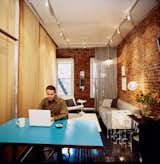
Checking email over coffee, Hughston places his laptop on the fold-down Formica table that Sanders designed. Jack Lenor Larsen's Cybelle fabric covers the wall on his right. Above the sofa hangs an Italian pendant lamp of mysterious origin; if you recognize it, please contact us.
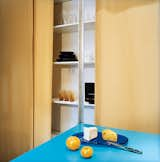
Hughston keeps all his tableware behind the curtain, on the shelves nearest the kitchen. The ample shelf space, covering the entire wall (except that taken up by the Murphy bed), makes it easy for Hughston to avoid mess. The contrast of gold and turquoise is warm and lively.
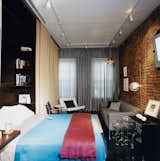
"I think of the bed as intimate space," Hughston says, "and putting the bed away—having it out of sight when not in use—is satisfying." The custom-designed Murphy bed, concealed by day behind the gold curtain is well built; it's ergonomically easy to lower and has a firm sleeping surface.

Milan Hughston's quiet street in Manhattan's West Village is moments from the neighborhood's boutique shopping and nocturnal ruckuses. Architect Joel Sanders made Hughston's space multi-functional; here it's shown as a living room, for relaxing or entertaining friends.

When slid toward the kitchen on custom tracks, the fold-down table gives Hughston much-needed counter space. Luckily, the apartment came with stainless steel appliances; Sanders covered the cabinets with matching Formica. A mirror behind the kitchen sink also adds a feeling of space.
Published
Last Updated
Get the Dwell Newsletter
Be the first to see our latest home tours, design news, and more.