• Home Tours
    • Dwell Exclusives
    • Before & After
    • Budget Breakdown
    • Renovations
    • Prefab
    • Video Tours
    • Travel
    • Real Estate
    • Vacation Rentals
  • Photos
    • Editor’s Picks
    • Bathrooms
    • Kitchens
    • Staircases
    • Outdoor
  • Magazine
    • Current Issue
    • All Issues
  • Shop
    • Shopping Guides
    • Furniture
    • Lighting & Fans
    • Decor & More
    • Kitchen & Dining
    • Bath & Bed
  • Projects
    • Editor’s Picks
    • Modern
    • Midcentury
    • Industrial
    • Farmhouses
    • Scandinavian
    • Find a Pro
    • Sourcebook
  • Collections
    • Editor’s Picks
    • Shopping
    • Recently Saved
    • Planning
SubscribeSign In
  • FILTER

    • All Photos
    • Editor’s Picks
    • exterior
  • Building Type

    • House(421)
    • Apartment(1)
    • Cabin(75)
    • Boathouse(1)
    • Shed(8)
    • Beach House(21)
    • Shipping Container(14)
    • Prefab(48)
    • Farmhouse(6)
    • Mid-Century(45)
    • Ranch(2)
    • Barn
    • Camper(5)
    • Airstream
    • Tent
    • Treehouse(1)
    • Tiny Home(46)
    • Small Home(11)
    • ADU
  • Roof Material

    • Shingles(13)
    • Metal(288)
    • Tile(6)
    • Green(51)
  • Siding Material

    • Wood(207)
    • Concrete(117)
    • Metal(540)
    • Vinyl
    • Stucco(21)
    • Brick(50)
    • Stone(43)
    • Glass(540)
    • Green(4)
  • RoofLine

    • Flat(322)
    • Shed(46)
    • A-Frame(5)
    • Gable(85)
    • Butterfly(10)
    • Hipped(2)
    • Gambrel
    • Mansard(3)
    • Saltbox(1)
    • Curved(7)
    • Dome(2)
    • Sawtooth(1)
All Photos/exterior/siding material : glass/siding material : metal

Exterior Glass Siding Material Metal Siding Material Design Photos and Ideas

Set high in Crestwood Hills, Richard Neutra’s 1956 Adler House underwent a faithful restoration by Tyler and Margaret Lemkin.
The cabin hovers over the site on stilts, giving it a floating effect.
Completed in just six weeks by Australian practice Archiblox, this modest prefab home is perched atop cliffs with prime views of Avalon Beach, just a short drive away from Sydney. Oriented east to west to maximize cross ventilation, the house is clad in marine-grade Colorbond Ultra steel and Queensland blue gum to protect against the elements.
The concrete-and-steel home by Faulkner Architects gives one family a refined escape in the mountains of Northern California.
To the front, the gardens are laid around a central lawn with a circling driveway which provides parking. There is also a garage for family cars.
Wexler and Harrison's original plan was to create affordable vacation homes for a growing middle class. When this home first went on the market with the others in 1962, it was competitively priced between $13,000 and $17,000. Today, the kitchen has been restored following guidelines from its original configuration, and the landscaping was updated in 2001 with Wexler's oversight.
To turn a home into a permanent residence for a family of four, Rama Estudio attached a prefab glass-and-steel box that extends into the surrounding wilderness.
Nestled into a grassy hillside, the cabins overlook ponds and oak, birch, and linden trees that grow on the property.
"The composite structure is extraordinarily durable,
Working with architects at The Miller Hull Partnership and interior designer Charlie Hellstern, they honored the 1960s Northwest-modern design while pushing the boundaries of renovating sustainably.
Fin wall shields porch from westerly breezes somewhat while maintaining views and providing lateral shear resistance.
This Beverly Hills kitHAUS is comprised of modernist prefab modules that can accommodate a variety of uses: from yoga studios to home offices, and from weekend retreats to pop-up kiosks and guest rooms.
Inspired by LivingHomes’ RK2 model, this custom prefab-hybrid home in Beverly Hills, Los Angeles, was made for actor Will Arnett by Plant Prefab.
The roof of this residence was made from scraps taken from the sides of the shipping containers. Its slanted design creates a wind tower effect that provides natural ventilation and negates the need for air-conditioning.
Australia-based firm Contained specializes in transforming cargo vessels into well-designed lodgings. Each 20-foot shipping container easily opens up, flips out, and unfolds into a luxurious hotel room.
The H4 is HONOMOBO’s most efficient shipping container home. At just over 700 square feet, the home has two bedrooms, a living room, a dining room, a full kitchen, and one bathroom.
Though this 2,808-square-foot home in Lewes, East Sussex, England, used to be an old workshop, Sandy Rendel Architects transformed it into a beautiful home with a building shell that was made of SIPS (structured insulated panels), and prefabricated offsite.
Landscape designer Grits Runis of Landshape designed the area around the cabins, planting a terraced garden that provides herbs for making tea.
The cabins and sauna that architect Zane Tetere-Sulce designed for the Ziedlejas Wellness Resort are clad with Cor-Ten steel and glass.
Tetere-Sulce created a glass facade for the front of the sauna building, which is built into the hillside and overlooks the ponds.
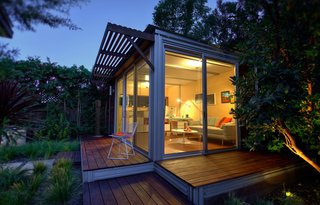
Expansive glass walls were paired with a Corten Steel frame to maximize the yard's garden views.
In the corner, framed, machine-sewn vintage fabrics serve as minimalist wall decor. The artwork is the creation of delavegacanolasso and is available for sale on the firm's website.
The interiors are lined with OSB Poplar wood, and insulated with 12cm of recycled cotton.
Architects Delavegacanolasso expand a client’s work-from-home office space by adding a Cor-Ten steel prefab to the backyard.
Inspired by ancient ruins, Frankie Pappas crafts a green-roofed, brick guesthouse that connects deeply with nature in the South African Bushveld.
At night, it is easy to see how the volume at the north end of the site is stacked with the library and a private deck above, and the en suite guest bedroom below. This is separated from the rest of the living space by the open garage, offering increased privacy.
The modularity of the home’s construction is referenced in the grid-like windows. These large areas of glazing allow the home to be filled with natural light.
The tower features a ladder for access to the utilities, and the roof is planted with native shrubs to soften the concrete construction and reflect the approach taken with the landscaping.
A concrete block tower in the garden beside the home contains a water tank and solar heating boiler with a shower below.
The metal roof and external walls are constructed from double-layered metallic roofing tiles, which were chosen for their durability against the elements.
The home requires very little maintenance and features a lightweight construction. The modularity of the design also helped to avoid excessive material waste during construction.
The site is a generous lot at an estate in Cotia, on the outskirts of São Paulo—an area that has plenty of greenery. Part of the concept for the home was to replace some of the existing exotic trees with native plants.
The clients are a husband and wife with grown children who no longer live at home. The husband is a psychoanalyst, and the wife is a history teacher at a middle school in São Paulo. During construction of the home, very little earthwork was needed, as the residence nestles into the sloped site to preserve the flat part of the site for a garden of native trees and shrubs.
Casa Parasito effortlessly provides accommodations for two people in a cleverly unique location: the rooftop of a city building in San Juan, Ecuador. El Sindicato Arquitectura wanted to not only provide a home, but also contribute positively to the densification challenge that the city’s inhabitants face. The design concept hinges on an A-frame facade. Within, an interior layout is marked by a rectangular core—also the main social/living space—from which all other utilitarian spaces, such as the kitchen, dining area, bathroom, bed, work area, and storage are accessed.
The three buildings are strategically organized around a central courtyard, creating an outdoor room that is protected from sun, precipitation, and wind. The openings between the buildings frame the predominant views.
Grasses, shrubs, and flowers surround the building, making it appear as if it grew out of the landscape, rather than being placed in it. Pavers in the grasses weave between the recreation locker building and the main residence to the central courtyard, which is situated under a canopy.
The elevated canopy above the three volumes not only protects the courtyard from the elements, but hierarchically demarcates this outdoor living area as the most important space in the structure.
The home is known as “Boar Shoat”—a reference to a young hog who is full of energy and life. “The term was used by the owner’s family when he was growing up to describe youthful vivacity,” says architect Hunter Gundersen.
12345...9Next

About

  • About
  • Contact Us
  • FAQ
  • Editorial Standards
  • Careers
  • Advertise
  • Media Kit

Subscriptions

  • Subscribe to Dwell
  • Gift Dwell Magazine
  • Dwell+ Subscription Help
  • Magazine Subscription Help

Professionals

  • Sell Your Products
  • Contribute to Dwell
  • Promote Your Work

Follow

  • @dwellmagazine on Instagram
  • @dwellmagazine on Pinterest
  • @dwell on Facebook
  • @dwell on Twitter
  • @dwell on Flipboard
  • Dwell RSS

© 2026 Recurrent Ventures Inc. All rights reserved.

  • Privacy
  • Terms
  • DMCA
  • Sitemap
  • Do Not Sell or Share My Personal Information