Collection by C
toms bayou
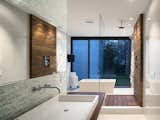
In the master bath, a custom raised Silestone sink is surrounded by a teak countertop and Porcelanosa glass tiles. Teak slats anchor the glass-enclosed shower.
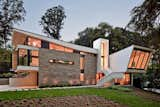
Svenson calls the floating aluminum stairway “a major sculptural element.” He adds, “We really wanted to celebrate the entry,” which is elevated because the site is ten feet higher in the rear. The earthy stucco and local stone cladding keep the home rooted to its landscape.

“So many houses seem like they’re completely still and heavy,” says Dencity architect Staffan Svenson. Inspired by his client’s role in the airline industry, Svenson relished the chance to create a home that evokes motion and lightness.
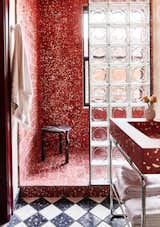
If you're looking to recreate this look in a home bathroom, Cooper thinks its best for small spaces. "Keep it contained if you are living with it every day," he says. "It's fun to go all out in a small powder room or secondary bathroom you don't use all the time. In your primary bathroom, you will likely get sick of it if you push it too far."
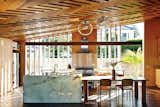
In the kitchen, the showstopping ceiling’s herringbone pattern is echoed by the terra-cotta tiles on the floor. Architect Michael O’Sullivan, who designed the steel-and-glass kitchen cabinets, the table, and the pendant lights (made by Lava Glass), further amped up the richness of the room by specifying an onyx kitchen island. Interior designer Yvette Jay, a collaborator and classmate of O’Sullivan, kept her material palette “tight and limited. I had to restrict myself so that everything here ties in with the architecture.”
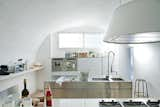
A double bowl sink is also quite self-explanatory, created either out of one large sink with a divider or from two distinct bowls framed into a single sink.
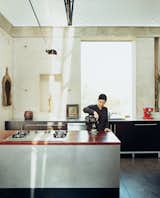
The House of Earth + Light had been featured in the pages of the New York Times and on the cover of Dwell’s premiere issue, and was revisited years later. In the kitchen, an elegant palette of materials defines the open space. The rear counter is sanded stainless steel; the island counter is Purpleheart (an exotic hardwood) with a range by Dacor.
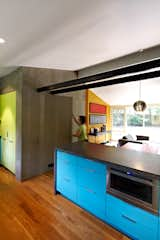
A dark concrete countertop is paired with blue laminate cabinets in architect Janet Bloomberg’s kitchen.
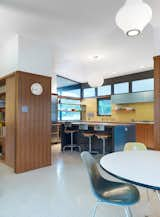
The open dining area and kitchen of a midcentury renovation in Austin shows the existing terrazzo flooring, the plaster ceiling, and the kitchen's tile backsplash—Fireclay Debris series in Daffodil—working in harmony. Floating shelves in the kitchen window and a stainless-steel countertop surrounding the kitchen's burners rest just beneath the backsplash. A Boca Raton Blue upper cabinet and Nelson pendants add interest and dimension to the kitchen's warm combination of wood, yellow and blue. Vintage chairs, seated at the kitchen island and in the front right corner at the dining table, complete the design scheme.
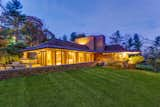
From the lawn, the home’s flat roofline evokes the character of Prairie style residences.
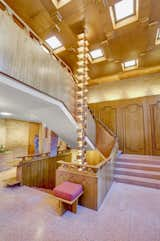
Custom furnishings, like this stool, can be found throughout the home. A 25-foot teak pendant light stretches from the ceiling down through all three levels. In the TV show, Brye Adler starts live taping at the top of the staircase.
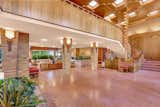
The grand foyer features terrazzo floors, pillars made of Roman bricks, massive teak paneling, and tessellated skylights.
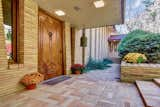
Signature elements of Frank Lloyd Wright’s style abound—starting with the front door.
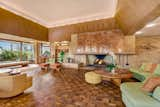
The main living room set the scene for “Miami After Dark.” The lavish interior features parquet teak floors, Italian marble, and floor-to-ceiling windows.
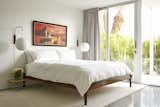
Sconces by George Nelson for Herman Miller flank Jessy and Steve’s bed. The painting was a wedding gift.
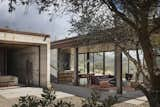
On an undulating stretch of California coastline, a hidden guesthouse runs free of the grid. "The house is elemental," says project architect Dan Weber of Santa Barbara–based firm Anacapa, who collaborated on the project with designer Steve Willson. "We endeavored to make it out of materials that would wear and take on a patina over time, so they could feel like part of the landscape." Unfinished steel, board-formed concrete, and glass continue inside, where rich black walnut—used for ceilings, cabinetry, and furniture—provides an inviting contrast. "On a foggy day, you want that feeling of warmth around you," says Margaret. Brass fixtures complement the deep-hued wood.

At Under, a Snøhetta-designed restaurant balanced on the Norwegian coast, guests dine 16 feet below the ocean’s surface. The tilted concrete tube gives the impression that it’s sliding into the sea. “The idea was to make a tube that would bring people from above sea level down under the sea,” lead architect Rune Grasdal told Dezeen. “That transition is easy to understand, but it’s also the most effective way to do it. It also feels secure, but you don’t feel trapped.” The angle was also designed with the building’s aquatic neighbors in mind. Over time the structure will become part of its environment, acting as an artificial reef. Marine research tools like cameras have been installed outside the restaurant to help scientists learn about the population, behavior, and diversity of the species living in this part of the North Atlantic.
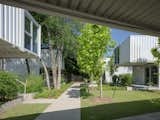
A central "street" runs through the development and affords the feeling of a micro-neighborhood with the recessed front entrances of each home connecting to the communal path.
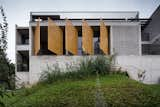
The pivotal screens can be adjusted to adapt to the sun’s angle. As they are made from perforated sheet metal, they do not block views from the wine tasting room.
25 more saves