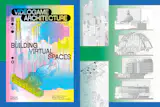
How “The Last of Us” Video Game Makes the Fallen American City Into a Wild Frontier
While the portrayal of violence in video games is common, the brutality and harsh realism of the United States of America as depicted in The Last of Us remains shocking even today. Naughty Dog’s postapocalyptic tale of Joel and Ellie’s journey through a society lost to a fungal plague is communicated through two central themes that run through the game. Players will regularly encounter characters and scenarios that illustrate the cruelty of human beings toward one another in the face of the unremitting threat from ‘infected’. But more spatially, the game’s central narrative takes us on a tour through cities and towns that have collapsed into ruin, questioning what urban and suburban environments might look like when humans retreat and nature returns.
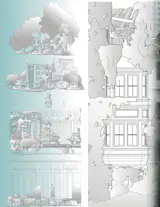
Elevations of buildings found along Joel and Ellie’s journey, showing how nature has overtaken both urban and suburban architecture.
While the game’s story focuses on the harsh existence of life in a post-Cordyceps pandemic world, the environments that Joel and Ellie travel through communicate the complete breakdown of society. Great cities of America are shown dilapidated and overrun by the natural world, with buildings relegated to mute shells struggling to contain the proliferating flora. The world is presented to players as-is, with little exposition as to precisely how it came to be so overgrown other than the human retreat into quarantine zones. Yet as Sarah McCreedy argues, "The Last of Us emphasizes environment such that it almost constructs it as a character in its own right." The status of buildings and cities as signifiers of decay within The Last of Us connects to a long cultural fascination with ruins and ruination. The treatment of nature also relates to a less well known term, ‘rus in urbe,’ literally country within the city, a term first attributed to the Roman writer Martial, which describes a fascination for bringing nature into an urban environment.
As architect Jonathan Hill argues, "a ruin’s incomplete and broken forms expand architecture’s allegorical and metaphorical potential" where "a fragmented composition is a truer reflection of a contemporary society than a complete composition." This is particularly true for the environment we encounter, where the ruined architecture encompasses two of the great symbolic cultural spaces of America: the powerful city and the idyllic suburbia. This has the effect of returning the American metropolis to a ‘frontier’ state, perfectly supporting the narrative of a ‘Western’-style journey through the wilderness that just so happens to be within a city.
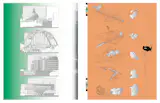
Sectional drawings showing the architectural landmarks that players are shown at the beginning of each story chapter, before navigating through the landscape to find them (left). Studies of real-world areas encountered in the game, showing the architectural reference points that are compressed and distorted by the game’s developers (right).
Natural selection
This setting allows Naughty Dog to create a world that plays with meaning, which Melissa Kagen calls a "postapocalyptic pastoral" where the developers "juxtapose a failed modern civilization with nature’s powerful, victorious reclamation of the places once controlled by human technology." A playful example of this in architectural design is the work of architect James Wines, whose studio SITE created a series of subversive designs for American store chain Best, one of which was called the Forest Building. This was a standard ‘big box’ store as found all over the U.S., but literally integrated with an existing forest, the brick structure of the building appearing to be torn apart by the trees growing outside of, and into, the building. By using camera mods to detach ourselves from Joel, we look out across the landscape of Boston and find numerous other examples of how the developers explore where urbanism ends and nature starts in interesting ways. As we arrive at the Massachusetts State House, turning the camera round and flying off into the city reveals rows of buildings covered in vines, while wrecked cars, buckled trucks and twisted street furniture poke out of the lichen green pools of floodwater. Such images are not unlike photography studies of real-world Detroit where our "fascination with images of first-world urban decline" intend to tell "a history unsuited to the war memorials and equestrian statues that dot the national landscape."
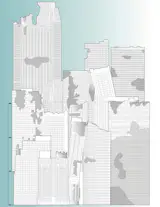
Elevational drawings of the various skyscrapers seen in the background skylines across America, which subtly reinforce the landscape of ruin and degradation found on the streets.
Further beyond this, we encounter the ‘hinterlands’ of urban business districts, with huge skyscrapers looming over the city. While certain sections allow us to venture into these structures, they typically remain in the distance, with derelict towers becoming ultimate signifiers of collapse. This is particularly emblematic of American urbanism, with the skyscrapers echoing the work of architects such as John Portman or SOM, masters of the huge, blank-faced buildings such as Atlanta’s Peachtree Plaza and Chicago’s Willis Tower. Using the camera mod to venture to the edge of the game’s maps, we record examples of the skyscraper typologies that are used throughout the world and how they crack, crumble and fall in response to forces that are never made clear. Some of these structures are used repeatedly while others are designed to closely match real-world architecture such as the BNY Mellon Center in Pittsburgh. By drawing them together as a landscape of elevations that moves upward as the story progresses, we can see how the broken skyscraper is a repeated motif that can both indicate a specific contextual location alongside a general atmosphere of social collapse.
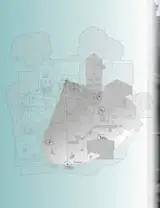
Looking over the street in Waverly Township where a sniper tracks Joel and Ellie, we see the landscape of objects and cover that allows players to find and flank the shooter.
Broken bucolia
Waverly Township is where we encounter the effects of the pandemic on suburban life, marking a shift in scale from the city centers. After being washed down a river and having navigated a tunnel system full of infected, Joel and Ellie find themselves picking their way through ransacked houses as they journey towards a radio tower. In a rare moment of downtime for the player, the walk through Waverly presents a romantic and almost bucolic atmosphere, with houses overgrown by plants, nestling into a lush green landscape. The Last of Us uses these environments as picturesque interludes, but at the same time, the destroyed cities we visit also connect to an underlying fascination in picturesque art and architecture, that of ‘the ability of art to bring mean scenes—which in nature disgust—up to beauty. As John Macarthur explains, picturesque designers were fascinated by grotesque scenes such as butcher’s shops or Rembrandt’s paintings of animal carcasses. Away from Waverly there is also the more monstrous beauty of buildings overgrown by Cordyceps itself, where nature, architecture and the human body become completely merged.

A visual archive of domestic objects that can be found as players traverse houses, hotel rooms, and makeshift living quarters, each communicating something about the lives left behind.
Of course, the quiet does not last long, and in one of the game’s key encounters, a long suburban street must be traversed while under sniper fire. As Joel moves between cover, creeping room to room within houses, the type of domestic spaces we were just freely wandering around become ones of tension, scrabbling for crafting materials on worktops and using furniture to hide from hunters as we try to reach the sniper’s nest. In this encounter, Joel will likely shield himself from view by means of family cars, fridges or upturned dinner tables. Brutal combat takes place in living rooms and kitchens.
The abandoned objects of a previous life are carefully arranged to facilitate Joel’s safe passage through the area. But, as the preceding moments of calm demonstrate, these domestic objects and the places they inhabit work throughout the game as a means of quietly communicating the magnitude of what has happened to society.
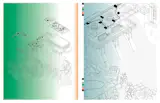
Isometric drawing of ‘Tommy’s Dam’, showing how the architectural space is activated differently in combat, as crates and pieces of machinery suddenly become cover from attackers.
Walled off
While narratively the game presents an ultimately futile journey of two people across the new American wilderness and back again, nature and the post-pandemic wasteland is perhaps the true star of story. A world in ruins is ‘an image of the future as well as the past, encouraging us to imagine not only what is lost, but also what is yet to occur.’
At the end of the game, as Joel and Ellie crest a hill and look over Jackson, we return to the suburban idyll that so briefly exists at the start of the story. Gone, for a moment, are the cities and people torn apart by nature’s antagonism. Yet we know they are never too far away.
Excerpted from Videogame Architecture: Building Virtual Spaces by Luke Caspar Pearson and Sandra Youkhana. Foreword by John Romero. Copyright © 2026, Sandra Youkhana and Luke Caspar Pearson. Republished with the permission of Thames & Hudson.
Buy the book

Top collage by Dwell. Source images courtesy Thames & Hudson
Related Reading:
Published
Topics
LifestyleGet the Dwell Newsletter
Be the first to see our latest home tours, design news, and more.