• Home Tours
    • Dwell Exclusives
    • Before & After
    • Budget Breakdown
    • Renovations
    • Prefab
    • Video Tours
    • Travel
    • Real Estate
    • Vacation Rentals
  • Photos
    • Editor’s Picks
    • Bathrooms
    • Kitchens
    • Staircases
    • Outdoor
  • Magazine
    • Current Issue
    • All Issues
  • Shop
    • Shopping Guides
    • Furniture
    • Lighting & Fans
    • Decor & More
    • Kitchen & Dining
    • Bath & Bed
  • Projects
    • Editor’s Picks
    • Modern
    • Midcentury
    • Industrial
    • Farmhouses
    • Scandinavian
    • Find a Pro
    • Sourcebook
  • Collections
    • Editor’s Picks
    • Shopping
    • Recently Saved
    • Planning
SubscribeSign In
  • FILTER

    • All Photos
    • Editor’s Picks
    • exterior
  • Building Type

    • House(105)
    • Apartment
    • Cabin(6)
    • Boathouse
    • Shed(1)
    • Beach House(3)
    • Shipping Container
    • Prefab
    • Farmhouse(1)
    • Mid-Century(14)
    • Ranch
    • Barn
    • Camper
    • Airstream
    • Tent
    • Treehouse
    • Tiny Home(3)
    • Small Home
    • ADU
  • Roof Material

    • Shingles(11)
    • Metal(52)
    • Tile(18)
    • Green(6)
  • Siding Material

    • Wood(52)
    • Concrete(110)
    • Metal(18)
    • Vinyl
    • Stucco(6)
    • Brick(7)
    • Stone(17)
    • Glass(32)
    • Green(5)
  • RoofLine

    • Flat(23)
    • Shed(9)
    • A-Frame
    • Gable(110)
    • Butterfly(3)
    • Hipped
    • Gambrel
    • Mansard
    • Saltbox
    • Curved(2)
    • Dome
    • Sawtooth
All Photos/exterior/siding material : concrete/roofline : gable

Exterior Concrete Siding Material Gable Roofline Design Photos and Ideas

A concrete lintel and post marks the new window and door in the facade. The building's position makes inhabitants feel like they are hunkered down in the olive grove.
The 1930s home in London that architect Grant Straghan remodeled for himself and his family is enlivened by blue-green cement tile exterior cladding.
DGN Studio renovated and extended  a semidetached Victorian terrace near London Fields for clients Rebecca and Roman. The rear extension is defined by a material palette of exposed concrete and white-oiled oak, which was chosen for its durability, as well as its warm texture and grain. “We are very aware of the dialogue around the sustainability of concrete as a building material, so we were keen to make sure its use was related to a specific set of practical tasks for which it would stand the test of time,” says DGN studio cofounder Geraldine Ng.
Board-formed concrete provides a pleasing but not overly decorative finish for the backside of the lower level. The living room volume and concrete terrace sit atop the garage.
The front of the home shows how the roof was lifted to maximize the views.
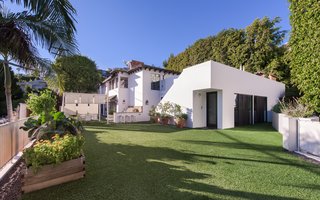
The front façade received fresh white paint and new landscaping. The blue door was painted "Flaming Torch" from Behr, a vibrant orange.
The custom sliding window screens, which shield from solar gain, were designed by the couple and are a modernized reference to the operable shutters that Denise remembers from her childhood in Austria. They first used the idea on one of their apartment buildings.
On the front facade, ground-faced concrete blocks contrast with cumaru wood tongue-and-groove siding.
A rear view of the home shows how the old structure is wrapped in corrugated Cor-Ten steel, marking it as an "artifact of the site," as John describes. The new residence gently slopes away from the neighboring house rather than towering over it.
The exterior of the home features warm blackbutt timber cladding and crisp black metalwork. Each level of the home opens out to a deck or balcony, and the curved white balustrade outside the main bedroom is a contemporary take on the original architecture.
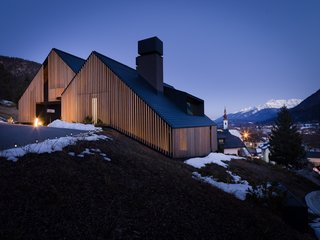
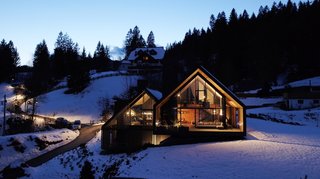
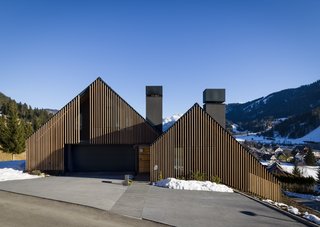
Silvano Zamò, third-generation winemaker at Le Vigne di Zamò winery, and his wife Brigitte tasked architecture firm GEZA with a holiday home on a hilltop location in the tiny northern Italian village of Camporosso, not far from the ski resort Monte Lussari.
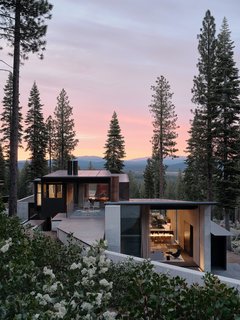
On a steep, forested, nearly 30-degree slope adjacent to a ski run and lodge north of Lake Tahoe, Greg Faulkner, founder of Faulkner Architects, spent multiple years working on this contemporary family cabin. The roof "tilts up to the mountains and down to the valley like a visor, while the main home mirrors the ski run to the east side of the property, so the home has a central axis that runs up through it," he says. During the winter, one can ski directly into the living room, with its inset fireplace and 17-foot-high ceilings.
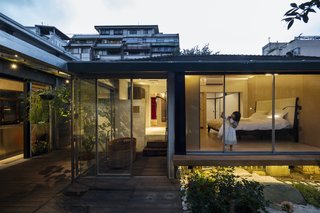
During the renovation, Chu extended the bathroom next to the master bedroom outwards to create a bath and shower room that blurs the boundaries between interior and exterior. He also added a skylight made from a repurposed car sunroof, which was purchased secondhand for $100 and could be operated by remote control to easily let the elements in. “There were many challenges in what we wanted to do,” says Chu. “Then, we searched for materials and ways of doing that—or we let the site inspire us.”
The sliding front door is made of glass panels, and its bright red color was inspired by the red doors (symbolic of fortune and prosperity) found in traditional villages in Taiwan. “We wanted the front door to be transparent so that light filters into the interior even when the door is closed,” says Chu. “It was very important to have a constant relationship between inside and outside.”
“A conglomeration of boxes around a bit of a pitched roof” is how Mark describes his transformation of the 1920s Los Angeles bungalow. Inverting the traditional layout, he set the private rooms in the front and a large, open living area in the rear.
In the daytime, the Polygal system pulls in soft, natural light, while at night there are a rainbow of options. "It has a beautiful quality of natural light during the day—plus it manages UV rays and privacy, and controls glare," says Lori.
One facade features Polygal, a polycarbonate sheet first manufactured in 1970 and now available in various layers, colors, and degrees of transparency. The Polygal used for Trammel House has LED light strips inside, which the Louises play with for holidays and parties.
Jim and Lori Louis’s three-bed, two-bath home in East Dallas came to life because of a unique partnership between the couple and A. Gruppo Architects. "They really listened to our goals, embraced our aesthetic, and honored our budget," says Lori.
Determining the structural integrity of the original brick dairy was paramount to the design of the new addition perched above. The existing brick walls, footings, and roof structure were all assessed, and steel features prominently in the extension to ensure stability.
Nestled within a forested site, the home is the perfect getaway for a family and their relatives and friends.
Located in Austin’s historic Hyde Park in the company of 1920s-era bungalows, the Concrete Casita by Ravel Architecture is distinct with its contemporary, low-lying profile, yet feels at home with the neighborhood. Designs to become in-law’s quarters or serve as a versatile, indoor/outdoor space for an active Austin family, the 600-square-foot structure has a rugged makeup of board-formed concrete, rusted steel, and glass. Ravel Architecture partners Alex Finnell and Devin Keyes chose board-formed concrete for the exterior, scoring the vertical boards to "get a really nice texture and interesting dynamics," says Finnell.
The home’s private spaces are located below, in a more secluded area that doesn't compromise on water views.
Originally designed in 1939 by Roscoe Hemenway, the Burton House was once home to famed artist Verne Tossey, who was best known for his campy pulp fiction book covers throughout the 1950s and 60s. Recently, Portland-based designer Benjamin Silver and builder Oliver Olson have completely renovated the home, transforming the property into a modern interpretation of Hemenway's original design.
Designed to comfortably accommodate three to five employees, the 1,000-square-foot home office by Matt Fajkus Architecture complements an existing midcentury abode. The addition includes two individual office spaces, a conference room, a studio, a bathroom, and storage space. An operable wall divides the main space as needed. The wood-and-stucco addition features a pitched metal roof that jives with the existing home's midcentury style.
The firm took inspiration from early barns in the area. “They’re very lightly built here because we don’t have snow,” says Haesloop. “So then the eaves are very tight. There are no overhangs. So, we were interested in using the Equitone to fold down to the land.”
This view shows the two forms backed by the Cypress trees. The main social areas are to the right, and the bedroom cube is to the left.
Windows wrap the length of the wall in the main section of the house and overlook the green space. “It’s a very unusual setting for the Sea Ranch—and Kieron, who’s from England, absolutely loves it because you get these beautiful big green meadows,” says architect Eric Haesloop.
“We wanted to create a house that did justice to the incredible landscape of the Sea Ranch, and also to its immediate surroundings—a combination of bright open space looking toward the ocean, but also an area that was sheltered and shaded by a gorgeous stand of Cypress trees,” say the couple. “We also wanted to preserve and honor the tradition of Sea Ranch architecture—Kieron is a huge history buff, and he had started reading about the origins of the Sea Ranch build paradigm, as well as the utopian ideals upon which it was founded in the 1960s.”
Originally built in 1940, this 3,260-square-foot home has undergone a complete redesign, reimagining the property as a midcentury-inspired, contemporary estate. The renovation of the four-bedroom, five-bath residence also included the addition of an entirely new wing and landscaping including cacti and palm trees . Highlights of the home include an open indoor/outdoor floor plan, a vaulted tongue-and-groove ceiling in the great room, expansive glazing, and gorgeous desert landscaping across the 16,000-square-foot lot. The iconic home also comes with a bit of local history, as it was previously owned by Florian Boyd, the former Mayor of Palm Springs from 1953 to 1957.
Located in Austin’s historic Hyde Park in the company of 1920s-era bungalows, the Concrete Casita by Ravel Architecture is distinct with its contemporary, low-lying profile, yet feels at home with the neighborhood. Designs to become in-law’s quarters or serve as a versatile, indoor/outdoor space for an active Austin family, the 600-square-foot structure has a rugged makeup of board-formed concrete, rusted steel, and glass.
Pinon Ranch appears to emerge from the dense oak grove.
The “knuckle” connects the public and private spaces with the meadow on one side and the oak grove on the other. The space between the volumes is as carefully considered as the architecture itself.
Cantilevered out over the hillside the residence, which also serves as the couple's primary residence, is threaded between the trees, anchored by its concrete foundation which stops just short of the tree’s roots.
The gabled structure peers out from the dense oak grove to the meadow below.
The upper floor contains most of the living spaces, while the lower concrete level houses the entry room, a triangular office, and a laundry and storage room.
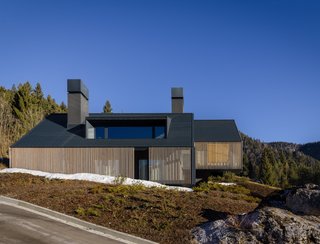
The Z House's structure consists entirely of concrete. Wood screens wrap around the sides, and Prefa materials top the roof.
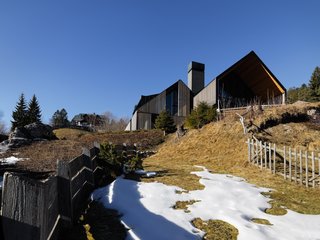
The complexity of the very steep, rock-studded site was a big challenge for the architects. Here is an image of the west side of the house, where the service areas, garage, and entrance are located.
A modest, gabled 1965 hut on the outskirts of Guatemala City was transformed into an expansive 4,467-square-foot getaway. Blurring the indoors and out, architect Alejandro Paz adhered to the original architectural elements while adding modernized touches. The roof maintains the same angle as the original hut, but reversed, while new modules give the space a new identity. With floor-to-ceiling glazing, the home allows for the residents to take in the Guatemalan forest from all angles.
A view of the Z House illuminated at night.
Deep roof overhangs not only protect the interior from direct sunlight, but also provide privacy.
The house is designed to step down the sloped site. Over time, the larch screens will develop a gray patina and create a cool contrast with the warm-toned interior wood.
“The approach path is one of the key points of the project. The arrival is a precise and inevitable sequence: the road climbs steeply, the house shows itself from afar in the middle of other buildings, then hides, and then reappears in a scenic perspective from the bottom where you can feel the whole size of the building,” says GEZA.
The two structures are connected by green space.
"By reversing the shape of the land and the house, we wanted to think about the relationship between house and nature and notion of form," said the firm.
The home's lower level is submerged in the hillside. The three bedrooms on the upper level have access to the roof terrace.
The 2,026-square-foot house is split into two structures, with an underground garage separating the two halves.
The exterior walls of Casa Quinta da Tília are painted the same color as the tin roof finishing, which is made from local Japanese cedar wood. The broad skylights in architect Pedro Maurício Borges's design not only draw in the wonderful Azores sunshine, but also frame the majestic, parasol-like crown of the linden tree.
A view from above shows the swimming pool.
The private outdoor space includes manicured grounds and mature shade trees.
12Next

About

  • About
  • Contact Us
  • FAQ
  • Editorial Standards
  • Careers
  • Advertise
  • Media Kit

Subscriptions

  • Subscribe to Dwell
  • Gift Dwell Magazine
  • Dwell+ Subscription Help
  • Magazine Subscription Help

Professionals

  • Sell Your Products
  • Contribute to Dwell
  • Promote Your Work

Follow

  • @dwellmagazine on Instagram
  • @dwellmagazine on Pinterest
  • @dwell on Facebook
  • @dwell on Twitter
  • @dwell on Flipboard
  • Dwell RSS

© 2026 Recurrent Ventures Inc. All rights reserved.

  • Privacy
  • Terms
  • DMCA
  • Sitemap
  • Do Not Sell or Share My Personal Information