Why You Should Care About Siding as a Material Choice

Siding has often been treated as a utilitarian wrapper when it comes to a home’s exterior, but it has the potential to have a major impact on elevating a project, from the rhythm of the boards to the depth of a reveal or the way a corner is detailed. Hardie® Artisan® Siding, a premium fiber cement siding collection by James Hardie™, is designed with these details in mind, treating siding as a distinctive aspect of the architectural vision rather than simply a layer of cladding.
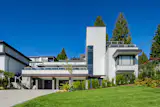
Hardie® Artisan® Siding creates a striking streamlined silhouette.
The defining feature of Hardie Artisan Siding is surprisingly simple: extra-thick boards. Each board—which offers the aesthetic of traditional wood siding with much lower maintenance—is five-eighths of an inch thick, creating a substantial profile that produces deep, crisp shadow lines across a facade. As the sun moves throughout the day, shadows sharpen and soften to give the exterior an ever-changing sense of depth.
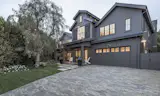
Hardie® Artisan® Siding boards are delivered to site smooth and primed for paint, allowing rich colors to further define a home’s gabled volumes.
That thickness also changes how corners can be resolved. Instead of relying on an applied corner trim that adds unwanted visual noise, Hardie Artisan Siding is thick enough to be mitered on site. This allows the boards to wrap cleanly around the built form to create a continuous architectural expression.
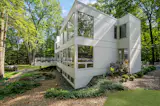
A light palette and V-Groove profile turn joints into graphic shadow lines.
Profile is one of the most significant ways to alter the expression of siding, and the Hardie Artisan Siding collection is available in lap, V-groove, shiplap, and square channel. Each profile creates a different degree of shadow. The square channel makes the joint between boards bolder and more pronounced, V-groove introduces a finer linear detail, and shiplap references a more traditional siding language.
Playing with the orientation changes the reading of the facade again. Boards can run horizontally or vertically, or continue overhead as a soffit to emphasize the roofline. Color adds another layer of character; pale tones bring shadow lines into sharper relief, while darker hues give the exterior a solid, monolithic quality.
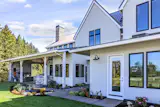
Horizontal Hardie® Artisan® Siding shows how orientation can shift the entire expression of a home.
Seen across the scale of an entire building, these details matter. A change in board direction can express different volumes and geometric forms, carrying the same material from cladding to soffit creates a seamless sense of cohesion, and deeper, more pronounced joints and shadow lines add depth to an otherwise flat surface.
As the outermost layer of the home, siding has to contend with a multitude of environmental challenges. Hardie Artisan Siding is a combination of architectural beauty and long-term resilience. Made from durable fiber cement, it is engineered to resist severe weather, moisture, pests, and external fire. It also is a noncombustible material,* meaning it will not ignite when exposed to a flame, nor contribute fuel to a fire. James Hardie also develops its products for optimal regional climate performance. Only Hardie® fiber cement is Engineered for Climate®, offering different formulations to help stand up to the specific climate demands in the region where it is installed.
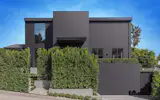
Hardie® Artisan® Siding is designed to withstand the elements and is backed by a 30-year warranty
So no matter the location, Hardie fiber cement siding is built to withstand environmental challenges and requires less maintenance than traditional wood siding—proving an exterior’s true success isn’t measured by how it looks when a project is completed, but by how it performs and ages over the decades that follow.
Ready to take the next step? Find a local pro to help you execute your design vision with Hardie siding at jameshardie.com.
---
*Hardie® fiber cement products are noncombustible and/or have a Class A fire rating when tested in accordance with ASTM E84. Fiber cement fire resistance does not extend to applied paints or coatings, which may be damaged or char when exposed to flames. The use of noncombustible siding, combined with other fire mitigation measures, may help harden a home against external fire.
Published
Last Updated
Topics
ExteriorsGet the Dwell Newsletter
Be the first to see our latest home tours, design news, and more.