
Inside the Japanese Museum Built From Tsunami Debris
The air is thick with ocean salt and summer heat as I climb the hill toward the Sanriku Railway station in Okirai, a small village in Japan’s Iwate prefecture. I’m five days into hiking the Michinoku Coastal Trail with Oku Japan on the tour company’s first guided trip since the 620-mile route opened in 2019. Our guide, a soft-spoken Tokyo local, has been steering us to places we’d never stumble upon as English-speaking travelers. Earlier that day, we met the mayor of a fishing town. Then we had lunch at a strawberry farm only open once a week. The sweet taste of the plump, red fruit still lingers on my tongue when, in the distance, I notice a haphazard shack made out of scrap wood and corrugated metal, glinting in the sunlight like a beacon.
As we approach the strange compound, a man steps out from a house next door to greet us. He introduces himself as Waichiryo Katayama, but friends call him Waichi-san. He’s the builder of this colorful and curious museum called Shiome, meaning "the place where the cold sea current and the warm sea current meet." Every single piece of the facade, from the roof to the gate to the hand-painted walls, is debris from the Great East Japan earthquake and tsunami that struck the country’s northeastern coast on March 11, 2011.
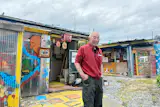
Waichiryo Katayama, a resident the Okirai fishing village in Japan’s Iwate prefecture, stands outside a museum he built using debris from the wreckage of the massive earthquake and tsunami that struck the country’s northeastern coast in 2011.
One exterior wall is lined with clocks frozen in time, their hands still pointing at the minute and hour when floods wiped out the village’s community hall. That same wall displays photos of the town both before and after it was swept away, as a memorial of sorts. A staircase forming the roof of the wall, Waichi points out, is the evacuation bridge from the primary school; all 70 students got out just in time using this "miracle staircase." In total, the disaster resulted in more than 20,000 confirmed deaths across three prefectures; Waichi says 96 people died in Okirai, which earned it the nickname "the miracle village."
As I peer at some aerial photos, I hear neighborhood kids out back riding scooters and playing video games, their small voices speaking quickly in Japanese. Meanwhile, Waichi smiles big and talks with his hands, and his joy cuts through any heaviness.
"I am a kid at heart," he tells me. Unlike Shiome, many monuments and museums that memorialize natural disasters suspend tragedy in stone, silence, and seriousness. Just south of Okirai Bay, the Kesennuma City Memorial Museum, which I visited later on my trip, preserves a high school that was badly hit by the 2011 flooding. Visitors, including me, clutched tissues and dabbed their eyes as they quietly roamed between the exhibits, including a simulation of the earthquake magnitude and a compilation of news broadcasts from that day.
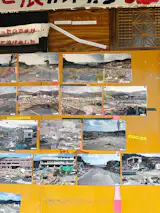
One wall inside the Shiome museum shows photos of the town after the disaster.
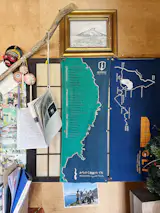
Shiome sits along the Michinoku Coastal Trail, which brings a regular stream of visitors to the museum.
On the other side of Japan, the Kobe Earthquake Memorial Museum replays recordings of survivor stories and preserves artifacts to honor the 6,000 lives lost there in 1995. In China, the Tangshan Earthquake Memorial commemorates a 1976 earthquake that killed hundreds of thousands. And in Texas, the Galveston Seawall Memorial, a statue of a family in distress marks the 1900 hurricane that remains the deadliest natural disaster in U.S. history.
In contrast, Shiome hums with laughter, whimsy, and playfulness, an energy that traces back to its origins. Two months after the earthquake and tsunami, volunteers were still clearing debris from the roadways when community leaders started discussing ideas for redeveloping the town. In a booklet about Shiome that Waichi and a friend published in 2014, he recalls saying, "We need to hear what young people and kids think about the future of our hometown too." He suggested asking kids to draw pictures of what they envisioned for Okirai. Instead of drawing flying trains and cars in a futuristic world, they drew Okirai before the tsunami hit: school buildings, their favorite bakery, the mountains, the forest.
Waichi thought that sharing the drawings could uplift the community’s spirits. Working in construction with his father, he had the knowledge and wherewithal to build. He started with a ruined gas station, assembled plywood panels into gallery walls, and invited neighbors and children to stage an exhibition in May 2011. "The good rumor had spread and many people and groups from many places came over to view it," Waichi writes in the book. "...the space became a much better community space than I had expected."
Not long after, as the village started to rebuild, Waichi was asked to relocate the exhibition. This sparked new ideas for evolving Shiome into a playground. Children painted murals onto plywood of flowers, happy faces, animals, and forests. Volunteers helped build a court for the Japanese game gateball for adults to play alongside children. Then in 2012, he relocated the project again, this time adding a place for people to mark the loss of lives with memorials, photographs, and prayer stones. "I thought that those photos should be seen by other people and we should keep them as important education material [so as] not to forget what had happened," he writes in the booklet.
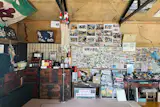
The museum is as much a space for remembrance as it is a community hub, with photos of visitors pinned to a gallery wall.
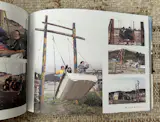
Waichi, who has a background in construction, made a swing out of a boat.
Other additions at that time included a slide made from a rubber tube, a swing crafted from a small boat donated by a neighbor, and a massive log for a bridge. He didn’t plan; he let inspiration strike before he developed new ideas in the space. Now, nearly 15 years since it was first established, Shiome is in its fourth iteration, positioned next to Waichi’s house.
On weekends and after school, children play there. Local leaders host meetings. And through summer and autumn, prime hiking season on the nearby Michinoku Coastal Trail, hikers come by, sometimes looking for a place to stay. One part of the building is the museum and educational center, exhibiting the upcycled debris and memorials, including tsunami maps drawn by Waichi’s father. The other part of the shack is set aside as somewhat of a hostel and secret private house for travelers, featuring crawl spaces and cozy rooms—all designed spontaneously by Waichi.

"It is a free space for everyone," Waichi tells me. "It’s a place of joy, where I look forward to seeing kids and visitors playing and sheltering there. It is also a place where I can visit with everyone, and see how they are and how they will change over time."
Inside one of the rooms, there’s a tatami mat and a makeshift kitchen. A faux Christmas tree strung with lights and ornaments decorates a corner year-round, and a mobile of origami birds hangs from the ceiling. Printed photographs of visitors throughout the years are tacked up one wall, along with a map of the full Michinoku Coastal Trail. Before my guide and hiking group heads to the station to catch our train to the next town along the trail, I sit down inside at a long community table, and chat with Waichi a little longer. Next time I visit, I’ll know there’s always space at Shiome.
Related Reading:
Published
Get the Dwell Newsletter
Be the first to see our latest home tours, design news, and more.