
Dwell 24: 5 Emerging Design Studios Exploring Hard and Soft Edges
This year, we broke our list of the 24 most intriguing emerging designers into five thematic categories: Riffing With History, Hard and Soft Edges, Serious Play, Ornamentation With Intention, and Natural History. To read the introductory essay by market editor River Davies, click here.
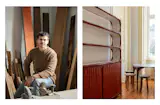
Eduardo Orúe Barceló of Atelier Orúe aims to present striking color combinations with his wood and stone furniture, including the shelf pictured on the right.
Atelier Orúe
Oeiras, Portugal / @orue.atelier
The Argentine designer Eduardo Orúe Barceló blends wood and marble to create furniture with sinewy edges. They’re sprightly despite the heft of his materials. Orúe has been working with wood since he was a teenager, but stone is a newer, harder material for him to manipulate, so his process often begins with settling on a marble first. He then matches the rock against various woods until he finds a pairing he’s excited by. Since Orúe doesn’t dye the woods he works with, the color combinations of the two natural materials guide his selection process. A bookshelf made with a reddish African wood and a white Portuguese stone is sculpted, sanded, and polished by hand at his workshop, with rings of cool marble seamlessly encircling the inner three shelves. "When you see the furniture pieces, I want them to feel like they are alive and expressing something," Orúe says.
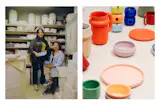
Though MOT Studio designers Gabriela Delgado and Ana Lucía Santoyo are committed to their local design scene, their first tableware collection was inspired by Santoyo’s study abroad program in Norway.
Get the Shop Newsletter
Smart shopping for the design obsessed. Find what you love in our expertly curated selection of finely crafted home, office, travel, and lifestyle products.
MOT Studio
Mexico City, Mexico / @mot.studio___MOT Studio
Gabriela Delgado and Ana Lucía Santoyo embody the old idea of acting locally while thinking globally. As MOT Studio, the Mexican designers created their first tableware collection to accommodate meals from all the culinary traditions recognized by UNESCO’s Intangible Cultural Heritage list. "I kept thinking about how we can be the same but different," Santoyo says. "What do we all have in common?" The pair’s monochromatic ceramic tableware has simple shapes accented with bulging rings that would be equally at home on a table in Kyoto or in Mexico City. But Delgado and Santoyo haven’t forgotten where they are from, as they celebrate the talent among the Mexican artisans and workshops fabricating their designs. "We want to appreciate that," Santoyo says, "and understand that it’s bigger than us."
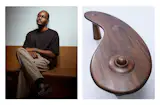
Many of Paul Ledron’s pieces are defined by smooth curves, like the Tanyè table pictured on the right.
Paul Ledron
Abidjan, Côte d’Ivoire / @paul.ledron
Paul Ledron’s Tanyè table might be the perfect metaphor for the Côte d’Ivoire designer’s POV. Ledron rendered ovangkol hardwood into a boomerang swipe, boosting the table surface on three legs that appear to push through it. One-of-one works like this are only part of the designer’s practice, which also includes limited-edition furniture and lighting and, soon, open-edition pieces and small items, like ashtrays and bowls. All are in service of Ledron’s grander vision of a new design language for Africa, which he says is too often reduced to clichés like rough-hewn shapes and recycled materials. The furnishings people in West Africa live with are "not an actual representation of their culture, their beliefs, and their view of the world," he says. Ledron intends to change that, one table, ashtray, or light at a time.
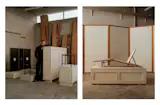
Salem Charabi’s furniture is informed by his time spent studying architecture, including The Bird Who Lost His Shadow long chair, pictured on the right.
Salem Charabi Studio
Cairo, Egypt, and Copenhagen, Denmark / @salemcharabi
The Danish Egyptian designer Salem Charabi considers his architecture degree, from Copenhagen’s Royal Danish Academy, an approach that "can be applied to everything from a door handle, chair, city plan, to the way we inhabit the world." His design aesthetic "comes from a curiosity about what is around me." When a well-traveled couple commissioned Charabi to make them a packable furniture collection, he considered the resources and colors of Copenhagen, where he was living at the time, and created a lounge chair made from Danish cherry and a washi-hemp fabric made in collaboration with a Japanese weaver. The back brace blends both Danish woodworking tradition and the mechanics of ancient Egyptian folding chairs. With his works, Charabi is inspired, rather than restricted, by the inherent limitations of his materials, and it shows: "My job becomes getting as close to my initial thoughts as I can but within the constraints of the world."
—Jinnie Lee
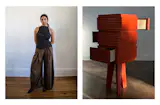
Tanuvi Hegde’s Chaos chest, pictured on the right, is one example of her desire to give physical form to a feeling.
Tanuvi Hegde
New York City / @tan.hegde
In architecture school, Brooklyn designer Tanuvi Hegde learned to think about environments as something people can "walk through and feel." Since then, she’s been less interested in what she calls "the shell" than in how it’s experienced: "I’m designing for the body and not just the eye." With her collection Exhibit (A): Furniture for the Anxious Being Hegde, brought that idea down to a smaller scale, making a chair, table, and chest that interrupt anxiety through inviting interaction, rather than simply representing the feeling artistically. That approach comes through in Chaos, a red chest of drawers inspired by the familiar clutter of a junk drawer. Its exterior is perfectly symmetrical, but there are no obvious cues for how to open it. Instead, you have to trail a finger along a hidden notch, then pull drawers that slide out at unexpected angles: a tangibly anxious spiral designed to "pull you out of the chaos in your own head." "It’s always about a feeling," she says. "I’m constantly chasing a feeling and trying to give that feeling a physical form."
Top photo by Rodrigo Alvarez
Selection curated by River Davies and Adrian Madlener
Published
Last Updated
Get the Shop Newsletter
Smart shopping for the design obsessed. Find what you love in our expertly curated selection of finely crafted home, office, travel, and lifestyle products.