
Launch Pad 2026
MIOS
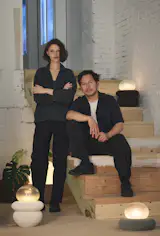
When Renata G. started to think about using G-code, the primary language used to communicate with 3D printers, she knew nothing about it. She and brother-and-sister pair Cristian and Cindy Candamil, who would become her cofounders at MIOS, had been working on ceramic designs together, and Renata thought incorporating liquid deposition modeling (a kind of 3D printing that uses fluid materials, including clay, instead of the usual plastic) might make their lives easier. After two years of trial and error, 3D printing hasn’t simplified their production process. But it has differentiated their line of ceramic-base table lamps from more mass-produced-looking 3D printed lighting.
"We were the only ones at ICFF really doing this ceramic printing, so it was nice to see that we were able to be so developed in something so new," Cristian says, referring to how much experimentation MIOS has done compared with other brands. "A lot of the comments were from professors at RISD or Parsons. They’re like, We’ve been trying to figure this out. How did you do it? Where’d you get your master’s? We were like, Oh, no, we’ve just been trying to mess with it for, like, the last two years." The core difficulty of ceramic printing, as opposed to printing with thermoplastic material, is that you’re working against gravity when using clay, making it hard to produce consistent results. They also hand finish each piece in the studio—the job isn’t entirely done by the printer, which is why Renata’s initial intent of saving time and energy was never fulfilled.
Winning Launch Pad’s Best Lighting award is a testament to the trio’s dedication to cracking this unwieldy tech. That said, their commitment has driven them to try to understand it even deeper. "Getting the award was really cool," Cristian says, but "as designers we’ve gotta push even harder."
Amin Tadj Studio
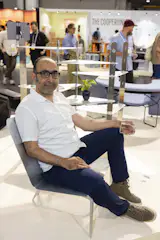
It was during a visit to ICFF in 2025 that Amin Tadj decided he wanted to give furniture design a try. Tadj had been an architect for over 20 years by that point, first in his native Iran, then here in the U.S. at firms including NADAAA and SO–IL, but he had grown interested in offering design products, rather than selling design services, as he had in the beginning of his career. While designing a house in upstate New York, he ordered more than 300 custom steel brackets that would be exposed along the ceiling beams in the property. It was cheaper to use his own designs and that would allow him to control the aesthetic, too. He realized he could apply the same process to furniture and got to crafting, designing about 20 chairs before settling on the BenDi Lounge, one of two pieces he displayed in May at ICFF.
Winning Best Furniture Design at ICFF’s Launch Pad came as a surprise to Tadj, who noticed upon arrival at the fair that many of the works on display prioritized form. "The first day I went there, I saw a lot of these amazing, beautiful, funky designs, and my furniture was engineered to the bone," Tadj says. He worried his pieces were totally out of context. Being recognized by the jury showed him that there was value in his perspective. "Seeing that still this kind of attention to detail is something that catches attention, that was super heartwarming for me."
Top photo credit: Jenna Bascom Photography for ICFF
Published
Topics
Dwell Magazine