
How Frank Gehry Became a Household Name
It’s near impossible to live in Los Angeles and not feel Frank Gehry’s presence. The architect, who died on December 5 at his Santa Monica home at the age of 96, shaped the city in his eccentric, unconventional, and sometimes wacky view. As a former L.A. resident of 15 years, I remember taking my parents to his sensationally sculptural Walt Disney Concert Hall, where we gazed on its reflective contours against a bright blue California sky; my dad, a home builder who wanted to be an architect, made one of his best pictures of the building his iPhone background. On another occasion, I watched as a friend gracefully danced a site-specific contemporary piece on its steps. When I visited Los Angeles more recently, I noticed the evanescent quality of the building’s silvery waves through the floor-to-ceiling window of my hotel room, inside The Grand LA, also designed by Gehry.
Most will know Frank Gehry for his public-facing works, perhaps most notably the Guggenheim in Bilbao, a titanium-plated museum with a compelling sense of movement that has come to symbolize the city’s late-’90s revival. This groundbreaking civic work and others were made possible by digital modeling software, which Gehry adopted early on to expand on his deconstructivist style, where he pulled apart and distorted conventional ideas of what a building should be. But whether transforming municipalities with daring structures or experimenting with single-family homes, over the course of his half-a-century-long career, the Pritzker Prize–winning architect put people, delight, and playfulness at the forefront of his some 70 projects, which made him revered within architecture circles as well as a household name well outside of them.
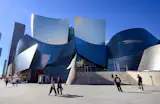
With the Walt Disney Concert Hall in downtown Los Angeles, opened in 2003, Frank Gehry experimented with monumental, swooping shapes clad in stainless steel.

The Guggenheim in Bilbao, with its gleaming titanium facade, is an emblem of civic renewal for the city. After it was built, Gehry-designed buildings became trophies for towns. His civic works also became templates for cities around the world, who introduced eye-catching museums by other architects in a bid for international attention.
Get the Pro Newsletter
What’s new in the design world? Stay up to date with our essential dispatches for design professionals.
After immigrating to Los Angeles with his family in 1947, Gehry earned a degree in architecture at the University of Southern California in 1954, before serving in the U.S. Army for two years, where he designed furniture for soldiers. He then studied urban planning at Harvard’s Graduate School of Design before returning to Southern California, where he remained a lifelong resident of a region that, over many decades, became an evocative portfolio for his work.
It includes the David Cabin, Gehry’s first built work, a residence completed in 1957 in Idyllwild, east of Los Angeles. The cabin melds Frank Lloyd Wright’s Usonian ideas—specifically how a home should relate to nature —with Japanese references, and a palette of off-the-shelf materials including redwood siding, corrugated metal, and chain-link fencing that foretold a lifelong fascination with the raw, mundane, and not traditionally "beautiful." These choices were rooted in Gehry’s past, too: As a youngster he worked part time in his grandfather’s hardware store, stocking shelves with some of the same everyday items used to build the cabin.

The David Cabin in Idyllwild, California, completed in 1957 for a neighbor of Frank Gehry’s wife’s family, is the architect’s first built design.
Gehry was often more sculptor than architect, as he was masterful at flipping convention on its head, peeling layers off a building like an onion. Fearlessly, he celebrated the guts of a structure, leading many to regard him as a deconstructivist. (Gehry, for one, did not count himself as part of the late-’80s movement by the same name.) Early friendships with L.A. artists, including Ed Moses and Robert Irwin, exposed Gehry to reimagined warehouses and industrial live-work spaces, which, one could imagine, emboldened him to approach his craft with a sense of freedom and openness, not to mention utilitarianism. Precious was never the goal; livable was.
Gehry experimented heavily with his own Santa Monica home, which would end up being one of the most controversial and fantastical projects of his career. In 1978, he gut remodeled a pink bungalow featuring the "dumb, normal materials," he saw around the neighborhood, including chain link. He gave the kitchen an asphalt floor, and the home had an inside-out aesthetic, where the interior, exterior, and bones are visible all at once. Santa Monica’s mayor declared it a masterpiece, but neighbors were less enthusiastic; one went so far as to put a bullet through one of its windows.

Frank Gehry’s home in Santa Monica was one of his most controversial works, bringing a deconstructed aesthetic to the neighborhood with an assemblage of off-the-shelf materials.

The kitchen floor is asphalt, part of the indoor/outdor functionality Gehry strove for in the design.
He rarely hewed to convention, and especially not with the ad agency turned home he designed in Venice to look like binoculars, a 1991 collaboration with husband-and-wife pop artists Claes Oldenburg and Coosje van Bruggen. It was praised for its humor and bold combination of art, architecture, and function. (It has never failed to bring a smile to my face.) My husband (who won the Gehry Prize for his master’s thesis at SCI-Arc, where Gehry taught and was a trustee), can’t get near the 1984 Norton House, also in Venice, without stopping to contemplate its pastel stucco, concrete cubes, and lifeguard tower homage, whose plywood flaps make it look like it’s about to fly away. Early in our relationship, my husband showed me that L.A.’s Westside is filled with gems by Gehry; casual walks became architectural tours, unorthodox forms—not glossy or even necessarily elegant, but certainly imaginative—popping up out of nowhere, demanding a double take.
Like some of the best creatives, Gehry could be irreverent. Once, at a press conference in Spain, when asked by a reporter if his architecture was purely about spectacle, he silently lifted his middle finger. His structures, public nor private—apartments, family homes, condos, artists’ studios, guest houses, and major residences—do not fit neatly into any one box, likely because the vanguard of the time, of which Gehry considered himself a part, tended to think of boxes as inhumane. "I was rebelling against everything," Gehry told the New York Times in 2012, which included the modernism of Mies van der Rohe, an architect he was never shy about criticizing. Of the Farnsworth House in particular, he said, "I just couldn’t live in a house like that… I thought it was snotty and effete. It just didn’t feel like it fit into life."
Of course, Gehry weathered plenty of criticism himself. Some felt his buildings were more like sculptures than functional architecture, and others dismissed his work as "the same scrunched up paper design." Few could deny, though, that his work evokes strong emotions, at least one element of great architecture. Greatness, or at least fame, never seemed to be the goal, though, as Gehry hated elitism. He was ambitious, but driven more by wanting to stretch the bounds of what is buildable and livable. Meticulous, eccentric, and mischievous, these elements alchemized to radically change the landscape of modern architecture.
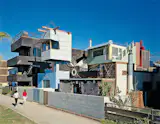
The 1984 Norton House in Venice, California, designed for a former lifeguard, features a lookout at the front of the property modeled after a lifeguard’s tower.
Though his later career trended toward substantial commercial and institutional projects, Gehry welcomed clients eager to experiment with home design, seeing relatively smaller-scale projects as opportunities to dance with a new design language. Budgets were often significant, but Gehry still emphasized doing more with less. "I don’t think you have to spend egregious amounts of money to make buildings that are good for the community, good for our world, that are interesting, and that are humanly accessible. You just have to want to do it," he told Time Magazine in 2022. One of Gehry’s last built projects—a Silicon Valley home 10 years in the making that’s a collage of Gehry-isms, with corrugated metal roof petals, sculptural brick volumes, asymmetrical skylights, and hefty Douglas Fir beams—reminds us that a single-family home can be just as breathtaking as a monumental museum.
After Gehry designed Bilbao’s Guggenheim, he arguably became the first "starchitect," achieving a level of fame shared by few other architects of his generation—or any, for that matter. The forms of his work became a brand pushed by cities the world over, what has been called by some as "the Bilbao effect." But Gehry’s stature is ultimately owed to a willingness to explore uncharted territory: a civic building, or a home, doesn’t have to be what others want it to be. In fact, you can make it up as you go along. "You’ve got to bumble forward into the unknown," he once said.
Top photo by Bonnie Schiffman via Getty Images
Published
Get the Pro Newsletter
What’s new in the design world? Stay up to date with our essential dispatches for design professionals.