A Gaetano Pesce Sculpture With a Timely Message Lands in Boston
Gaetano Pesce, the late Italian modernist known for his provocative and rambunctious sensibility, was a true polymath and a prolific one at that. Ever experimental, his body of work includes furniture composed of gloopy kaleidoscopic resin, a corporate headquarters in the mid-1990s that was so vibrant and zany that some employees described it as working in a migraine, and a conceptual house from a postapocalyptic future that was a meditation on isolation and the human condition. "I don’t make things so they appear nice or elegant," Pesce told PIN-UP in a 2021 interview. "I make objects to communicate different stories to people."
The majority of Pesce’s work is in museums or private collections, but he also created the occasional public artwork, a medium he appreciated for bringing social commentary into the open and for helping us understand the time in which we live. For the most part, these installations have been temporary, including a scaled-up version of his Up armchair in Milan, a piece intended to critique violence against women, as well as a 40-foot-tall sculpture in Naples, an homage to a theatrical mask that had a phallic resemblance.
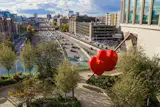
Now a new permanent installation by Pesce has graced the city of Boston, and it’s his only public sculpture in the United States. Named Double Heart, the 30-foot-tall piece is composed of two bright-red hearts pierced by an arrow. At night, the installation glows. It is installed at Lyrik, a new mixed-use development in the Back Bay, a neighborhood on the south bank of the Charles River known for its historic brick townhouses and shopping streets. An adaptation of a lamp Pesce designed in the 1970s, Double Heart symbolizes the importance of love and connecting with others.
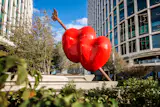
The city of Boston is the recipient of the first and only public sculpture in the United States by the late Italian artist and designer Gaetano Pesce. Titled Double Heart, it’s a celebration of love, joy, and connecting with others.

The sculpture is located in Lyrik, a new mixed-use development built over the Massachusetts Turnpike. Incidentally, the highway offers an unobstructed view of the sunset and the public plazas within the space are a popular place for people to visit to see it. The sculpture, which is visible from the roadway below, offers another focal point. The hope is it becomes as iconic to Boston as the Bean is to Chicago.
"Pesce was passionately interested in how his work connected with the public, which is why he so often employed narrative, figuration, and memorable iconography," says Glenn Adamson, a curator, historian, and author of the 2022 book Gaetano Pesce: The Complete Incoherence. "While it’s true that much of his work was domestic in scale, I think we actually see this communicative aspect of his work at its highest pitch in his public art works."
Pesce debuted a smaller version of Double Heart in 2023 for an Art Basel exhibition at the Jardin des Tuileries in Paris; he designed the new one specifically for Lyrik before he died. "This object is significant because it has meaning in a moment when the world is not doing so well," Pesce said of the piece. "So many stupid people are in positions of power, and they are doing serious damage. Art and design have a very significant role to play." And that role is to remind us of what matters most, he says. "This piece encourages people to be careful and stay connected to positive expressions, culture, and all kinds of things—because this is what the world needs."
The message remains highly resonant, especially since political tensions have risen so drastically in the years since Pesce’s comments. In this context, the clarity of Pesce’s iconography, as simple as it may be, sends a strong message. "It’s just a slight transformation of an image from Valentine’s Day—even a child will recognize it," Adamson says. "Through the simple duplication of the heart, though, he turns sentimentality into profundity. At a time when social division is all too widespread, he invites us to consider the deep mutuality of love."

Double Heart began as a resin lamp with a marble base that Pesce initially conceived of in 1979 through a series of drawings and works on paper. Giulia Tosciri, of Studio Pesce, notes that it was "essential for [Pesce] to express his creativity and ‘messages’ through different forms: objects, drawings, and architecture with no boundaries," she says. "Scaling up the lamp is just a different way of expressing the same message of positivity through a universally recognizable image, the heart."

A radical designer, Pesce was not limited to one medium, scale, or type of object. For him, the story and narrative came first, then the appropriate method to communicate it.
Samuels & Associates, the developer of Lyrik, commissioned the sculpture from Pesce, who was working on the piece before he died last year at the age of 84. The art advisory firm Goodman Taft helped Samuels & Associates select Double Heart and hopes it becomes an iconic destination for locals and visitors alike, doing for Boston what Anish Kapoor’s Cloud Gate did for Chicago or what the High Line’s monumental Plinth commissions have done for New York. Good public art installations become mascots for their respective cities—and draw a significant amount of foot traffic.
"Art in public space creates a rare opportunity to bring the visual culture of our time into an open, everyday dialogue, one that’s accessible to everyone, regardless of background or familiarity with art," says Molly Epstein, a senior partner of Goodman Taft. "The most successful public artworks aren’t only visual landmarks; they are emotional or intellectual touchstones."
Recently, Boston has been investing more in contemporary public sculptures, including a new Martin Luther King Jr. memorial by Hank Willis Thomas that debuted in 2023 and a new public art triennial that launched this year. Lyrik is built over the Massachusetts Turnpike and the development has become a beloved place for people to watch the sunset. Double Heart will be installed on a deck that pedestrians on the plaza, and drivers on the road below, will be able to see. For the location and context, Pesce’s sculpture was a perfect match.
"It is a space, seen by millions of people each year, that offers an opportunity to embody the idea of welcome, seen from afar and up close," Epstein says. "With Double Heart, Gaetano Pesce offers us that gesture: radiant color, piercing form, and a symbol that speaks to love, vulnerability, and connection. This place becomes not only a civic gateway, but also a pilgrimage site for all who come seeking the vitality of art, the spirit of design, and the optimism that creativity brings."
Top photo courtesy of Gaetano Pesce’s Studio, New York and Champ Lacombe, Biarritz/London. Photo by Aram Boghosian
–
Published
Topics
Design NewsGet the Dwell Newsletter
Be the first to see our latest home tours, design news, and more.