Advertising

You are here

The Trabecula Bench

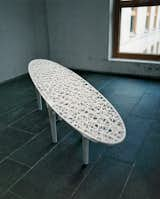
Freedom of Creation—In recent decades, computer-aided design (CAD) has transcended the screen, thanks to the advent of automatic fabrication, a process wherein three-dimensional objects take shape by rapidly building up thin layers of material based on a digital model. It sounds like science fiction, but the technologies are simple; soon you’ll even be able to make a 3-D printer at home for about $600 (reprap.org). While most designers avail themselves of rapid prototyping, few have begun using the machines for rapid manufacturing. Freedom of Creation (FOC) leads the way with their Trabecula bench, one of the largest rapid-manufactured furniture pieces at six feet long, two feet high, and just 14 pounds. Dwell talked fabbing with Janne Kyttänen, a designer at Amsterdam-based FOC, and paid a visit to their manufacturing facility in Munich.
A finished Trabecula bench. At six feet long and two feet high, it is one of the largest rapid-manufactured pieces of furniture in the world, and yet, owing to it's materials and biometric cues, it weighs a mere fourteen pounds.

  • Drawing

    Kyttänen’s designs travel straight from his imagination to the computer. “Hardly anything happens on paper anymore,” he says, “because most of the files are so complex that it’s practically impossible to sketch them.” He uses a range of CAD software, from the user-friendly SolidWorks to the spline-savvy Rhino, but mostly 3D Studio Max.
    The computer is his workshop. “I can’t imagine any other tool at the moment,” he says. Though it may seem more complex than the old pencil-and-paper method, CAD is actually quite intuitive, and the interfaces continue to improve.

    Kyttänen prefers desktops to laptops—a big screen and an ergonomic mouse are crucial—but he also designs on the go. “I can be anywhere,” he says. “In principle, you can even operate these machines from another location. I can build my future around this [unrestricted] way of life—–buy a house at the beach, do my stuff from there, no problem.” With rapid manufacturing, the process is hands-off and divorced from location. It’s worthy of a new name: remote design.

  • Slicing

    The design files are sent to EOS GmbH, a Munich-based factory with six different types of laser-sintering machines. Before they begin, a slicing software divides the Trabecula into some 6,000 cross sections that are about 1/12-mm thick, which, according to Kyttänen, is “crude by today’s standards.” (Direct metal-sintering machines, which layer and fuse material with electron beams, can work in layers as this as 20 microns.) The bench is much larger than the sintering “build envelope” in which it’s made—a rectangular space that’s 15 by 27 by 23 inches, where the laser will move in x-y-z axes. This means that before slicing, Kyttänen has divided the drawing into three parts, and arranged them to fit in the bucket. “It’s like playing 3-D Tetris all the time.” Built into the sliced parts are interlocking pin joints—–something along the lines of dowel joints in carpentry, though Kyttänen prefers the image of pins that join broken bones, since the Trabecula was inspired by the light-but-strong structure of bird bones.

  • Photo

    Sintering

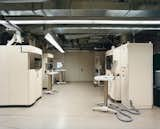
    “Sintering” is not an everyday word for most people—it means using laser energy to melt and fuse particles. It’s traditionally applied to metal, but nowadays it works very well on certain varieties of plastic such as polyamide. The Selective Laser Sintering (SLS) machine first sets down very thin layers of powdered polyamide with a spreader; they form what Kyttänen calls “a building platform.” A laser beam then passes over from the top, melting the layer locally, thus solidifying the powder and creating the product “according to the 3-D file that the slicing program has created.” Those two steps alternate, layer by layer, until the entire form is sintered. It takes about a day and a half to bond the Trabecula bench, and another 12 to 15 hours for the material to cool. The machine works 24 hours a day—no cigarette breaks. “Eventually,” says Kytännen, “what you have is this big bucket full of powder, and you break it open and take out the parts. Then you can reuse the powder that comes off.”

  • Photo

    Unpacking

    When the bucket has cooled, it’s time to assemble the pieces. Ahmadou Kaloga, an EOS applications support technician, usually does the unpacking. “It’s like an archeological dig,” says Kyttänen. “A dinosaur in a pile of sand.” After carefully removing the pieces and brushing off excess dust, Kaloga gives them a light sandblasting with glass beads. Florian Pfefferkorn, a polymer-sintering product manager at EOS who helps Kyttänen develop rapid-manufacturing objects, explains that this is necessary “to get rid of the loose powder that sticks to their surfaces.” The pieces are then assembled, their interlocking joints reinforced with cyanacrolate, a.k.a. Super Glue. A pneumatic spray gun coats the Trabecula in paint that Kyttänen insists, withholding specifics, is just for looks. “It’s nothing special, but I can’t tell you what it is.” Secrecy aside, he rejoices that rapid manufacturing is growing more popular as its efficiency, aesthetics, and cost savings become clear. “We want people to understand what we’re doing,” he says. “At this stage, the more competition, the better.”

dwell.com is your online home in the modern world. Join us as we follow our team around the globe on Twitter, Facebook, and Pinterest. Want more? Never miss another word of Dwell with our free iTunes app.

More

Add comment