When I ask Shino and Ken Mori what the calligraphy hanging in their entry alcove says, it takes some back-and-forth to arrive at the answer—and even then, I suspect, it is only the closest ap-proximation the English language could offer. “‘We don’t have much, but friends are welcome,’” Ken replies. To which Shino adds, “‘This house is empty, that’s why you can get smarter.’” Smarter? “If you don’t have things, you have to think to accomplish things,” Ken explains. “Basically, you don’t have to have much.”
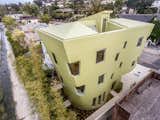
And the Wabi House, which architect Sebastian Mariscal designed for the couple three years ago, is, on its face, not much. In fact, from the perfectly ordinary suburban street on which it sits, it’s little more than a white cube rising from a black rectangle. But just as the calligraphy encourages the home’s residents to find greater meaning within, so too does the Wabi House itself.
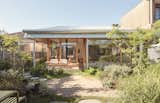
With doors open, Shino and Ken pull an Eames LCW chair for Herman Miller outside to enjoy the space.
“From the list of what Shino and Ken wanted and didn’t want, I could sense that they were sub-consciously requesting an introspective house,” says the bicoastal Mariscal, who has offices in Woodstock, New York, and San Diego, California. “They didn’t want a show-off house; they wanted somewhere they could live forever.” After find-ing out that the property was subject to neither design restrictions nor neighborhood reviews, Mariscal’s San Diego–based design-build team transformed the typical ceramic-shingle-roofed rancher (after completely deconstructing it) into a one-of-a-kind architectural achievement.
But while the Wabi House fits Shino and Ken’s lives like a perfectly tailored suit, the pair didn’t dictate any of the design. “We wanted Sebastian to come up with his own style and ideas,” says Shino. “We tried not to tell him too much—the minimum.” So after an initial series of discussions about what the home should and shouldn’t be, Mariscal (in Ken’s words) went dark. “It was slightly uncomfortable,” Ken chuckles, “but after a few months he pretty much came back with the house you see today.”
“It’s great when you find a client that challenges you to do something more meaningful,” says Mariscal. “They really trusted me.” And so the Wabi House serves as an object lesson in how the most spectacular creative results are accomplished: through the confident patron-age of dedicated, willing clients.
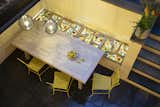
At the client’s request the kitchen contains neither upper cabinets (Shino can’t reach them) nor an oven (they only used the old one once—to reheat a pizza). A modular Roche Bobois Mah Jong sofa adds a decorative flourish to the living area while maintaining as low a profile as the traditional Japanese furniture.
In Tokyo, Shino’s main living area was about the same size as the tatami flooring that serves as a multi-purpose space on the Wabi House’s ground floor. “I only had one table where you would do everything—eat, work, sleep,” says Shino, “so I know that it is possible to live with just one room.” Ken was pleased that the design reflected elements he recalls enjoying from his grandmother’s traditional Tokyo house—such as the large engawa—but also that it was more practically suited to their day-to-day lives. Before, he says, “the house had these rooms you wouldn’t go in for several months,” he says, “so they just ended up as storage space. Here you go through everything every day. It’s all livable space.”
An atypical modern house that translates the language of traditional Japanese building into a Southern California context, the Wabi House is a compelling study in contradictions. “I was playing with an idea of opposites,” Mariscal says. “For instance, from the street you don’t see any windows, but once you go inside, it’s almost all open.” Although the roof deck affords a view of the surrounding area, the lasting impression of the Wabi House is of a building that focuses inward onto the very specific lives of its residents. It may be an average lot on an average street, but when Shino and Ken return home, they have an extraordinary kingdom to themselves.
For more images of the project, view our slideshow and go behind the scenes of the photo shoot in our video.
Disappointing to see an article on a project where the landscape seems so critical to the success of the design not give mention to the name of the landscape architect. Dwell should have taken it upon themselves to give proper credit to the landscape architect, Marcie Harris for her contribution to the project.
WOW! I received my September 2011 issue of Dwell "Japan Style" today. The Wabi House (The Hidden Fortress, pg. 94) is one of my favorites and is a great display of East (Japan) meets West (California). My Japanese wife and I plan on taking a similar approach in the redesign of our house. It was a pleasant surprise to see that you gave a short lesson in Japanese home design terms via "It's the Joint" (pg. 82) and "The House Deconstructed" (pg. 81). However, I am somewhat confused as to why you used "Garden" (term number 10) instead of "niwa (garden) or "uraniwa" (rear yard or backyard). BTW, nice "Finishing Touch" with the Kiuchi Tatsuro piece, "Fields of Old." I look forward to receiving my next issue of Dwell.
Considering myself more of a "cottage" person as well as more traditionalist than modern, your magazine has certainly captured my attention in a big way. The Town House in Sweden is hands-down my all time favorite, I absolutely love its openness and airiness, however, The Hidden Fortress is amazing and comes in at a close second in my opinion. While I don't care for that much use of the black color, I am fascinated by the charred wood appearance and the lack of any lacquered pieces. The entrance of the property with the koi pond gives the impression of entering a magical place. The Zen garden is a wonderful touch and appears so serene. The soaking tub has blown me away. Is that a pond behind the soaking tub or is that another, larger, bathtub? I am not at all familiar with Japenese home design, but very much enjoyed your explanatory article, it was very enlightening and educational. Can you feature any houses that have more traditional cabinetry/furnishings with the open/modern/airy/space saving look you are so wonderful at designing? Keep up the awesome work, I always look forward to the next issue of your magazine. In the meantime, I will re-read this one a few more times, this one's a keeper!
Who builds that bed?!?
The Wabi House is one of the most facinating houses ever featured by Dwell. Can you provide info on the frosted glass doors?
The construction of the house is documented starting with this blog post: http://pursuingwabi.com/2007/05/06/why-a-makeover/
Is there any company that pre-builds homes that has something like this? I love the layout, materials, feeling of the home.
I am a little late to the party of comments but I did see this reposted on twitter and took the time to read the wabi story. Very enjoyable and interesting to read about the difficulty of translating the calligraphy. Well done overall Doug Wittnebel
"No Maintenance" No maintenance yard..... Impossible and another way of saying I'm not realistic, and I'm profoundly lazy.
Pure Privacy. But feels like very much isolated in this space. Majority restricted from the surrounding... Great materials and colors used.
How can Dwell neglect to include a floor plan diagram so we can understand the houses layes and relationship to the landscape. Maybe I would not expect this in House Beautiful but Dwell was supposed to be more informative. They are acting like a decorating magazine.
I am as disappointed as "Sam" above by the missing floor plan of the Wabi house. Actually by any architectural articles in any magazine without a floor plan.
Image 3: When that tree grows it's going to lay waste to the fence. I'm sure Mariscal's team considered this fact, but still decided to go ahead with it. If the "spirit of wabi-sabi" is beauty through imperfection, shouldn't they plan for imperfections in the design that won't lead to one side of the yard being torn and falling to the ground. So that's the first criticism, of the concept (which could be dealt with in a different way) And secondly; I think the detailing on those two fence holes could have been done more cleanly. Alas, it is already passed...
Overall, a beautiful design though. Interiors and deck-spaces look very attractive. There's a subtle touch of informality along with the contemporary design in the photography.
RSS Feed
Add a Comment