Seeing What Develops
In 2004, The Houses at Sagaponac—a controversial development on eastern Long Island—celebrated its first completed house. In 2005, the first residents move in.
Along the Montauk Highway on a cold December day, fog obscures dead tree trunks that guard the marshlands like a line of ghosts. Driving to eastern Long Island’s Hamptons in light traffic, windshield wipers and headlights on, it’s easy to forget the frenzied summers here, when people from Manhattan’s higher tax brackets try to relax on beaches, sailboats, and golf courses. This could be any sandy stretch of the Northeast coast, until the highway thins to an avenue lined with Bridgehampton’s boutiques, salons, and gourmet food stores.
Heide Banks and Howard Lazar sold their beach bungalow last year, trading the duney getaway for something more unique: They became the first homeowners in
The Houses at Sagaponac, a development that stirred up controversy among locals, summer people, and architecture buffs long before anything was built. The development sits on a woody parcel between the Montauk Highway and the East Hampton Airport, and is named for its neighborhood, Sagaponack (inexplicably dropping the k). It’s seven miles west of East Hampton and three miles north of the ocean. Banks awaits me at their house, which she and her husband bought for $2.95 million.
The Banks-Lazar residence, also known as Sagaponac House 43, was designed by the Iranian-born and U.S.-based architects (and sisters) Gisue and Mojgan Hariri, who signed on to the project in 1994. “It started when Richard Meier sent us a letter citing the developer’s good intentions,” says Gisue. “We’d had a long-standing interest in doing a spec house with a developer, and this seemed like an important opportunity.”
Meier is a friend of Sagaponac’s developer, Coco Brown, whom the press has portrayed as everything from a visionary to a cheapskate. Brown purchased the 150-acre tract for a bargain $1.6 million back in 1991, and partitioned it into 35 lots. With Meier’s help, he hired world-renowned architects to design each house. He convinced them to work for low fees, enticing them with the project’s lofty intent. “These days the majority of houses in the U.S. are built by developers, with no architectural input,” says Gisue. “Brown’s project could show developers that architects are a good investment—that building well-designed houses is highly profitable.”
“It’s going to be an unprecedented place,” Brown says of his development. “Every house is distinctive, like a work of art.” When Brown’s gallery is complete, houses by hotshots like Philip Johnson, Zaha Hadid, and Lindy Roy will sit adjacent to the Banks-Lazar residence.
“The development makes a social statement,” Brown adds. “Everyone here in the Hamptons is from New York, but their houses pretend they just came in on a whaling vessel. We wanted to bring back contemporary architecture, and I see a new generation of buyers. The art market is indicative—young collectors today are much more interested in [Jean-Michel] Basquiat than [Camille] Pissarro. We hope that Sagaponac will become like an art market, which will increase the property values. That would be good for us.”
Brown’s fans say the houses set a new standard for high-end developments, bringing good architecture back to the Hamptons, where mid-century modernism gave way to rabbitlike McMansion proliferation from the 1980s onward. Critics accuse him of using architects’ fame to sell property that’s otherwise undesirable, frequently trembling under the airport’s low-flying private jets, far from the ocean. But in today’s winter mist, the din of praise and criticism feels remote, while those jets are far from earshot, probably parked in warmer climes.
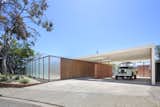
Driving into a large cul-de-sac, I easily locate the Banks- Lazar home, as it’s the only one finished. (A nearby house by architect Henry Cobb is fully framed and, according to Brown, already sold.) The Hariris’ design is both spare and luxurious—a rectilinear L-shaped plan set around a sculptural patio and pool of travertine. Clad in huge glass curtain walls and bleached red cedar, the house’s warm gray hue gently offsets the reds, browns, and occasional lichen greens of the damp surrounding scrub.
Last September in the <em>New Yorker</em>, architecture critic Paul Goldberger made a frank assessment of these houses. “What you are getting, if you choose to buy into Brown’s project,” he wrote, “is not a house designed specifically for you, but a slice of contemporary architectural culture.” A reasonable point, though Goldberger’s qualm seems precious if one considers that some 95 percent of new houses in the U.S. are not “designed specifically” for the residents—let alone by an architect.
Besides, Banks and Lazar are satisfied consumers. Banks, a psychotherapist and author who has appeared on <em>Oprah</em>, explains that the house “complements my dichotomous desires for socialization and quiet.” Lazar, a real estate consultant with a passion for abstract art, appreciates what the Hariris cite as the house’s inspiration: Alberto Giacometti’s <em>Figure in a Box Between Two Boxes Which Are Houses</em>. The sculpture, in which a gaunt figure stands in a void between two rectangular solids, is clearly mimicked in the L-shaped plan’s rectangles, both of which are centered by glass-walled voids. The layout enhances the public-private dichotomy. “It feels very open,” Lazar says.
In the backyard, plans for a painting studio for Lazar are underway, which the couple commissioned the Hariris to design. “Once we decided to spend the money and build the studio and outdoor bathroom, the decision to use the Hariris was easy,” Banks says. “We were as committed to the addition as we were to maintaining the integrity of the entire project. We knew in the end it would greatly increase the value of our property.”
Banks’s hope echoes Brown’s expectation that raising the architectural bar might increase the development’s prices. They seem to be onto an idea—one that, unfortunately, undermines the notion of altruism in Brown’s work. Critics complain that the houses cost more than the project’s mission stated they would, and Brown himself has said that he hopes they’ll get more expensive.
Perhaps the critics are loath to accept that today’s Hamptons aren’t those of the 1950s, when scrappy abstract expressionists like Robert Motherwell and Jackson Pollock fled New York City in search of quiet (and cheap) places to create. These are the Hamptons where Billy Joel marries a 23-year-old and sells his $32 million mansion to Jerry Seinfeld without a broker, and Paris Hilton parties with P. Diddy in his 12,500-square-foot PlayStation 2 Estate. Brown’s houses may be modest by comparison, but they reside in a real estate climate where taste, bad or good, has become a commodity.
There’s no telling how a successful high-design community in the Hamptons will influence the average American developer, whose target house price is about a twentieth of what Banks and Lazar paid. As for whether the nearby airport and three-mile drive to the beach will taint life in Brown’s houses—the sorts of questions Hamptonites fret about—only summertime will tell.
Advertising
Advertising
Advertising
Latest
-
02.09
An Architecture Guide to Pyongyang
German architect and writer Philipp Meuser realizes that…
-
02.08
Fair Chairs
We continue our coverage of the 2012 Stockholm Furniture and…
-
02.07
Seven from Stockholm Design Week
It's about mid-way through the 2012 Stockholm Design Week and…
Follow
Dwell
-
At the top of the monumental staircase @bsaspace by Howeler+Yoon. Awesome opening tonight @bsaaia! http://t.co/z9cli8TT #design
-
Thanks, @dailytekk, for including @dwell on your list of 100 Best, Most Interesting Blogs & Websites! http://t.co/hbMnDiTO #design
-
Was Mario Manningham's Super Bowl catch a work of #architecture? http://t.co/zxD47gN1
-
“@archpaper: Move over Ice Cube, Moby jams to #architecture, launches new blog about Los Angeles: http://t.co/eVKNB5WK”


Love the website content, great stories about interesting places. But the website structure is a different matter, your code needs quite a bit of work. Some of your tag brackets have been converted to html entities making them display in the page instead of functioning as intended: <em>New Yorker</em>
Very elegant, but simple, designs, ideal for SIPs(Structural Insulated Panels) and/or ICFs (Insulated Concrete Forms) as the building envelope system(s) for a super energy efficient, sturdily constructed (and, yes "Green" home)
the way the kitchen / living room flowed into the bedroom was just beautiful... as is the bathroom. that being said - the place looks like a stage, not a home. everything is totally opened to the street - from the enormous bedroom window to the kitchen and the living room and even the backyard.... definitely would not want to live here.
Great to see that there are those who want Modern in an area that is typically much more traditional. Lets move forward America, and if you live in a place that is or looks like it's a hundred years old this means you.
Brown and Richard Meier are absolute GENIUSES on the Issue of Spec Homes needed to be Updated and Upgraded by Trained Architects and/or Designers with VISION and GEOMETRIC DIVERSITY! Meier is my all time FAVORITE ARCHITECT!...and I've loved ZAHA HADID's work even before she had anything built!...We must do more of these types of Developments throughout the US...in order to maintain a level of Quality and Esthetics becoming of the Land of FLW and the GREAT AMERICAN DREAM!....Hoot4Fruit...Hooting!
I'm a student at an art institute, I decided to make a 3-D computer model of a house. My professor suggested for me to look at this site, After doing so i found this house and thought it would be a good model, but I it would be best if i had more plans and pictures of it please contact me if you can do this for me. thank you Matthew johnson
RSS Feed
Add a Comment