Scrap House
"Repurpose, refurbish, recycle" was the guiding principle for a metals broker in Ontario who harnessed his passion for–and knowledge of–industrial materials to create a new house from old scrap.
In the tiny Town of the Blue Mountains, 90 minutes northwest of Toronto, Ontario, the tallest point on the horizon is a brightly painted radio tower. The red-and-white column stands in contrast to the rolling, forested landscape, but it’s a good match for the house just down the hill from its base. Past a rusted metal gate—made from an old truck chassis—sits a country house with an industrial heart, built with used I-beams, polished concrete, galvanized steel, and recycled hardwood.
This is not your average house in Blue Mountains, where farmers have been supplanted by skiers and new houses tend toward French country. But it’s the dream home of metals broker S. J. Sherbanuk, and it was inspired by his work digging through closed factories in search of valuable materials.
His designer, James Campbell, says he knew from the beginning that Sher-banuk would be an unusual client. “He said, ‘I don’t want a house—I want a shed. A nice shed,’” Campbell recalls.
A wiry, intense guy who spends his leisure time skiing or cycling, Sherbanuk had very particular ideas about how his home should look. “I’ve always had this fascination with industrial buildings, and with my work, I’ve been in a lot of steel mills,” he says. “Plus, I’m a modernist, so the way to combine those things is to build an environment with stuff I’m familiar with.”
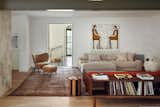
Sherbanuk’s approach to sustainability is as utilitarian as his design sense, leaning less on the recent arrival of efficiency technologies and more on the long history of material reuse and the unfailing reliability of industrial scrap to last for centuries. Outside, old galvanized-steel siding provides the skin for the house. Inside, in the living-dining area, a series of exposed steel girders supports the broad roof. Two of the girders, rescued from a demolition job, bear marks from their last lives in another building. Downstairs, Campbell designed a bar built of Douglas fir and I-beams. The steel here is new, but the wood was cut from planks found in the Toronto warehouse of a forestry company. In the living area, custom cabinets made of hot-rolled steel conceal the expensive entertainment system.
Even the art on the walls reflects the theme: A photograph by Edward Burtynsky of a mine tailings pond and an otherworldly photo by Jesse Boles of belching smokestacks are beautiful reminders of the precarious interface between industry and nature—and our power to direct it toward good or harm.
All of this—industrial chic and attention to recycled materials—comes naturally to Sherbanuk. He used to co-own a large scrapyard, and he’s seen many tons of steel, copper, and aluminum go from finished product back to raw material. “All metals are infinitely recyclable,” he says. There’s also a more personal resonance to the house: It reminds Sherbanuk of his childhood in a mining town on the north shore of Lake Huron. “I hung out in the shed because our house was really small,” he recalls. “I had three brothers, so that was the only place I could get away.”
Completed in 2007, Sherbanuk’s home is a series of irregularly shaped “sheds”: a long, low volume housing the guest suite and living-dining area; another with a workshop, laundry, and mudroom; and a three-story, metal-clad tower for the kitchen, bedroom, and workout room. It’s an odd shape, yet it fits the landscape, hugging the contours of the hillside and nestling into the shade of the forest at its peak.
This combination of rootedness and roughness is inherent to the designer. Campbell, whose family has lived in the area for generations, is determined to develop an architecture that reflects the area’s traditional building forms: “The barns and springhouses, they’re the local vernacular, and that’s a real inspiration for our work in this house.”
Campbell—who designed the house with his associate and wife, Suzanne Wesetvik—also employed basic sustainable building strategies. Its main exposure is to the southeast for optimal levels of sunlight; in winter the concrete floor gains heat during the day and releases it at night, supplemented by radiant-floor heating systems. Small windows along the west side let in prevailing winds for natural ventilation.
All of this certainly makes the house more sustainable, but Sherbanuk figures the house’s greenest quality will come out in the long term. “With most houses, when they’re torn down, everything goes into a bin,” he says. “When this house gets pulled down 60 or 80 years from now, they won’t even need a bin. It’s all gonna get reused.”
Advertising
Advertising
Advertising
Related Products
-
Steel Trash Can
by OXOThis is a classic steel trash can, but with a…
-
Mode All-In-One Recycling Center
An estimated 75% of household trash can be…
-
Jupiter Scrap Lights
by GraypantsThe duo behind Graypants studio are often…
Latest
-
02.03
Friday Finds 02.03.12
It's a balmy Friday here at Dwell's San Francisco office, and…
-
02.03
David Stark Pop-Up Shop
New York designer David Stark is the ne plus ultra of event…
-
02.03
Test Kitchen Before-and-After
In our February 2012 issue we featured the new experimental…
Follow
Dwell
-
Sofia Coppola has a nice loft for sale in Little Italy, but how 'bout those bentwood Breuer chairs? http://t.co/w4OdmvgZ #design #hubbahubba
-
Huge crowd at the sf #design center for @dwellprez and @dianabudds talking social media.
-
Getting ready for the social media and #design panel at SFDC http://t.co/gnBp543c
-
The new anteak line from @walkerzanger looks pretty good. #Design #tile


Brilliant!
Very smart and considerate of the enviroment. That house is actually not to far from where I live.
The shape and textures of most of the house are great. The fact that most of the materials are re-purposed makes it even more amazing. But, come on...it's OK to paint the front door.
Really nice and I love the heated seating area on the porch. The wood/metal and outside mix is amazing and so warm and comfortable. To know one can do this out of scrap as my project mostly is is inspiring.
what a nice kitchen, what's the wall made from ? Stanless steal ?
well done it,s my dream to own a scrap home
I think that this house is a wonderful creation. I love how nothing seems to have any paint on it, but it looks just as beautiful, if not more. If the door was painted, it just wouldn't be right. Its amazing how this scrap house can convey such a natural feel. I like the feeling of not being bogged down with paint everywhere.
Oh yeah, this is my guy right here. I think we're looking at the future as we begin to dismantle and create new ways to use above-ground material. Form meet Function; Function meet Form. Nice. Here in NYC, the rush for usable scrap is heating up (crackdown on scrappers) which to me is a strong indicator of where we're headed -- it'll just get hotter. I was very fortunate to get in and get out of my scrap career before the modern gold rush. The fact that this gentlemen has access to the material is another story altogether. Big question: permitting? Anyway, this is my first visit to Dwell. I like it very much so far. Thanks... Tommy
excellent in concept but these photos make it look very sterile; strange that so much re-used material can look un-lived-in; the spool table looks terribly unpractical what happened to the Dwell philosophy of photographs of homes as they are in real life?
I'm not a huge Ayn Rand fan, or really at all, but this house totally looks like somewhere I would imagine Henry Rearden living. It's gorgeous.
I love it! Re-cycling or re-purposing materials is really intriguing!! My husband and I live in 100 year old barn (old for Idaho!) and have re-purposed so many materials which makes it all the more interesting for us - and for our visitors.
absolutely incredible! thank you for sharing. we have a special appreciation for your fine use of metal. love it!
This home is AMAZING! It is beautiful, functional, small-footprint and made from repurposed materials - it is TRULY a dream house. Take THAT, HGTV!
RSS Feed
Add a Comment