Prince of Tides
For all the joys of beachfront living, it’s not without its risks. But with some smart design and sound engineering, this small coastal house stands tall against the threat of rising tides.
There’s no easy way to get to Stinson Beach. The last few miles of every route are winding snakes of sharp curves and steep grades. But the stomach-turning journey doesn’t deter visitors. Often more than ten times as many day-trippers as locals can be found along this short stretch of Pacific coast just north of San Francisco.
Life here is blissful indeed, but for the 800 or so people who call Stinson Beach home, the risks of coastal living are real. Sitting in the sand with Peter Dwares, who bought a home here in 2005, I get a beach-chair tour of the tiny seaside cul-de-sac. “That house over there went into the ocean once,” he tells me, pointing toward a tall wooden structure sited just steps from the waves. “A winter storm sent water over all three stories.”
From his perch Dwares can enjoy a glass of wine while gazing at the ocean.
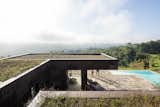
Dwares recounts the neighborhood history casually, knowing that his own home is unlikely to meet such a fate. His architects, Matthew Peek and Renata Ancona of Studio Peek Ancona, designed an elevated living space next to his 1940s modernist bungalow that is engineered to withstand floods, hurricanes, tsunamis, and the potentially drastic rise of sea levels. The structure is the first completed prototype of a model they envision being appropriate for any number of low-lying areas.
Prior to establishing their practice in San Francisco, Peek and Ancona lived for many years in Italy, where Ancona was born and raised. “We were inspired by the floating architecture of Venice,” says Peek, who studied there on a Fulbright scholarship. Practicing alongside leading European architects and engineers, Peek cultivated his aptitude for technological innovation—–a skill that is most evident in the use of concrete and steel. In the case of Dwares’s house, the concrete forms a floating foundation with thickened edges, set flat on the sand, as opposed to resting on piers buried deep in the ground, which is often done in coastal zones. The system also has environmental merit, Peek explains, “using 30 percent fewer materials than conventional flood zone foundations.”
With almost as much area dedicated to decks as to interiors, Peter Dwares’s house is truly made for outdoor enjoyment.
The architects’ design process was steered in part by a multitude of zoning regulations set by organizations ranging from the Stinson Beach Village Association all the way up to the Federal Emergency Management Agency (FEMA). The structure had to be elevated at least 12 feet off the ground, and the interior area could comprise no more than 450 square feet. Peek and Ancona made up for the space restrictions with ipe decking on all sides of the house totaling 350 square feet. Given the spectacular views, it was hardly a compromise—–indoor-outdoor living is possible almost year-round.
The fair climate also allowed for natural green features, such as passive heating and cooling. With the windows open, cross breezes off the ocean keep the rooms comfortable on warm days. When the temperature drops and the windows are shut, solar heat warms the interior. The exterior rain screen creates an air chamber around the building that adds extra insulation. In Peek’s initial sketches for the house, he’d imagined an even more dramatic passive strategy—–essentially a giant moon roof that would pivot open completely to reveal a full sky view. While that concept didn’t fly, the overall efficiency of the design did earn the project Platinum status in Marin County’s green-building rating system.
Among the sustainable features, the most visually compelling is the landscaping in the entry courtyard, which feels at once tropical and quintessentially native. Using only drought-resistant plants, landscape designer Michael Bernsohn established a garden that attracts myriad butterfly and insect species. From the cantilevered deck, yellow monarchs can be spotted making their way to the botanical feast.
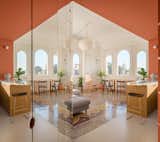
The garden and front patio supplement the modest living space upstairs. Peek Ancona’s addition contains just one main, multipurpose room with a modular Murphy bed for sleeping. Glossy wood floors and minimal furnishings create a tranquil atmosphere, enhanced by the sound of waves drifting in through large windows. “I wanted it to feel a little Pacific Rim but also nautical,” Dwares says. A collection of Asian-influenced art and a large model ship reflect his fusion concept. Peek adds that at night the entire structure glows like a lantern through the exterior red cedar ventilation wall.
From the main room, a short hallway leads to a Japanese-style master bathroom tiled in green slate, and beyond it is a narrow outdoor alcove just the right size for Dwares’s elliptical machine, which has a direct view of the ocean. While the seaward vistas call the most attention, Dwares didn’t want to neglect the view to the east of the house up the lush slope of Mount Tamalpais. A set of sliding doors opens to reveal the profusion of redwoods and ferns. “It’s just amazing to wake up in here,” Dwares muses.
Dwares and his girlfriend, Sonia Pilar, awaken almost every weekend in this airy nook along with their two-year-old daughter, Chloe. During the week they live in San Francisco, where Dwares runs a real-estate development company and a nonprofit organization for youth mentoring. While he could have chosen to buy a house about a quarter-mile north in the gated community of Seadrift, Dwares enjoys the more idiosyncratic assortment of both houses and people on his little street. Neighbors and tourists alike share the swath of public beach just a few houses away from his front door, and it’s clear he takes pleasure in chatting with just about anyone smart enough to know that the dizzying drive to Stinson Beach is worth every winding mile.
Advertising
Advertising
Advertising
Latest
-
05.23
The Making of Screenplay: Part 8
Jenny Wu, a partner at Oyler Wu Collaborative, documents the…
-
05.23
Veliero Shelving by Cassina
In 1940, architect Franco Albini made a single model of his…
-
05.23
ICFF 2012: Picks from Javits Center
This week we're digging deep into our favorites objets de…
Follow
Dwell
Reloading tweets…


Great idea! Dramatic form and clean lines.
Progressive contemporary architecture comes to (the) light - highly impressive in design, quality and functional use of space!
Wonderful design, functional and beautiful
A wonderful essay on the taming of nature in such a wild place. Serene.
What a beautiful, functional, sensible and revolutionary combination of ideas. Bravissimi!
Barb forwarded your message. Gorgeous. Thumbs up! Cousin Monroe
Fabulous design . . let's see more!
Bravo Matt & Renata - truly functional art!
Congratulations to you both! What a beautiful of warm materials and efficient use of space. Wish you had more pictures. Your award is well deserved!
Love it. Does anybody know what species of bamboo (I assume it's bamboo - maybe it's not) is in the planter at the bottom of the stairs?
Thanks Allan. The plant is horsetail, Equisetum, a vertical accent for the entry stair. Found along the edge of water bodies, we selected it to echo the local context of marsh grasses.
Hi Sonia.....Congratulations to both of you and Peter... for the nice merit given by the magazine to the house in Stinson Beach . The house is really great..Great architecture and engineering. I could imaginer Chloe growing and playing on summer there,,,and enjoy the sand beach.
Such a nice and safe house. I can especially appreciate the security it affords as I was once in a house by the sea when a hurricane struck. I wasn't sure that either the house or I would survive. Very scary. Such would not be the case with this house; I would feel safe and sound and enjoy the show. Congratulations
It would be nice to have a detailed explanation of what a floating foundation is and how it works.
Thanks for your interest Leah. The foundation is light enough that it floats in the wet soil, but heavy enough with a hybrid anchor and weighted perimeter system that it resists waves above. The foundation provides an alternative to typical deep piers that often measure forty feet underground, so it uses considerably less materials and labor. Contact our office directly for any additional questions.
I'm wondering how much it would cost to build a similar home. I have a small vacant lot (9100 sf) and I think this one could be a head turner.
Has anybody build such a well designed structure in the Ninth Ward area of New Orleans? My wife and I toured the Make It Right project (Brad Pitt's efforts with many supporting firms). What we saw was more boxy that this design but would hav benefited from the floating foundation. I think they used pilings instead which was a lot of work and cost. I am also aware of the homes being built on the River Maas in the Netherlands. In those the foundation is an actual barge so they can float up to 20 feet above the nominal low water mark.
Do you sell the Building plans for this house? If you do how much is the building plans? I own a resort please let me know!
Who constructed this gate/fence? Was it made locally? We're in the bay area and would love to try and replicate some of the characteristics. Thanks!
Thanks to all for your interest--our architecture firm is Peek Ancona. For specific design and construction questions please email Matthew Peek AIA. mpeek@peekancona.com
Can you please tell me what kind of wood / timber was used for the siding. Thanks, Jay
What type of wood is used on the siding? Great looking home.
Happy 2011! We just spent the new year at a house in Stinson Beach. It was new years eve and we were at the beach which was steps from the house and as we were walking back I looked up and said "wow, that's the house from dwell". The next morning which is right now I had to bring it up here online so they can see I'm not crazy for calling out random houses. Also we got in last night and it is dare devil drive on the coast to get here. I'm not crazy about cliff drop offs. Cool place though!
This could work perfectly up here in Vancouver. Minus the palm trees but dam!!! that would be sweet
"There’s no easy way to get to Stinson Beach. The last few miles of every route are winding snakes of sharp curves and steep grades. But the stomach-turning journey doesn’t deter visitors." hmmm, I always thought it a very charming ride, especially with a car that handles well...the house is great!!...
RSS Feed
Add a Comment