Prefab, Proven
In January 2003, we issued a challenge to 16 architects: Design a modern prefab home for $200,000. Here’s the story of the house that resulted from that challenge—and what we learned along the way.
In April 2001, Dwell devoted an issue to prefab homes. Featured projects included a black-and-white post-and-beam house in Fox Island, Washington; a high-end penthouse manufactured in Sweden, shipped by boat, and then craned onto London rooftops; and a page on R. Buckminster Fuller’s prefab bathrooms. It was a fascinating topic, but—magazine deadlines being what they are—we barely scratched the surface.
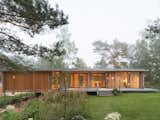
Wieler and Tung enjoy two of the home’s several decks.The home is clad in red cedar siding and features a multitude of view-enhancing windows by Loewen. The decking is composite wood by Trex.
My interest was piqued, however, and I eventually wrote an entire book on the subject—aptly titled Prefab—that was published in 2002. During the course of my research, I learned that countless modern architects and designers had tried their hand at prefab—from Le Corbusier to Frank Lloyd Wright to Philippe Starck—yet their efforts had resulted in a series of noble failures. It was not for lack of trying, but nothing ever seemed to get off the ground. I also learned that in the realm of pre-fabrication, the United States was decades behind. The innovative, modern pre-fab homes that were being built were in places like Japan, Sweden, and the Netherlands, where good design is omni-present. Sadly, little was happening in this country to move things forward.
Then, one afternoon in the summer of 2002, I took a call from a young entrepreneur in North Carolina named Nathan Wieler. He had seen the prefab issue of Dwell and read my book, and he wanted to know how he and his fiancée, Ingrid Tung, could purchase a prefab home in North Carolina. We got to talking about the dearth of reasonably priced modernist houses and the surplus of cookie-cutter housing. A few minutes into the conversation, I had an idea. “Hey, Nate,” I said. “We’ve been thinking about launching some sort of housing competition at Dwell. If you’re game, we could do it for a modern prefab house for you.”
Tung takes in the wooded view from the house’s back deck. Inside, the Goetz sofa, Eames lounge chair and ottoman, and Aalto stool are all from Herman Miller.The rug and throw are by Emma Gardner.
Wieler was thrilled with the idea, so I walked across the hall to the office of our publisher, Michela O’Connor Abrams, and blurted out my plan for a competition to build an affordable, modern prefab house. Much to my surprise, she agreed right away.
Had any of us stopped to consider the enormous challenges of undertaking such a project, we might never have proceeded. But we threw caution to the wind, and in the January/February 2003 issue of Dwell, we an-nounced the Dwell Home Design Invitational, in which 16 architects and designers were invited to design an innovative prefabricated house for $200,000.
In May 2003, the architects submitted their proposals. Soon after, Wieler and Tung came to Dwell’s San Francisco offices to meet with me and our panel of advisors (architecture and design curator Joseph Rosa, president of Hanley Wood LLC Frank Anton, and architects Ray Kappe and Sarah Susanka) to select the winning design. Later that month, at the International Contemporary Furniture Fair in New York City, we announced Resolution: 4 Architecture as the winner.
The master bedroom has a number of windows in varying shapes and sizes, providing unique views to the woods outside. The bed, chest of drawers, side tables, and geometric linens are all from West Elm. The Tolomeo wall lamps are by Artemide.
Res 4 had developed a system of building based on prefabricated modules that could be inexpensively produced in a factory environment, trucked to the site, and craned onto a concrete foundation that houses all mechanical systems. These easy-to-transport modules could be configured in any number of ways to create limitless home-design possibilities. Res 4’s invitational design created a program specific to the clients, their needs, and their site. Two intersecting “bars” form the house: The communal areas are housed in the lower-level bar, while the private spaces are in the second-story volume. Special materials and features like cedar siding, bamboo flooring, aluminum-clad windows, and even a roof deck with fireplace highlight the customization potential of prefabrication.
We had our design. Wieler and Tung had acquired their building site, seven wooded acres atop a steep grade in Pittsboro, North Carolina. Now all we needed was a manufacturer willing to build the home.
Getting a manufacturer to build the Dwell Home proved more difficult than anyone had expected. The work required to engineer a single home that differed from a manufacturer’s regular product line was vast. The startup costs were high and the incentives were small. Most manufacturers weren’t interested. “A modern home doesn’t look like anything they’ve done before, so it’s identified as a problem,” architect Joseph Tanney of Res 4 observed during the search. “A lot of these manufacturers don’t want any part of it. So finding someone receptive is key.”
That receptive someone turned out to be Elliot Fabri, CEO of New Era Building Systems, whom I’d met when we were both judges for an undergraduate architecture competition earlier that year. One of his companies, Carolina Building Solutions (CBS), became the factory for the Dwell Home.
The guys at CBS were alternately frustrated and, in the end, inspired by the task before them. As Mike Zangardi, general manager of CBS, explains, “Our biggest challenge was the design conversion process. But Resolution 4 did their homework and provided a great design within the limitations of the highway department’s ‘keyhole’ through which all oversized deliverable loads must pass.”
“The design conversion process,” Zangardi continues, “began when we started to redraft or engineer the modules to fit into and take best advantage of CBS’s manufacturing plant without tampering with the original design.” Some adjustments were needed and, as Fabri explains, design conversion didn’t come cheap. “There were tremendous engineering costs—$15,000 to $20,000. But now that’s done. When you’re a pioneer, that’s the sort of thing you run into.”
A view from the top of the stairs, past the office to the master bedroom. Sunlight filters through extensive fenestration to the hall, which features a runner by Emma Gardner. Artwork by Campbell Laird hangs over B&B Italia seating in the couple’s office. Not shown is a Herman Miller desk complete with Aeron work chair.
In addition to the obstacles presented by engineering, inclement weather, and, of all things, the start of deer hunting season (which warranted the temporary closing of CBS), basic communication often impeded the Dwell Home’s progress. “It’s a different language,” said Tanney early in 2004. “It’s as if we’re speaking German and CBS is speaking Italian and we’re both learning French so we can communicate.”
As things worked themselves out at the factory, Wieler, the architects, and the contractor, Steve Olson, tackled the work to be done onsite. Preliminary land searches had yielded flat expanses of land, but Wieler was intrigued by the hilly Pittsboro property. The foundation proved to be trickier than expected, given the grade of the site and the re-engineering of the modules, and more expensive, costing approximately $17,000.
Meanwhile, back in San Francisco, there were good days and bad days as I received calls reporting on progress—or the disappointing lack thereof. There was frustration on all sides through this period of protracted delays. “In the heat of battle, we wanted nothing to do with it [building future Dwell Homes], but now we’re game,” says Fabri. “The worst thing would be to do one and then never do this again.”
On April 6, 2004, after months of arduous preparation, CBS began work on the Dwell Home modules. It took just five days to construct the framing and install insulation, sheathing, rough plumbing and electrical, 80 to 90 per-cent of the Sheetrock, windows and trim, weatherproofing, cabinetry, and stairs. “It was quite a day,” recalls Tanney, “as if a huge weight had been lifted off our shoulders.”
On April 13, work was completed on the modules. On April 21, five flatbed trucks, each with its own police escort, transported them from the CBS factory in Salisbury, North Carolina, to Pittsboro. By the 23rd, the modules were set onto the foundation and the roof was gingerly put in its place. It had taken nearly a year to get to this point, and we all hoped that the remaining work would be a walk in the park. But things weren’t turning out that way.
The cost of producing the modules came in at $100,289—more than $1,500 under CBS’s initial estimate—but other costs were greater than anticipated. The allocation of dollars for the finishing work became problematic as Olson struggled to reapportion funds to his subcontractors after completing the foundation. The architects made almost weekly trips to North Carolina from New York, each time creating new punch lists, but little progress was being made by Olson and his team. How ironic, I thought, that the most difficult part of the process was turning out to be not the prefabrication but the more traditional finishing work.
At the eleventh hour, as the deadline for the Dwell Home Open House loomed, Elliot Fabri learned of the work delays and graciously offered to send out a crew from CBS to finish the job. In a Herculean effort, a team of CBS workers showed up and in stifling July heat did their best to wrap things up. With their help, we were able to pull off the event, attracting nearly 2,500 visitors to the home on July 10 for the Open House.
People often ask me “Why prefabrication?” and I make an analogy with automobile production. Cars—whether top-of-the-line BMWs or economical Saturns—are all produced in a factory, thus eliminating the variables that come with an uncontrolled environment and guaranteeing efficiency and standardization in construction. It’s useful to look at the fabrication of houses in the same way. To be sure, there are poorly constructed factory-built homes, just as there are cheap cars. But luxury cars are also factory-built and, as we’ve shown, well-designed homes can be, too.
It is instructive to think of this first prefab Dwell Home as the concept car, the unique version that sets the stage for future production models. Generous donations from the Dwell Home sponsors—everything from a home networking system to windows to appliances to furniture—offset initial research and development costs and allowed us to demonstrate the full potential of customized prefabrication. As the Dwell Home was a one-off project, it cannot accurately be described as mass-produced and as such the full cost savings that prefabrication promises were not enjoyed.
An important thing the Dwell Home brought to light is that, with the majority of prefab construction across the country, a sense of context is missing. By contrast, the Dwell Home’s design fully exploits its surroundings: There are plentiful windows and sliding glass doors to frame the view and let in natural light, generously sized decks off the front and rear façades, and a roof deck with an outdoor fireplace.
The home also demonstrates the importance of a liv-able floor plan and a well-orchestrated flow of space. On the ground floor, the open-plan module that contains the living room, dining area, and kitchen can be entirely open to the outside or enclosed by a striking gunmetal-gray curtain. Classic modern furniture provides comfort and style without taking over the room. The open kitchen, with its gleaming stainless steel appliances, is ideally suited to the love of entertaining the home-owners had described in their initial program.
Upstairs, private spaces are more compartmentalized. The master bedroom at one end of the volume looks out onto a grove of trees (and will eventually have its own private deck). Two bathrooms and a guest room/office run along the same axis, their entrances unified by bamboo flooring. The simple lines of the office area at the opposite end are highly conducive to concentration—though the roof deck that extends out from it is bound to be a great outlet for procrastination. Overall, the Dwell Home is a striking example of what can be achieved with a well-thought-out modular system of construction.
The stage has been set for future Dwell Homes, and now that the initial work has been done in engineering, planning, and coordination, the true cost and time-saving benefits of prefabrication can be realized. “As we develop relationships with manufacturers,” explains Res 4 project architect Michael MacDonald, “it will become economical to incorporate more of the materials and products we would like to use, those that have the potential to transform the way homes look and function, by allowing these products to become part of the manufacturers’ standard palette of materials that can be ordered in bulk and whose inventory can be maintained at the factory.”As this strategy evolves, there is still much work to be done to fulfill the economic promise of prefab. Initial estimates for the Dwell Home came in at $87 per square foot. In the end, the cost was probably closer to $110.
“In hindsight,” Tanney explains, “we would have reduced the square footage or reduced the scope of the roof, roof decking, exterior fireplace, and overall skin. If someone wanted to build the Dwell Home in North Carolina or a similar state, we’d recommend budgeting $125 per square foot. In the Northeast, we’d recommend budgeting $150 to $175 per square foot, and in areas like Southern California, we’d advise budgeting about $200 per square foot.”
It is true that much of the appeal of prefab for the public has been tied to cost savings. At the present time, those savings are not as significant as the consumer might hope. But one cannot underestimate the efficiency and precision of this type of construction, if done right, and the value of the time saved in the process.
Unified efforts are key for this movement to keep momentum. A single buyer hoping to buy a single home is still apt to be disappointed by what is available and what he or she will have to pay for it. But things are changing. A number of architects and designers have really thought things through and are spearheading the successful production of modern prefab homes. And, perhaps most important, the manufactured-housing industry is starting to take notice. Without their commit-ment, even the most brilliant ideas and designs cannot be realized.
The Dwell Home Design Invitational may have been a competition to build a single home, but in the end, I believe we’ve built so much more: a community of like-minded individuals excited about the potential of something that can improve the quality of our lives.
Advertising
Advertising
Advertising
Related Products
-
Prefab Prototypes: Site-Specific Design for Offsite Construction
A detailed guide to six different prefab…
Latest
-
02.03
Friday Finds 02.03.12
It's a balmy Friday here at Dwell's San Francisco office, and…
-
02.03
David Stark Pop-Up Shop
New York designer David Stark is the ne plus ultra of event…
-
02.03
Test Kitchen Before-and-After
In our February 2012 issue we featured the new experimental…
Follow
Dwell
-
Sofia Coppola has a nice loft for sale in Little Italy, but how 'bout those bentwood Breuer chairs? http://t.co/w4OdmvgZ #design #hubbahubba
-
Huge crowd at the sf #design center for @dwellprez and @dianabudds talking social media.
-
Getting ready for the social media and #design panel at SFDC http://t.co/gnBp543c
-
The new anteak line from @walkerzanger looks pretty good. #Design #tile


Tell me about the drapes and track system. It looks like a great solution for big windows. Thanks for what ever info you may provide.
If you're thinking of running another contest in NC, I know my husband and I would be game! We're a couple of designers (with 3 cats) striving to build our empire in our small house. I LOVE the style of this prefab as we've been designing a kitchen and bedroom around a studio but have yet to come up with the funds. Since you've already got the sources in place, I think Raleigh would be a great place to resume the work! @ecstewart
Awesome idea! Thanks for putting this to print, and continuing to move the construction/design industry along!
How does a company like EcoSteel fit into the prefab world? They don't build modules but pre-build the structure's all steel components and SIP-like metal wall, floor and roof panels... As with pre-fab, the foundation work needs to be done ahead of time. The electrical, plumbing and hvac is done after the structure is delivered and assembled. As far as I know, the design is pure custom but the construction is factory done.
I am enamored with the pre-fab home that looks fabulous. Are there more pictures? More of the drape/track system? I would like to get the word out to more firms on this idea!
Interesting in learning more about this house and the cost per sq. ft. as I am thinking about a builder in the bay area and like this plan better. Please send more info. to us. Patricia and Michael Hill San Jose, CA
i am interested in putting a prefab addition on my house. could you please tell me how to go about getting in touch with some of the architects/manufacturers. thanx
I have purchased a lot and would like to build my "modern" dream home in Martinsburg, WV.I have been reading at different prefab websites and the cost of a 2500 - 3000 sf home is 6-700,000...nightmare !!! Can you guide me on how I can make my dream home affordable. Just read your article about the DWELL prefab home contest... and you gave me hope !!!! Please point me to the right direction. Cherry Lobaton 11/22/2009
Just read your great article. I have reading Dwell Mag. now for about a year.Love the articles . My husband and I just bought earlier this year about 2acres on the road behind us in North Pole, Ak. We have thought of a prefab as a possibility. Needless to say we have a shorten building season here and a greater need for a well insulated home. We have a small pond on the property. It is actually part of what was called Clear Stram which I am sure is probably a run off of the Chena River.We are thinking of putting in the road, well,septic and hopefully starting on preparing a house site.Our present house is a modular but would need extensive remodeling if we were to stay in it. We would appreciate any info. you might have on companies doing prefabs here in Alaska.We did not want a cookie cutter house. We could have easily gotten one of those and it is sometimes difficult to find someone willing to help you work out what you want.We do not want a huge house. It does need to be one level.We look forward to hearing from someone and thank you for reading this.Norma
I love the idea. I am ready to get away from the "cookie cutter" lifestyle. I would like someone to help me in my venture to build a prefab modern home. Please help... I need a starting point.
Just a note to anyone who is considering building a "Dwell Type" modern home such as the one featured in this article. An ideal building envelope system to consider: SIPs (Structural Insulated Panels) Many of the modular and prefab companies do use this system in connection with their home offerings but SIPs are available all over the US, and internationally as well, and are specified by many architects as a "green building" option. (Super energy efficient, a sustainable material, less job site waste, etc) While many contractors are already experienced with SIPs there is a very short "learning curve" for those who are not.
So, Resolution 4 had won Dwell Home Design Invitational to design a modern prefab home for $200,000? Is this $200K the design fee or construction to finish fee? If the former, what's so special about it? If the latter, then the question is whether one: they cheated that it never really able to build a modern prefab that cheap, or two: the cost to build the same house jumped 100% the very next year and that's before their profit, thus making the Dwell's $200K challenge which I assume supposed to scream affordable, pointless. The big question to Resolution 4 is. Same house built in 2010, how much? As I stated with other prefab company (MDK, Marmol Radziner, et): The sustainability of a prefab or any green product is unattainable if it's unaffordable.
pretty cool. is there water damage to the bedroom window, picture 7?
I love this house. After making all the miscues and mistakes and miscommunication while designing and building this house, now you are ready to build my house like this for truly $200,000. Can you do it in Wake County? I'm ready.
Dear Dwell, It seems this is a topic that is still ever present among your readers. As an on and off subscriber over the years, I have managed to see the changes and development of pre-fab among architects and various manufacturers since this issue. With the increased costs of new and existing homes in the NYC Metropolitan area and then the subsequent drop of home values over the last two years, we are in a situation in which the conventual housing market offers very few options in buying an economical home without moving to another time zone. Pre-fab seems to be a very real solution. The problem is we don't have access to reputable companies and architects who are involved with modern designed products. My question picks up where Noah James left off: who is out there today that offers a modern pre-fab product comparable in cost today to what the objective cost was for Res 4? Is the goal of an affordable modern pre-fab realistic? If, yes, then word needs to be spread and people would respond. Thank you
We are the current owners of the above dwell house. One thing for future pre-fab modular house owner to consider: energy efficiency. With 103 windows and not well-insulated roof and walls (easier to pre-fab and transfer?) this house demands high electricity bills for heating and cooling. Consider geothermal and solar power when you build the house. But it will bring the cost up considerably. By the way, many of the materials and products in the house were sponsored by manufacturers. For instance, the deck material, windows, doors, floor materials, appliances, etc. So the actual cost of building the house is significantly higher than $200K. I don't know the answer Enrico di Giovanni asked: which portion of the $200K is design fee?
Hi! I'm from the resort island of Cebu,Philippines. My husband & I adore your magazine =)! We first came across Dwell when my sister gave me a copy while the hubby & I were in the midst of building our home (from the ground up,Phew!). Now, we hunt for back issues of Dwell in magazine/bookshops & grab any copy we can. There's just no other means for us to get one... Thanks & we hope you'll feature more innovative/green family homes. I just hope we can still keep finding your mags in the bookshops =)
I am very interested in purchasing a wooded vacant lot either in Orange County, NC (Chapel Hill area) or an 8 acre piece in an adjacent county. This is precisely the style of home I'd be looking to build, but I wonder how much the learning curve has been straightened in 8 years when it comes to energy conservation, more precise financials, and a NC builder's ability to blend prefab with on-site constructed elements that may not come "bundled" in the package.
This looks like the home that Resolution advertises for about $600,000 or more!
It is telling that your greatest difficulties were experienced setting the home while the factory of course whipped it out the modules lickedy split - no problem! therein lies the greatest difficulty of modular construction: prejudging your total costs without the ability to revise or gradually anticipate some of the logistical problems you will encounter onsite. Once those modules are built they better fit one way or another or you and or the factory are out a lot of money as a contractor. This is why it is so crucial to meticulously plan and employ highly experienced estimators and modular/pre-fab set crews.
I feel we can reach this goal of affordability, sustainability, and efficiency in prefab housing. As a wall panel / truss designer, the software is out there to do all of this. We just need cooperation between architects(big part), contractors, and the manufacturing companies building the prefab systems to all be on the same page to create a "dwelling" that is aesthetically pleasing, flowing and affordable to the everyday middle class worker. In my everyday design work, I have yet to see an architects design be "efficient" or "cost effective". They take the customers ideas, draw some lines, make some pretty elevation views and leave it up to the rest of us to make it work. It needs to start with them. Architects and designers in the construction industry need to work side by side to create the most efficient, affordable, and comfortable homes on the market. This can be done. We just need to start thinking differently about how the system, as a whole, works and above all communicates...
Prefab has the future, in Germany one on six of the new building houses are prefab houses
RSS Feed
Add a Comment