On the Level
These elements can be anything from fake dormers and inoperable shutters to extraneous stonework—whatever the developer who designed and built the house happened to have in his bag of decorative tricks. Inside, the textbook split-level presents a tangle of stairways and a confusion of half stories with awkward ceiling heights. It’s no wonder that when it comes time to renovate these buildings—as is happening with greater frequency as they surpass their 50th anniversaries—homeowners are instead choosing to tear them down and start again from scratch.
This is both a shame and a waste, according to Peter Cardew, the England-born, British Columbia–based architect responsible for the recent makeover of a split-level in a bedroom community northwest of downtown Vancouver. “It’s a pity,” he says, “because the split-level is an original type that represents a significant time in the history of North American housing, the postwar building boom.” Like Victorian housing before it, much of which was demolished in the 1950s, “the split-level has a cultural value worth preserving,” he says, acknowledging that this is unlikely to occur until the split-level acquires widespread cachet, which it currently lacks, or the stock becomes endangered. Right now there is a surplus of cookie-cutter split-levels strewn across the continent. These buildings will continue to come down—which is wasteful, because many of them are structurally sound. “When people talk about sustainability, they are usually referring to new architecture,” says Cardew. “But when you figure that most of the energy that goes into a building comes from the one-time act of construction, you are already ahead when you can keep a building rather than demolish it.”
Demolition was the furthest thing from the owners’ minds when they hired Cardew—but then, so was sustainability. “This was just a decent house, and we needed someone to help us with a new kitchen and to open things up a bit,” says JeanClaude LeBlanc. The
33-year-old real estate developer had been renting the 3,000-square-foot house with his 31-year-old girlfriend, Megan Griffith, when the owner planted a “For Sale” sign on the sprawling lawn out front. LeBlanc responded by purchasing the property and calling in Cardew.
LeBlanc reports that the scope of the project expanded “once we cracked things open and found all kinds of problems—wiring, plumbing, you name it.” An acknowledged perfectionist, he realized that whatever alterations he made would be diminished by things left unchanged. “New next to old can work, but it doesn’t always,” he says. “I have plenty of friends who can live with design discrepancies and would never have gone as far as I have because of the detail involved; it just doesn’t matter to them. But we wound up gutting the place. I work at home and walk through these rooms 30, maybe 40, times a day. And I didn’t want to have to look at anything left unresolved and think, I could have done something about that.”
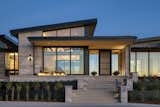
The decision to gut the home paved the way for a truly minimal aesthetic to emerge. “We didn’t do much, but we did a lot, if you know what I mean,” Cardew quips, skirting the details. When you compare before and after photographs, you can see that this is true. Where the old façade was standard-issue split-level, busy and cutesy, the new one is handsome and plain. By subtracting a cosmetic dormer and a few other superfluous openings, exchanging complex elements for simpler ones (for example, a mullioned picture window for a single sheet of glass), and adding a light-colored concrete driveway (the perfect foil for a house painted black), Cardew reworked the façade so that it looks better proportioned and draws attention to—celebrates even—the split-level’s iconic form.
Inside the home Cardew addressed LeBlanc’s shopping list of concerns: the need for a more gracious entry, natural light, and an open feeling throughout the public spaces. By reangling the outside stairs and widening the front door to a welcoming five feet, the architect created an entry that feels both distinctive and generous. By lowering the ceiling height to seven feet in the foyer, he made the adjoining living-area ceiling feel much taller than its conventional eight feet (an old trick from Frank Lloyd Wright’s playbook). By knocking out the walls and doors that separated the living, dining, and kitchen areas, he turned a ’60s layout into an ’00s open plan that reflects the casual way LeBlanc and Griffith like to live.
To take advantage of natural light, Cardew did a few things you might expect, like painting all the walls a light-bouncing white (“We’ve found a tintless white base works best in this gray environment,” says project architect David Scott, referring to Vancouver’s notorious overcast), and covering the floors on the main level in hand-troweled reflective concrete (“It’s lighter than machine-troweled,” Scott notes). However, most of the home’s light comes from seven seven-foot-wide floor-to-ceiling windows Cardew had installed—four on the main level and three in the den/recreation room, located a half story down from the kitchen.
One of the architect’s biggest challenges was to deal with the most awkward moment in standard split-level architecture: the juncture between the single-story and two-story structures. In this house, the hookup is visible twice: from the foyer and from the no-man’s land between the kitchen and den. In each instance, a section of wall from the second floor drops out of the ceiling on the main level to form a bulkhead. Compounding the problem is the half flight of stairs leading down to the home’s lower level. “Even though you know you are not going to hit your head when you go down the stairs, I am six-foot-three, so I think about it,” says LeBlanc. “I could see Peter thinking about what to do about this the first time he came over.”
Cardew’s response was to create a gap between the building’s two halves and extend the offending bulkhead wall up to the second-story ceiling, where it now butts against a corner window that has been tucked under the existing soffit. The introduction of the skylight transformed a negative into a positive. Where once there was an obstacle, there is now a grand expanse of wall alive with the play of daylight.
Natural light contributes to the home’s overall calming effect, as does the limited palette of materials—mainly drywall, concrete, and maple—and Cardew’s treatment of rooms not as separate entities but as part of a continuous whole that blends harmoniously with the building’s original character.
“We retained the past to sustain the future,” says Cardew. On the other hand, LeBlanc admits that while he is behind the “big idea” of preservation, his motivation for saving this one, and in such a meticulous manner, was personal. “There’s just so much junk being built out there; I didn’t want my renovation to be part of that.”
Advertising
Advertising
Advertising
Related Products
-
Level Bookcase
by Arik LevyPrimary colors and black lines put Piet Mondrian…
-
Plane Toy
Suspended from the ceiling as an aeronautic…
-
Tools
by Björn DahlströmAttractive enough to go straight from the oven…
Latest
-
02.09
An Architecture Guide to Pyongyang
German architect and writer Philipp Meuser realizes that…
-
02.08
Fair Chairs
We continue our coverage of the 2012 Stockholm Furniture and…
-
02.07
Seven from Stockholm Design Week
It's about mid-way through the 2012 Stockholm Design Week and…
Follow
Dwell
-
Jay-Z on the importance of weighty flatware: http://t.co/ynVmXIRs #interiordesign #forksneedtobeheavy
-
Old-school #transportation http://t.co/0uXuKbK5
-
A bit out of date, but spotted in Stockholm none the less! #travel http://t.co/3UTJ3N13
-
Our overage of the Stockholm Design Week continues with a look at a few especially haute seats: http://t.co/AI8RmEdw #furnituredesign


how amazing to see a split level house in a magazine article. while it is not my favorite style of house i have been living in one on long island, ny for almost 15 years! when my daughter told me about the article i found it difficult to believe. no one writes about split levels! they are everywhere but they might as well be no where! anyway, i love what this couple did with their's. is there anyway i can find out the dimensions of their rooms so that i can compare their house with mine. also are there any other photos of their kitchen? thank you for the article. it is an inspiration!
Nice article and great photos. This home style is typical of West Vancouver real estate stock, and most of these homes are being torn down and rebuilt now that land prices have soared. It would be more interesting to see some of the important 50's and 60's architecturally designed modernist homes featured in Dwell. So many of these homes in West Vancouver are overlooked. There are several important homes on the market right now that can bought at the same prices as ordinary splits and that have much more interesting design than this house.
Splits are funny- their open-space design is fairly contemporary-- but many of them, including ours (circa 1973) were built with a traditional aesthetic (we think ours really wanted to be a colonial when it grew up.) To confuse matters, the the former owners updated it to about 1986. So what we're trying to do is restore it to a 1970s feel that it never really had in the first place! This article gives us lots of great ideas- many thanks!
We are Dwell fans and were very inspired by this remodel, especially the exterior color and materials, but also by its creative minimalism. We own a split-foyer (bi-level), not a "split-level" like the subject of this article, but some of the ideas could apply to either style. Just by opinion but I think it best when remodeling these types of home to keep them in their period, rather than trying to create a faux colonial or something alien to the original design. Work with it -- there's much potential there. I began writing about our split-foyer model on my blog, and will be posting more images as it progresses. I also have been gathering useful links. Check out: http://purcellart.wordpress.com/2011/11/17/split-foyer-challenge-update/
RSS Feed
Add a Comment