Got Mjölk?
This Canadian duo searches out top Scandinavian and Japanese designs and brings their best finds back to this Toronto shop.
Juli Daoust and John Baker broke the cardinal rule of retail when they opened Mjölk in 2009. “You’re supposed to pick a name people can pronounce,” Daoust says. Instead, the couple chose a moniker that pays homage to Nordic traditions and describes both the Scandinavian and Japanese design aesthetics the shop specializes in.
Pronounced “mi-yelk,” mjölk means “milk” in Swedish. “Sweden’s Arla milk packaging has won a number of awards, and its design really stuck with us,” Baker says. “The words that characterize milk are the same ones that describe the two regions’ design aesthetics: pure, simple, sensual.” The store echoes those sensibilities with its crisp interiors and carefully curated items by artists that Daoust and Baker met on scouting trips to Japan and Sweden and its neighbors. Though it may seem a stretch at first, the items from abroad feel perfectly natural in the Toronto shop. “The climates and experiences in Japan and especially in Scandinavia are so similar to ours in Canada,” Daoust says. “It’s easy for us to connect with them.” So while the name may be foreign, Mjölk’s wares feel right at home.
Wood is a favorite material of owners Daoust and Baker, who select pieces that show off the natural grains of each cut.
What inspired you to open the shop?
Daoust: We're not painters, we're not makers. We're people who are creative in other ways, like being able to curate a shop. Plus, it's in John's blood.
Baker: My grandpa had a hardware store and a camera store. My dad manages a car dealership.
Studio Note’s f,l,o,w,e,r,s ruler features handpicked, dried flowers embedded in acrylic in one-centimeter intervals.
You opened in 2009 during tight economic times.
Baker: There's always a second coming of modern design in response to a recession: Alvar Alto bent wood because steel became too expensive. Iittala simplified its designs because it was too costly to be ornate. We knew people were either going to buy the cheapest things possible or start looking at disposable products as unsustainable and begin investing in products for the long run.
What drew you to Toronto’s Junction neighborhood?
Baker: Downtown became so expensive, and that pushed people either east or west. In the past five years, this area has really become a destination. A lot of young, independent businesses have popped up, starting with reclamation stores Smash and Post and Beam. There’s also Crema Coffee Co., Pandemonium Books & Discs, Junction Fromagerie (a Quebecois cheese shop), and Bunner’s gluten-free vegan bakery, to name a few.
How do you select an item to sell?
Daoust: I’ll be making something or getting dressed and wish I had a better can opener or a better shoehorn. Then, I try to find the best one there is. Everything we put in the store is something we would want in our house. It all ends up upstairs in our apartment at some point.
How do you grapple with the common perception that foreign design costs more?
Daoust: We made our shop look too slick; everyone thinks everything is really expensive...
Baker: But we recently counted all the things in the store under $100 and there are hundreds. It actually surprised us!
You worked with Christine Ho Ping Kong and Peter Tan of Studio Junction on the interior design; how was that collaboration?
Baker: A lot of our ideas for the store were things they had already executed. We wanted a curved wall, and they had recently created one for an exhibition at the iconic Gladstone Hotel; after the show they said, why don’t we use it in the store? Christine and Peter are master manipulators: If you’re seeing something not quite right, they’ll help nudge you in the best way.
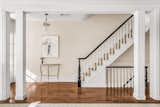
At the shop, Poul Henningsen’s PH 5 lamp for Louis Poulsen hangs over the Sandra table by Thomas Sandell for Asplund and Scandia chairs by Hans Brattrud for Fjordfiesta (top left).
Why do you host exhibitions in the space?
Baker: Everything has a story. By having an artist come in during the exhibition, walk around, and talk to people, costumers know if they buy one of his pieces, they're supporting this great designer who can continue to work. Japanese artist Oji Masanori signed the backs of plates for people when he was here. It was amazing.
What's next for the shop?
Baker: We went to Japan twice in a row to source products and just got back from Scandinavia--Reykjavik, Copenhagen, Stockholm, Helsinki. Norway Says was one of our favorite design firms; we were so sad when they split in 2009. But now we get two new companies--Andreas Engesvik and Anderssen & Voll--that are both doing amazing things. We're also redesigning our site and finally launching an online shop.
Catch our slideshow of Daoust and Baker's favorite products in the shop.
Don't miss a word of Dwell! Download our FREE app from iTunes, friend us on Facebook, or follow us on Twitter!
Advertising
Advertising
Advertising
Related Products
-
Wire Ware
by Naoto FukasawaCan be placed on the plate together with your…
-
Wood Trivet
What good is a fresh carafe of coffee if you…
-
Travel Bottles
Now here's a bright idea: breeze through the…
Latest
-
05.23
Veliero Shelving by Cassina
In 1940, architect Franco Albini made a single model of his…
-
05.23
ICFF 2012: Picks from Javits Center
This week we're digging deep into our favorites objets de…
-
05.22
ICFF 2012 : Design Milk Presents
"Reinvention; Writing History in Aluminum" showcases a…
Follow
Dwell
Reloading tweets…


Nice shop! Kindly advise your webpage as soon as you have your online store. Regards, nelson
Expensive minimalism. I don't get it. Vintage is so much better on so many levels.
Greetings, I'm a Toronto resident and I ventured to the shop last Friday for the first time - I was very impress to the point that it is my opinion it is one the best design and furniture shop in the city. The collection @ Mjolk is extremely well curated; you get the feel that you're in a design museum where you can actually touch and try the products. In addition, there's a nice range of products from accessories, seating, lighting and dining wear. The shop mostly carries items that are functional in nature with a serious artisan touch and the owners are extremely knowledgeable about materials and construction processes. The result is an authentic, classic but down to earth experience filled with high quality and interesting goods. Definitely worth a look if you're looking for something out of the ordinary.
Thanks for the comments. Nelson: The shop is up! Visit it at http://store.mjolk.ca/ Glo: Sorry you're not finding it to your fancy. It is amazing how many products there are under $100 and under $50 though. Patrick: Thanks for telling us about your trip to the shop; it really is a place worth visiting, and Julie and John are great curators and storeowners.
Amazing piece - Love Mjölk. One question remains, who made Juli's boots?!
RSS Feed
Add a Comment