Fertile Grounds
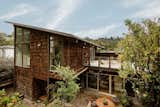
Nestled in an apple grove in Sebastopol, California, the Orchard House is a rural idyll. And with the voracious design appetites of a family of gastronomically inclined clients, this concrete prefab construction is quite literally a moveable feast of a home.
During harvest season in Sebastopol, California, the sweet smell of fermenting apples travels from the orchards all the way to Highway 101, luring drivers off the road in search of a fresh Gravenstein or Golden Delicious. Though just 50 miles north of San Francisco, the Sonoma County town is absolutely rural, dense with fruiting trees and vineyards, and it’s partly for this that Naomi Hupert and Ben Kinmont moved here with their son, Ian, and daughter, Natasha, in 2003. But they couldn’t leave New York City behind entirely, so they found a pair of architects who could adapt elements of their Manhattan loft to the California countryside.
The wide front door opens onto a wide central living space where the entire family—and a regular cast of visitors—spends much of their time.
One feature the family hoped to retain in the new home was the unified, open living space they’d enjoyed back east. But this wasn’t the only requirement. First and foremost, the house had to be completely accessible to teenager Ian, who gets around in a power wheelchair. Second, they needed a place that could accommodate two home offices and a study area for homeschooling Ian. Third, they needed space not just for cooking, which they do a lot of, but for massive kitchen projects like making wine from their homegrown grapes and oil from their olive trees. “It was very task oriented,” admits Naomi.
When Ben and Naomi found Anderson Anderson Architecture, they felt confident that their list of practical needs could be translated into a beautiful building. “What we liked about their work is that their projects didn’t all look the same,” says Naomi. “So we didn’t know exactly what we’d end up with.” Principals Mark and Peter Anderson embraced the opportunity to create an architectural container that would support the family’s daily life without interjecting a dominant design concept. “We wanted the house to be really robust and kind of rustic so that anything could happen in it,” Peter says. “It’s not fussy in the sense that one thing out of place would create a disruption. They completely live in it.”
A massive slab of cypress perched atop sawhorses provides storage for pots and utensils.
The central living space is wide and airy, with a comfortable sitting area at one end, a dining table at the other, and in between a spacious cooking zone. Only the sleeping quarters sit apart from the main room, along a sun-filled corridor lined with artworks by various members of the family. Two “drive-in” bathrooms feature open showers with long drains that occasionally harbor a wild mushroom or a few blades of grass. The house is wheelchair accessible both inside and out. Smooth pavement extends through a carport and covered walkway to a separate wing where Ben’s mother, Vikki, lives. “Ian can go from his bedroom all the way to mine in his wheelchair,” Vikki says. “It’s phenomenal.”
The material of choice for the loft-cum-farmhouse was concrete, for which the Andersons devised a prefab strategy. A series of identical C-shaped modules from the same formwork compose the structural system, which sits on a continuous slab foundation. In order to integrate the house into its surroundings, the walls line up exactly with the rows of trees outside, which are planted on a grid, spaced 25 feet apart. As a result, the expanses of floor-to-ceiling glass doors span the open alleys between the trees, creating seemingly infinite views in every direction that taper into trunks and leaves.
The concrete extends even into the interior structures, framing the large kitchen island, with custom niches for appliances and sinks. The only accent materials are wooden doorframes made from reclaimed redwood wine barrels and galvanized steel siding on portions of the exterior. In the center of the main living area, an enormous slab of salvaged cypress cuts across the space, resting on sawhorses with open shelving underneath. Throughout the house all storage areas are open, leaving crockery, dishware, food, books, and clothes in plain view. “There is no cabinet or drawer here,” explains Naomi, “because one of the hard things when you are in a wheelchair is to back up and open a door at the same time.”
The Andersons designed a system of four-by-four-foot concrete modules, created from a reusable formwork of 2-by-12-foot boards that could be easily moved around the site.
The open system is just one of many instances where Anderson Anderson’s intentions are borne out. The simplicity of the overall design presents no opportunity for conflict with the family’s way of life. Metal buckets of wooden spoons on the counter, giant bowls of table grapes from the garden, and a five-gallon jug of fermenting wine don’t amount to visual chaos; rather, they’re evidence of a hands-on existence.
Many of the culinary craft projects are an extension of Ben’s work as an artist and dealer of antiquarian books about food and wine. Off the kitchen, Ben stores his inventory—faded spines lined up on long shelves and a tall cabinet where a few select objects are kept. Next to a gaping fireplace in the sitting area is the most prized and frequently used of his antique cooking implements, an 18th-century French tourne-broche à poids—a delightfully analog contraption for turning a spit over a flame. Naomi demonstrates how it works, spinning a wheel that activates a set of pulleys that automatically turn the metal rod.
The oversize hearth (of which there is an outdoor double) was part of the original design specifications. “Ben said he wanted a fireplace big enough to cook a wild boar,” Mark recalls, “and I said, ‘That’s great because I’ve got a recipe for that.’ That’s when we knew we were the perfect match.” No boars have been cooked to date, but Naomi and Ben do entertain large groups on a regular basis, often preparing food grown on their property or nearby.
The five core members of the household are rarely without additional company. Ben’s brother Seth stays over often and visitors rotate in and out. “The Andersons did a very good job of creating spaces that are completely accessible to all our family and friends,” says Naomi, emphasizing the paucity of universal design that upholds high aesthetic standards. “We’ve seen quite a range of approaches, and they tend toward a generic hospital look with plenty of white plastic and poorly adapted structures. This house is so well designed that its accessibility is sometimes overlooked.”
Ben’s office contains an impressive reference library for his inventory of antiquarian books.
While Naomi admits to occasional nostalgia for city living, the family has found a comfortable rhythm in their country loft. “Our visitors joke that we have basically just transported our New York life right here without changing much except for lighting,” she laughs. But she never forgets, of course, that only here does a crisp autumn day bring the pleasure of apple picking in her own backyard.
To see more images of the project, including photographs that didn't appear in the magazine, please visit the slideshow.
Advertising
Advertising
Advertising
Related Products
-
Vintage Sheet Fat Quarter Packs
If you're a fan of classic patterns and love…
-
Anderson Beach House Print
by Nathaniel RussellUnencumbered by the ephemera of daily life…
Latest
-
02.03
Friday Finds 02.03.12
It's a balmy Friday here at Dwell's San Francisco office, and…
-
02.03
David Stark Pop-Up Shop
New York designer David Stark is the ne plus ultra of event…
-
02.03
Test Kitchen Before-and-After
In our February 2012 issue we featured the new experimental…
Follow
Dwell
Reloading tweets…


WOW! Who was the builder?
An inspiring house; it breathes freedom and sensitivity.
This is one of the most beautiful houses I have ever seen and really inspirational. The indoor/outdoor nature of it makes one want to bring their loft living to the countryside. I love the cozy quality created in what looks like a very large space. I am glad that Dwell gives us many practical and aesthetic alternatives in living. Thank you.
How did they get all that prefabricated concrete on site?
That home is awesome. Love that island in the kitchen.
It is an inspiring, yet comfortable, creative, open, and ultimately free space--what an amazing thing that it is also accessible! Brilliant.
oui j'aime beaucoup cette manifique maison je voudrais moi-aussi vivre la et peindre de grands Tableaux Bonne chance et soyez heureux Huguette
This house is awesome. I'd like to build one very much like it!
Outstanding design, highly personalized for the clients. Other "green" building systems that might be considered if someone is looking to build something similar: SIPs (Structural Insulated Panels) and ICF's (Insulated Concrete Forms).
Sips panels were considered; and were the Architect's intention, but as we were on a shoe-string budget, and we saved some $40k and 14,000 sf plywood with a simple wood truss assembly (at 7000 sf of plywood) versus the SIPS panels (2 sides of plywood) and then with a layer of taper foam for slope and then yet another layer of plywood over the top for the roof layer--which would have resulted in a total of 21,000 sf of ply for the roof assembly on these two residences (house and granny unit, carports). In the end, all of the form boards were used to complete the roof, having first been used for the perimeter foundation and floors, and then the 26 poured in place concrete "U" walls / fireplaces and monolithic poured walls; and then finally integrated into the roof assembly where the pre-fab 2x4 trusses were connected at the perpendicular rims. A wonderful house for this family; Anderson Anderson really got it right....
Beautiful home and love the garden. So tranquil is the table to sit and enjoy.
Hey - great looking Giant helping in the kitchen! Is that a Skansen?
Nice Giant Schnauzer! This is the first time I have seen a Giant in an article here. I have one too - only natural ears and tail. Great job on the house too.
Great work by both contractor and architect. Just beautiful.
Dear Editor and Sarah Rich, As a person intimate to this project from conception to completion, and a frequent visitor to this property. I find it astounding that there is no mention, interest , or credit given to the builder of this house. There is a conspicuous omission and disregard for the labor involved in the creation of this home. It is as if the entire thing sprang fully formed from the architects' foreheads like some grand Athena. I am curious if it is common practice in your articles to omit the builders when you list the project name, the architects and the location. If so, what is the reasoning behind this practice? It is often a critique of modernism, that it privileges concept and product over process. I am amazed at how far you have been willing to go in this instance in misrepresenting the facts to preserve your conceptual focus. Anderson and Anderson did not build this house, nor did the owners.(see Anderson and Anderson, Prefab Prototypes Orchard House page 96, Princeton Architectural Press, 2007) The "prefab" elements were in concept only. The house was constructed on sight, not by a "Crew of two," but by a local general contractor who designed and implemented many of the structural features that you highlight in the article. Why not set the record straight, and give credit where credit is due. Knowing, as I do, what actually occurred in the process of constructing this house, and how you have represented it. It is difficult to lend credibility to your publication. I believe you do a disservice to your readership by creating idealized fantasies, of concept, process and product. (As you have done in this case.) Rather than engaging with integrity the honorable struggle of attempting to represent the true spirit of the experience.
Your designs remind me of the Florida Design movement in the 50's and 60's. I just wonder what a 3 bed/2/bath would cost here in Florida and where to find a vacant lot close to work where the cookie cutters would allow such marvelous houses? This would probably be a problem here. I love your different homes. Thanks for the articles and the magazine. Pat Lingvay
I'm dying to know how the branch chandelier was created....simply amazing. Please post a DIY :) sure would love to make one or receive tips on how to.
I saw this in the magazine but it was great to see all of the extra photos online. What an extraordinary house!
Must have taken a while; reusing the same form boards for each poured component, did you have to get the cement truck back every time one dried? That would be a lot of trips
We poured the walls roughly in sets of six-- because there are some 28 individual concrete modules we had the truck and pump back for 5-6 times. The tall chimney (above the roof level) we formed and poured after the roof was built so we wouldn't be so far off the ground. We were purposely low tech to save money and resources.
I saw Dwell magazine at Lowe's with some really cool house on it so I thought I would check the website out. I am glad I did because I have looked at most of the house here on dwell and this is the one that caught my eye the most. Simply because I have thought about creating a concrete home slab on grade and was wondering how it would look. I love it and would love to see the floor plan. I also was surprised to see the Giant Schnauzer in a couple of the slide show pics. I can identify with that also as we have a Giant Schnauzer and a miniature. I guess I could picture myself in such a house before but now can physically see what it would actually look like. A couple of things about the concept of a concrete home that has puzzled me is how they do the roof and the cost of one. Is it flat or sloped? It looks flat from the pics but a previous post talks about 2 x 4 trusses so I'm confused. Finally, everything I have read states a concrete home is more expensive but I'm not so sure in the long run do to energy savings. Anyway, really cool home and it really inspires me to keep this type of home in mind when we build in the next few years.
You can see more images of the Orchard House at: http://www.moderndesigninterior.com/2010/09/minimal-architecture-orchard-house.html
Beautiful home! I really like the kitchen faucet, who manufactures it?
loving the indoor/outdoor style and the overall quality of the build, however it comes at a price! Great to see something modern, elegant & different…even if a little pricey ;)
Yes, there is need to move ahead and take some strong step to remove our negligence from nature and our climate.One day it will reduce these natural calamities.
I just got an email yesterday saying it was a road kill in michigan...."This monster was hit by a car on Michigan Ave. between Clinton and M-52. He was hit on Tuesday night, the night of the big snowstorm. Clinton police on left, guy on right was 3 cars behind the car that hit the deer and saw the deer flip into the ditch. Look at the thickness of the antler above the cop's hand. I guess this thing scored like 246 inches of rack. could be new state record, not hunting record of course. I heard the guy was going to donate the deer to Cabela's for a mount. The spread inside the rack is 28 7/8". unbelievable. "
RSS Feed
Add a Comment