Bringing It All Back Home
Relying on local materials, local craftsmen, and the land her family has farmed for over two centuries, a New Yorker rediscovers her Midwestern roots.
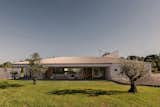
Rattled by 9/11 and worn down by 34 years in lower Manhattan, artist Lauren Ewing wanted to build a retreat where she could escape the city for a few weeks or months at a time. Ewing, a sculptor and Rutgers University art professor, considered sites in the Northeast but eventually turned to the 500-acre property in Vincennes, Indiana, that her family has farmed since 1806. The house she designed—–a version of the venerable Southern-style shotgun house, updated with a modernist flair—–has given her a place to unwind and reconnect with her Midwestern roots.
I went away to school when I was 17, and for the next 40 years I basically came back here occasionally on vacation, and that was it. After 9/11, I had witnessed not only my whole life but also my whole neighborhood and community change overnight.
I decided to build a house in a place that was kind of a refuge, where I could be self-sufficient if I needed to. And I wanted to spend time with my brother, Mark, who was just seven when I went away to school. I had looked in other places. I thought, Well, I’ll build a house on Cape Cod or Long Island, because
Ewing used Canadian maple for the hallway and living-room floors, giving them a bright, clean look. A built-in shelving system borders the hearth, creating functional and decorative storage spaces for firewood collected on-site.
I’m a kayaker and I love the water. And, you know, the real estate prices are just insane. I wanted to be efficient about what I did and I built this whole house in Indiana for $300,000.
I’ve always loved what I call “the wisdom of poor architecture.” I traveled to Louisville, Kentucky, with my brother, and I realized that it was the shotgun house that I really loved. It’s eccentric in its proportions. It’s what a kid draws when he draws a house; it’s an archetype of a house.
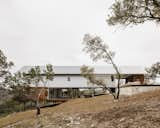
So this is just a big shotgun house: a single gable that runs from end to end without any beams and was efficient to build. I knew I could get 60 floor joists that were exactly the same and 60 roof trusses that were exactly the same and that I could create a shape that would remain true.
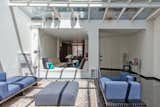
The floor-to-ceiling living-room window was inspired by Philip Johnson’s Glass House.
This is a two-bedroom house with only one bathroom, a kitchen, and a very large studio/living room. There are decks on both ends—–including a reading deck off my bedroom. And then it has a full basement, which houses one of my studios and is poured concrete, so it’s wonderfully cool.
There aren’t a lot of windows on the front of the house. One of my themes was to come into what looks like a closed space and then have the whole house open up when you walk in.
A leaf-green countertop adds a splash of color to the kitchen.
I wanted to make something that was going to be easy to take care of, too, so I sided the whole house in corrugated metal, the kind that’s usually used in the great big distribution warehouses that you see off highways. But I like it because the coatings of color are baked on, and the siding has a 25-year guarantee. For the exterior I picked Wedgwood blue. The walnut trees are yellow and the maples are orange and yellow, so it looks absolutely stunning in the fall. It’s a very cool, very recessive color—–almost the color of a shadow—–so it doesn’t stand out. It sort of sits back.
My brother did all the road building, landscaping, and tree clearing. I used a local company to make the doors, and a glass company that puts windows in grocery stores to do my studio window. I used solid Indiana limestone for the steps and Indiana sandstone for the hearth. The entire house was built with local materials and local craftsmen. These weren’t exotic choices, but they’re practical.
One of my extravagances was to get Canadian maple for the studio and hallway floors, because I wanted something that was almost pattern-free. One of the bedroom floors is maple that was taken from this site, and the other bedroom is ash, which was harvested on-site as well. All of the cabinetry is made from wild cherry, which we have in another field on the property.
The whole house opens up to the north, so I never turn the lights on until nine o’clock at night in the summer. I get this wonderful colorless, shadowless light all day long.
The surfaces of both decks—–including the small one off Ewing’s bedroom—–were fashioned from recycled plastic fibers.
I wanted the front of the house to look out on this wonderful little valley, which goes through the most dramatic changes. It’s beautiful here. It’s just a different world, and it’s a world that I basically didn’t have time for as a younger person. As I get older, I want to have time for it. I want to be here. It’s easier on my body and my brain.
I love New York. There’s the most critical and interested art audience in the smallest geographical area of any place in the world, so it’s very intense. And I like that. But I like this too.
Advertising
Advertising
Advertising
Latest
-
02.09
An Architecture Guide to Pyongyang
German architect and writer Philipp Meuser realizes that…
-
02.08
Fair Chairs
We continue our coverage of the 2012 Stockholm Furniture and…
-
02.07
Seven from Stockholm Design Week
It's about mid-way through the 2012 Stockholm Design Week and…
Follow
Dwell
-
Thanks, @dailytekk, for including @dwell on your list of 100 Best, Most Interesting Blogs & Websites! http://t.co/hbMnDiTO #design
-
Was Mario Manningham's Super Bowl catch a work of #architecture? http://t.co/zxD47gN1
-
“@archpaper: Move over Ice Cube, Moby jams to #architecture, launches new blog about Los Angeles: http://t.co/eVKNB5WK”
-
What does the #architecture of Pyongyang look like? Just interviewed the guy who wrote the guide book http://t.co/qA6Pm0Nm


Lovely house! Had you considered upstate New York? Perhaps you can't even get a piece of land for $300k within 2 hours of the city though...
Nice House. Very basic and clean. I like it. But why 300k to build? That seems like a lot for something so basic. Did that price include the land perhaps?
Reminds me of NYC architect Ross Anderson circa 1992 Vermont.
I love this little house, but I am wondering the same thing: Why so much to build? Wouldn't mind hearing more about this house and maybe where their money went and if it included land.
I'm guessing that this house has about 1600 sf of living area on the main floor (Based on "80" floor joists @ 16"OC) and just looking at the photo of the front, it appears to be about 20' wide. But it also has a basement with a garage. That's a little less than $ 200 psf without giving any credit for the basement/garage. Just a suggestion for anyone contemplating building a new home, whether this or some other design concept; Take a look at SIPs (Structural Insulated Panels) and ICFs (Insulated Concrete Forms) as "green" options for your building envelope system.
I want to answer some cost questions for readers. I started building on a hill in a deep woods where there was no access, utilities or water. Before the site could be cleared the first thing we had to do was build a winding road up a hill about 1/6 mile long. The road had to be cleared and graded with a bulldozer. Then a road bed was made by compacting many truck loads pf gravel and crushed rock. Drains were put in to direct runoff from the hillside. Then we had to run electric, gas, cable and phone lines to the site, underground, for 1/5 of a mile. Then we drilled a well and put in a septic system. Hard wood from the surrounding site was used for two sets of wall to wall, floor to ceiling wild cherry cabinets. We started with huge logs that had to be split with dynamite before they would even fit on a portable saw mill. After the boards were cut we kiln dried them and took them to an Amish mill where they were ripped, planed, sanded and finished. The ash and maple used for the 2 bedrooms was tongue and grooved. All of this was labor intensive but the results were very much worth the work. The house has a poured concrete 20' x 84' finished basement with a two car garage and a fully insulated, well illuminated, year around sculpture studio and shop with bathroom. An extended driveway and turn around space was put in to accommodate trucks for material and sculpture deliveries. The cost of the house also included kitchen and laundry room appliances and all furnishings. It is very inexpensive to maintain, everything works and was made to endure.
Lauren, Lisa filled me in on her visit and pointed me to this article. LOVE IT!! As always, you have created a masterpiece. Bet
I too love the house. Imagine having a home that would be in any article. I think Lisa said when she first saw the house, "the house fits you perfectly".
Absolutely lovely.
I love your design as it is much similar to an idea I have in mind as I plan my own dream cabin. I like the sound and idea of the closed space on entering and then opening up...just as I envision the way my dream cabin could be. It sounds wonderfully reclusive! I wonder what the height of the wall is as I'd love high ceilings for such a small space.
Lauren: Thanks for an explanation of the site-specific costs to build your lovely home. Building on a less remote site would significantly reduce costs, and as things stand, I don't think you paid too much for what you got. Well done! Good modern design doesn't have to cost $400+ per square foot.
i really like your place. any chance that you have a floor plan drawing to you could share? i'm interested to see the flow of and how you use the space? many thanks. suzy
This has a very creative feel. I love it.
Great job. This looks like a wonderful place to enjoy life. I love the glass in the livingroom and the cabinetry in the bedroom is stunning! Thanks for sharing it!
Looks like a little piece of heaven to me ....................
Beautiful home. Can you give me more details about the art above the fireplace?
RSS Feed
Add a Comment