Beantown Dream
In this tightly packed Northeast city where developers pounce first on any available lot, two young architects found a rare ground-up opportunity.
Over the past few years, John Hong and Jinhee Park have watched buildings proliferate around their three-story house. From the roof deck, the most action-packed view is east facing, where Goliath high-rise apartments gather around the Massachusetts Institute of Technology. Smack in the middle, Stephen Holl’s 2002 dormitory stands square and porous, like SpongeBob in a gray tweed suit. Farther off and almost obscured by new construction is an old Boston landmark: the pastel-striped cylindrical holding tank of the old Necco wafer factory, recently converted to a biotech facility.
After a moment assessing times gone by (the Necco headquarters was neat, but wafer memories conjure a chalky aftertaste), Jinhee and John point out the asphalt-covered rooftops of a classic, century-old New England housing type: the triple-decker. “They all have flat roofs, but none thought to build a roof deck,” John muses, adding, “I’d like to see more potted plants and hibachis.”
The three-story wood-frame buildings clad in placard, with one living unit on each floor, are elementary constructions; in John’s words, “three boxes stacked on each other.” In Jinhee and John’s neighborhood, a U-shaped landmass north of the Charles River known as Cambridgeport, triple-deckers became common in the early 20th century, when light-manufacturing plants, along with the once-renowned Valentine soap factory, created ample need for multi-unit working-class housing. Today, Cambridgeport’s dense urban fabric remains; the triple-deckers are restored, and most of the old factories have become loft apartments.
John and Jinhee, who run an architecture firm, Single Speed Design, also live in a triple-decker—but they designed it themselves. Both alumni of Harvard Design School, they formed their firm in 2000, when John, 35, was tiring of a two-year stint in New York, while Jinhee, 32, had finished her master’s. John, who was already thinking of moving back to Boston, got a call from his brother, Andy. “I found us a deal in Cambridge,” Andy told John, “so you’re moving back to Boston.”
Andy Hong, who is three years John’s senior, studied electrical engineering, architecture, and computer science at MIT, and then got a graduate degree at the MIT Media Lab. Part mad scientist, part wheeler-dealer, he started the software company ATG (Art and Technology Group) in 1991 with some grad-school friends. Today, Andy is an international multitasker; between various consulting jobs overseas, a sound production company called The Lodge, and a music label, Kimchee Records, he has hardly any time for his hobbies, which include building radio-controlled cars and airplanes. “I think I spend more money on radio-controlled vehicles than most people do on their real cars,” he admits sheepishly. It was the summer of 2000 when Andy phoned John.
Andy Hong tunes out with his hi-fi system in the living area of his ground floor. The big room contains a kitchen, a washer-dryer, and ample work surfaces. “Since I travel a lot,” he says, “I really look forward to hanging out in the big room, catching up with my hobbies and doing laundry.”
“I was looking for a space for my recording studio, and for John and Jinhee to open an architecture studio. I walked into a realtor’s office—a former Model T Ford assembly factory—and realized it was just what I needed. So I told the realtor, and he said, ‘Funny you should mention that. I just sold it to a developer, and he’s on his way over.’ ” Moments later the developer, Husam Azzam, walked in the door.
A gifted negotiator whom John later nicknamed “Sam with the golden tongue,” Husam was a good match for Andy. “He had purchased the office and the parking lot next door, where he was planning to build apartments,” says Andy. “It seemed like the ideal live/work setup for me and John, so I convinced him to sell me both properties. But since it was his first big chance to build in Cambridge, he insisted that he remain the developer.”
Andy made a condition too. He was unimpressed with Husam’s plan for the parking lot: a faux-traditional triple-decker. He didn’t see the point in rehashing a hundred-year-old style for a ground-up project. “I immediately thought John should do a redesign,” Andy remembers, “but Sam really wanted his signature on the building. So I convinced him that we could work together—that his signature could be our signature.”
When John arrived in Cambridge, he and Jinhee faced a huge opportunity, notwithstanding some constraints. “It’s downright rare, being able to design a house with a roofdeck,” John says of Boston, which, like many East Coast cities, has hardly a yard of unbuilt space. But working with a developer also presented tough stipulations: They had to use the developer’s contractors, who build only triple-deckers, tend to put things together as cheaply as possible, and won’t entertain building a frame out of anything but wood. When it came to details like corners and cabinetry, the architects had to escape the stock Home Depot/developer look, and find their own ways to achieve something contemporary and clean. Worst of all, they had two weeks for the design.
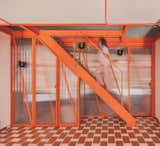
“It was hell,” John says of those two weeks. “But,” Jinhee adds, “it was interesting.” Reworking the triple-decker, they rotated the traditional plan 90 degrees: Rather than encapsulate the three units horizontally, they did it vertically. Each unit is three stories, with its own stairwell. John and Jinhee’s is on the north side, and Andy’s is on the south. Andy’s friends from MIT, Thos and Johanna Niles, inhabit the central unit with their dog, Ajax. Skylights and patios cut into every unit, while several double-height rooms bring in plenty of light and ventilation. The three apartments share the roof deck, which is adorned with whirligigs and a waist-high safety wall, which John painted with a Jorge Pardo–esque striped color scheme.
Avid cooks, Jinhee and John spend part of every day around their custom-built kitchen island, surrounded by Compasso d’Oro barstools. An edamame plant on their patio occasionally provides leaves for Korean dishes.
Inside, the architects found ways to contemporize the space, despite developer limitations. At the baseboards of walls, where modernists tend to want clean corners that triple-decker contractors can’t make, they replaced the usual neocolonial molding with rectilinear milled stock poplar. In the kitchens and bathrooms, they created budget custom cabinets by making special requests from The Home Depot and bringing sketches to Korean furniture makers in Queens, New York. They bought slate in bulk to cover all three apartments’ bathroom floors, patios, and the mud room where Andy cleans his mountain bikes. In that room, and in every bathroom, a spigot is built into the wall, and a drain into the floor, for easy cleaning—a feature Jinhee says is ubiquitous in Korea, where she grew up.
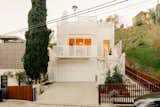
Finished in 2002, the project is clad in western red cedar and copper, which is slowly acquiring a green patina. Named the Valentine House, for its street (which was named for the soap factory), the structure cuts a striking figure in Cambridge. Husam was so pleased that he hired Single Speed for numerous other apartment projects now popping up in the area. Single Speed’s newest renovation is a Husam project—a four-story addition to a 1900s funeral home on Massachusetts Avenue, to be finished this year.
Last year another builder, Paul Pedini, called Single Speed Design after noticing the Valentine House on a neighborhood jog. Paul, who works for Cambridge’s Modern Continental Construction—a national infrastructure contractor—had been supervising much of Boston’s Big Dig. He was dismayed to see heaps of demolished highway materials headed for the landfill, and wanted to try building a house with them. Single Speed is now Paul’s architect, and the Big Dig house, the world’s first ever to be made from highway beams and roadbeds, is slated for completion in 2005.
Surprisingly, John and Jinhee are getting tired of the Valentine House. “It’s hard to live with stuff you designed,” he says. “It’s like having a painting you made hanging over the bed. When you see it every day, you can go nuts thinking about what needs reworking.”
Asked if his dissatisfaction has to do with designing for a developer, he accedes, but he’s quick to acknowledge the great reward came with it: the ground-up house in Boston that gave their career a kick-start.
Advertising
Advertising
Advertising
Latest
-
02.09
An Architecture Guide to Pyongyang
German architect and writer Philipp Meuser realizes that…
-
02.08
Fair Chairs
We continue our coverage of the 2012 Stockholm Furniture and…
-
02.07
Seven from Stockholm Design Week
It's about mid-way through the 2012 Stockholm Design Week and…
Follow
Dwell
-
At the top of the monumental staircase @bsaspace by Howeler+Yoon. Awesome opening tonight @bsaaia! http://t.co/z9cli8TT #design
-
Thanks, @dailytekk, for including @dwell on your list of 100 Best, Most Interesting Blogs & Websites! http://t.co/hbMnDiTO #design
-
Was Mario Manningham's Super Bowl catch a work of #architecture? http://t.co/zxD47gN1
-
“@archpaper: Move over Ice Cube, Moby jams to #architecture, launches new blog about Los Angeles: http://t.co/eVKNB5WK”


Is accessibility a tenet of good design? I don't know. However, let's just pretend that it is. The median home price in the US is between $185,000 and $285,000, depending on the region, as calculated by the National Association of Realtors. http://www.realestateabc.com/outlook/overall.htm. Let's use the high number and you can even add 10%. How about an entire issue devoted to houses that are below that benchmark ($313,500). Let's be fair and account for square footage as well and this time we will deduct 10% from the median. This would leave us with about 2050 which would be $153/sqft. Show me the modern designer who can do this and they will be the one's who lead the design revolution. I love your magazine; but, just one issue which is devoted to that which is accessible to me and millions of others would really be great. Thanks.
Here! Here! I agree with Mr. Corbin Give us something!
well said, Ryan! I've been looking for nice, modern house plans/designs that are around 2000 s.f and affordable to a middle class family and it's practically impossible. One issue! that's all we ask!
I couldn't concur more. The current modus operandi of these articles "sustainability + good design = boutique home=rich people" and which sends a terrible message and alienates a large swathe of regular people who want a house with a reasonalbe square footage and a reasonable price tag. Dwell should lead the charge in publicizing green design for DWELLings, not PALACES.
I echo your sentiments for an issue with homes that are more accessible in price. I love the design that Dwell delivers, but because of the inherent high cost of most of the homes that are featured in the magazine, I'm often reminding myself as I read: "Don't try this at home". Dwell for the people!
wow, this article blithely dismisses the boston triple-decker housing typology with the single word "elementary", which it is anything but. considered not just as a singular stand-alone building, but as a part of a built-up urban fabric, it's quite a complex spatial phenomenon that supports quite well a rich variety of ways of life - from the extended families that lived in them in the past, to groups of college roommates now, and things in between. considered on its own, the triple-decker's design is quite flexible in ways that have absolutely nothing to do with wall baseboards with clean corners.
Nice phrasing, Ryan, I can't help but notice that Dwell has increasingly turned into a modern version of Architectural Digest. Perhaps the tag line should be "People with an unlimited budget can have a really nice house."
please. dwell. get on it.
It does seem as though the earlier days of Dwell focused more on those with budgetary constraints than the issues of the past couple of years. I'd like to see more articles illustrating good, green design done cheap, as well. Please let us have our cake and eat it, too.
It's funny that these blogs have turned into folks venting about things that they don't that much about. Is it possible to do good design on a budget? Yes it is and this house is proof. Please stop looking at these websites if you are going to sit around and be h8ters. Get out and make change.
Well said Ryan. I like Dwell too but it lost it's focus a long time ago
jhost. i live in Boston. There is NO WAY this property is proof of a tight budget. The land itself,even with a knock down would have cost $300.000
A "triple decker" is a kind of sandwich; a "three decker" is a building style in New England.
I hear all the concerns about affordable housing, but know that this house is in a neighborhood that does not represent Boston's median income bracket. The area around MIT is home to a lot of very expensive new buildings...I say see it as the new Harvard Square.
focus on design, people. this house is beautiful and there are unlimited ways to build for less.
RSS Feed
Add a Comment