An Inno-native Approach
Osae-Addo threw himself into designing a home that would come to be a test for—and testimony to—their new life as a couple. With a passion for the contextual modernism of Finland’s Alvar Aalto, Australia’s Glenn Murcutt, and L.A.’s Ray Kappe, he sought to apply their lessons to Ghana, a onetime British colony where unfortunate concrete-block houses made with imported English portland cement have become the urban norm. “Interstitial spaces and landscape are what defines tropical architecture,” he says. “It is not about edifice but rather harnessing the elements—trees, wind, sun, and water—to create harmony, not the perfection that modernism craves so much.”
Unhappy with Accra’s concrete-block houses, the architect was determined to build with the materials found primarily in rural areas: timber and adobe mud blocks. “Adobe mud block doesn’t exist in cities in Ghana, which meant I had to create it,” says Osae-Addo. Furthermore, he didn’t want air-conditioning in a climate where the average temperature can approach 90 degrees, with humidity exceeding 90 percent (an idea that didn’t immediately fly with his soon-to-be wife).
The pair designed their house long-distance: Osae-Addo built models and sketched designs in his L.A. studio and emailed his ideas to his fiancée in London. She would reply with pragmatic considerations. “Initially I didn’t want a corridor between the two rooms [parents’ and child’s bedrooms],” recalls Osae-Addo, “and Sara said, ‘Hell, no, we have to be able to reach the kid.’” (Their son Kwaku was born in 2003.) Asafu-Adjaye remembers her skepticism during the design process: “I knew it would look good, but I didn’t know if it would work.”
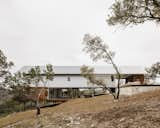
“I wanted to explore ideas of light, cross ventilation, and lightness of structure,” Osae-Addo says of their one-story, 2,500-square-foot house. Arranged in an L-shape, with bedrooms and TV room in one wing and the kitchen and dining areas in the other, the house has a balcony wrapping around it, inspired by both colonial English bungalows and the courtyard plans of rural Ghanaian houses. “There are no internal corridors,” Osae-Addo says, “so rooms extend from one wall to the opposite wall, allowing for free flow of light and air. We are always moving from room to room. It’s a very intimate house.”
The design follows the “no air-conditioning” philosophy by raising the structure three feet off the ground on a wooden deck to take advantage of cooling under-floor breezes. For cross ventilation, the house has sliding slatted-wood screens that neighbors thought were crazy in the damp, hot climate, and floor-to-ceiling jalousie windows. The project was not without its challenges, including, Osae-Addo says, “the limitations of labor, availability of materials, environmental conditions, and being ready to adapt the original design.” He continues, “There was a temptation to give up on the original concept of adobe, because of the difficulty in making it ourselves. We achieved the near impossible of taking a relatively unskilled labor force and inspiring them to think differently and be open to new possibilities.” Though the house is on the grid, solar panels provide backup power for lighting and heating water, and deep timber overhangs provide ample shade.
Construction began in 2003 while the couple was visiting Accra, and was finally completed in the fall of 2004; Osae-Addo, Asafu-Adjaye, and their young son moved into the house just before its completion. Osae-Addo has found so many design opportunities in Ghana that he’s left L.A. behind—but he also brought a slice of California with him. “We moved L.A. straight into this house—from our bed to our sofas to our TVs,” says Osae-Addo. “We have American appliances and equipment, including a complete Bulthaup kitchen that I’d bought while in L.A. and stored in my basement.” They love the juxtaposition of the mud house and Bulthaup kitchen, amusedly pointing out that a new one would cost more than the reasonable $50,000 required for the entire house.
But does it work? Even Asafu-Adjaye says yes, the house stays cool. “Sara had to eat her words,” says Osae-Addo. Shade trees also help, as does the lush garden that has grown on what was once a piece of arid, uninviting land. Asafu-Adjaye now says that the house is “so comfortable and easy to live in, I don’t like to go out.”
Her husband has coined a phrase for his approach to contextual modern architecture: “inno-native,” and it’s an approach he is trying to apply to condo projects and low-cost housing elsewhere across Ghana. “We must lead by example,” he says. With a burgeoning practice in Accra, and a smartly built abode of his own, Osae-Addo has the chance to do just that.
Advertising
Advertising
Advertising
Related Products
-
Alexander Girard Nativity Set
by Alexander GirardInspired by an Alexander Girard illustration…
-
Big Rac Attack by Charles Harper
We owe most of our Charles Harper collection…
-
Desert Limestone
Desert Limestone Caesarstone’s quartz…
Latest
-
02.21
San Francisco's "Forgotten Modernism"
While I was on a scouting trip for a future Dwell Reports…
-
02.19
A Zero-Energy Community: Part 10
Project Manager Brad Liljequist chronicles the building of…
-
02.17
Dwell's Cameo on The Office
For those who missed it, Dwell's December/January…
Follow
Dwell
-
Voting for the @CaesarStone Challenge is live! Cast your vote now for a chance to win an HD Flip Camera http://t.co/ExwpnR0H! #design
-
The Aetherstream hits San Francisco for the next eight weeks http://t.co/TEGDdzWs. Check it out in Hayes Valley #design #Airstream
-
Our zHome blogger explores an interesting #green #design approach: "designing for disassembly"-- & rates their project: http://t.co/c3efJzle
-
One of our favorite finds: Michael Murphy's "Forgotten Modernism" poster series of SF #architecture: http://t.co/UqUj1Ttb #art


This is a Very beautiful house. Everything is in its right place. Nice combination of different elements. Feels serene in there. I'm surprised no one commented here so far. seems that Africa is a very far place for some.
Love the use of the wood..floors , walls.......absolutely beautiful!
Very modern and sustainable design. Adore how natural lighting fills the whole house. How much green area does the house have and mainly on which side of the house?
I am so happy to have stumbled upon dwell mag to find out about an architect building this house in ghana. I visited Ghana years ago and every since I said I am going to move there. When I do move I hope I don't have a hard time getting in touch with this architect to see what I have to do to get one of these houses built. I can't wait.!!!
I really love this home! Given the context, the floor to ceiling windows and wood louvres give ample opportunity for air flow to keep the space cool. The wrap around porch is wonderful as well! I would love to build/live in a house so beautiful!
Very nice I like how the wood is used on the walls . I think it gives the house a very clean look and also a natural feeling .
THE WOOD FINISHING IS SIMPLE AND BEAUTIFUL
Great, beautiful and wonderful simple house. Trying to contact Joe Osae-Addo. Yes, we can!
As an African construction professional and soon-to-be exporter of green building products in West Africa, I am very pleased to find out that some houses are being built in West Africa with a Green design (also qualified as LEED certified). I will like to find out more information in regards to the energy efficiency of this house along with its usage in terms of water, electricity. Thank you for pictures, they were really beautiful. El H. Beye Performance Consultants
Good work done...great, nice and natural house...wood was really used well....and its a simple house too
i can't believe my eyes. is this ghana my home country??? this tells me my dream can also come true. thank you so much. this is an inspiration. i hope to contact u sooner than later as i'd need help in making and building my eco green house. thanks again.
One of the greatest showers I have ever seen.
Impressive that the architect was able to achieve such beauty whilst making a nod towards sustainability
RSS Feed
Add a Comment