Z for Two
In Portland, Oregon, two adjoining six-story homes on a formerly run-down urban lot add to the neighborhood’s density and its green cred.
From backyard chicken coops and homegrown rainwater harvesting to energy-efficient building codes and sod roofs sprouting wind turbines, Portland, Oregon, wears its sustainability street cred proudly. But as much as locals are happy to get innovatively earth-friendly, they’re often stuck in the architectural past, clinging tightly to Douglas fir roots and craftsman moldings. Portland-based architect Ben Waechter and his wife, Realtor Daria Crymes, set out to show that well-integrated modern design is as much a part of sustainable community building as are the latest, greatest green products. To prove it, they designed and built the Z-Haus.
After putting in time at renowned architecture offices Allied Works, in Portland, and Renzo Piano Building Workshop, in Genoa, Italy, Waechter started his own practice, Atelier Waechter, in 2008. The couple had returned from Europe, where “they have nicely designed, energy-efficient buildings as a matter of course,” says Crymes, whose input was instrumental to the Z-Haus’s design. “They don’t feel the need to go around on green house tours.”
“We drag chairs out there in the summer, hang out, and watch the kids ride their bikes around,” says Crymes. “It’s like a front porch.”
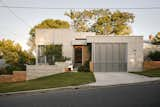
Waechter’s design similarly favors a neighborly approach to architecture. Sandwiched between two traditional foursquare-style Portland homes, the Z-Haus imitates their boxy feel, plus both front and back facades line up perfectly with the houses on either side “so we can look through our backyard to the neighbors’ yards,” says Waechter, which maximizes everyone’s sense of space. The natural wood siding was also chosen to match nearby houses, though those are mostly painted sprightly blues and greens and basic beiges rather than a very dark brown. A rainscreen system that separates the siding from the building lets air circulate, keeping out mold in the perpetually damp climate.
Since it’s a large lot, Waechter had the option of building two separate homes on the property. Instead, he decided on two attached houses with a common middle wall. Aside from imparting a sense of greater sociability, the joint wall has many green benefits, from decreasing the overall footprint of the project to reducing stormwater runoff with its smaller roof to an increase of 25 percent in energy efficiency by having to insulate only three exterior walls per house rather than four each. A small air pocket buffers the shared wall between the two homes from noises made in either house, making good neighbors better ones when they can’t hear each other.
Daughter Zoë finds a cozy spot at the dining-room table, by Dux, seated on an Eames Molded Plastic chair and under a George Nelson Saucer lamp.
The remaining spaces are contained in what Waechter calls each home’s “core,” a series of small rooms stacked in the center. It’s here where a visitor would look for the two and a half bathrooms, get a glass of water in the kitchen, or do a load of laundry. Having all of the water, ventilation, and mechanical systems in a central column allows for everything to vent through a few openings in the roof and lets the rest of each house remain a continuous open space.
To maintain a seamless feeling throughout the interiors, Waechter kept the material palette simple. A sustainably harvested white oak floor slides through each house and ribbons its way up the stairwell. All of the walls are painted white, and most of the windows are the same size. Each home is a blank canvas for personality to be imbued by the homeowners inside and the landscape outside. “We just wanted to make a functional container, like a gallery space,” says Waechter. “The art is the people living here, their furnishings, and the views.”
As a result, the houses feel serene and coolly minimal. There are neither predetermined bedrooms nor living rooms; any room can be used for any purpose. There’s a lack of doors everywhere but in the bathrooms, although sliding walls create privacy when desired, and there are no closets (“because then there is less flexibility,” Waechter points out). The generic quality of the rooms also “emphasizes the views,” he says. “As you’re moving up through the houses, what’s inside is staying the same, so your view of the street or downtown or Mt. Hood
is heightened.”
With white walls, rooms take on the characteristics of their inhabitants, such as in Zoë and Ari’s bedroom with its Ikea shelves of toys, books, and trinkets.
Though some Portland denizens are still a bit confused by the idea of integrated sustainability—–“a few people have said they don’t really understand what’s green here, since we don’t have solar panels or a geothermal heat pump,” says Crymes—–the response has been overwhelmingly positive. One of the two attached houses sold to commercial photographer, Marv Johnson, who moved in with his two sons and raves about the flexible space, ample natural light, easy access to shopping, and “surprisingly nice electrical bills.”
As for the other half of the Z-Haus? On a blistering 107-degree day last summer, Waechter and Crymes moved in with their two young children, Zoë and Ari, relocating from a 1955 suburban-development home. “We were sort of designing it for ourselves anyway,” Waechter says with a laugh. Crymes chimes in, “It’s more urban here. Our veterinarian is located two blocks one way, our doctor is two blocks away in another direction, we can walk or ride our bikes to parks in the summer. It’s a more interactive-with-our-community place to live.
It’s more us.”
Advertising
Advertising
Advertising
Latest
-
05.20
ICFF 2012: New from Black + Blum
Two products we really loved from the ICFF show floor came…
-
05.18
ICFF 2012: Axor Bouroullec Line
Today, bathroom fixtures brand Axor celebrated its North…
-
05.18
Friday Finds 05.18.12
Wrap up the week with our roundup of architecture, art, and…
Follow
Dwell
Reloading tweets…


I see the architects imported the high efficiency double paned windows that are so common through out northern Europe. After living with these wonderful dual axis windows for three years in Germany I am happy to see someone being sensible and importing them for US use. I wonder who the architects imported through as I'd love to install these windows on my home here in Virginia.
Hey, Emperor Nude alert! Have you noticed that this is an enormous black cube dropped like some 2001 totem in the middle of a traditional neighborhood? Windows placed with no consciousness of where the sun is; no place to meet the neighbors (they drag chairs onto the DRIVEWAY?), completely stark and cold design. Sorry but this cheap and easy box is not a design at all but a throw-back, a no brainer, and not stylish but forbidding. This is not architecture, it's not sensitive to the community, it's too big for the lot and the surrounding structures. I bet the neighborhood fought it, and that's no badge of honor for the guy who built it.
As an east-coast native I find it funny that by portland standards a suburban duplex with a garage door as an entrance is considered density-bearing and "urban."
"The structure holds itself trimly in place rather than sprawling to the edges of its lot..." Is this referring to the 3 feet on either side? I like modern architecture, but context is far more important. My sympathies to the rest of the neighborhood.
Wow - an incredibly inhospitable neighbor that is heralded as good design. Not so fast. And not so good either.
Beautiful house !Good design!I like the color of the house!
at least it looks better from the inside than the outside...
Craftman moldings have more character then this. "Waechter’s design similarly favors a neighborly approach to architecture. Sandwiched between two traditional foursquare-style Portland homes, the Z-Haus imitates their boxy feel, plus both front and back facades line up perfectly with the houses on either side “so we can look through our backyard to the neighbors’ yards,” says Waechter, which maximizes everyone’s sense of space." They are so thoughtful. I'm glad I am miles away from that monstrosity. I will enjoy my home that is stuck in the past.
I love the window layout! In fact, my wife Shelley and I are currently building a modern, passive solar home for ourselves. (I will submit pictures and facts later.) However, we were so impressed with the window layout we utilized the same approach for our attic windows. Again, I love it!
RSS Feed
Add a Comment