The Lowest Utility Bill on the Block
Hybridization is hit or miss (i.e., the jackalope). But this Houston home combines two housing types to create a conscientious alternative.
Even before the words begin to form sentences, when you talk to Brett Zamore about Houston and architecture you understand it’s going to be an intense conversation. He speaks with the kind of fervor normally reserved for topics like politics, the reason for which soon becomes clear: According to Zamore, Houston’s politics are dom-inated by huge developers operating in a new kind of sprawling, zoning-restriction-free Wild West. As the conversation continues, you cast Zamore in the role of Wyatt Earp—he’s quietly taking a stand.
“You’ll be in a neighborhood and it can change in a blink of an eye,” Zamore says somewhat excitedly. “Over the past ten years the city has been devoured.” A decade ago, Zamore was a graduate student at Rice University, where instead of playing mind games with paper architecture, he renovated a shotgun house in Houston’s Fifth Ward district, giving the house and the neighborhood a much-needed face-lift.
At the time, David Kaplan, now a business reporter for the Houston Chronicle, befriended Zamore while writing about the project for a Rice publication. A few years later, Kaplan was ready to find a place of his own. Instead of settling for one of the thousands of developer homes that have altered the Houston landscape like a nonindigenous parasite, Kaplan, still fond of the shotgun, rang up Zamore. The pair looked at possible fixer-uppers in Eastwood, an old residential and industrial neighborhood close to downtown that had yet to be clear-cut by developers. Zamore soon had a different idea: to build something from the ground up.
For the young designer, this didn’t mean dreaming in computer-molded blobs and subjecting the neighbors to a vision of Houston 2040; rather, Zamore conjured the area’s architectural past. Unlike the Wal-Mart mentality of developers (who’ll sell the same thing from Minnesota to Mississippi, regardless of practicality), Zamore based his design on a fusion of the hot and humid South’s most successful housing types: the shotgun and the dogtrot.
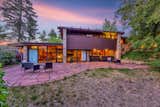
Sitting on two long and narrow lots, the Shot-Trot, as it is now known, borrows its 16-by-80-foot footprint from the shotgun. At the building’s center two large barn doors slide open on rails, creating a central breezeway—like a dogtrot. This was a pertinent exercise in historical reenactment. “Old homes were designed to have air flow through them and cool themselves off as best as possible,” Zamore states. “It’s like a self-mechanized air-conditioning unit.”
Like its neighbors, the Shot-Trot sits 30 inches off the ground on a framework of beams and drilled piers, which, according to Zamore, is both “critical for the success of air movement in the house” and better protects the home from floods and their aftereffect, mold (both of which plagued the city after Tropical Storm Allison in 2001). The Hardiplank exterior clad-ding was accordingly chosen for its resistance to humidity and termites. As a further measure, the walls of the house are designed to allow airflow from the base to the eaves by maintaining a gap between insulation materials.
By envisioning the Shot-Trot as a kit of parts, Zamore was able to scale back on construction costs and minimize waste of time and materials. He based the house on an eight-foot grid that accommodates standard-sized wood members, such as the four-by-eight sheets of plywood used in the decking throughout. Installation for these and much of the framing required little more than a nail gun, eliminating cumbersome onsite cutting. Materials were further consolidated, and precious time saved, by using prefabricated elements from local sources. Wooden trusses for the roof were constructed offsite by All Pan Inc., and installed in less than a day. The Galvalume roof, chosen over asphalt tiles for its longevity and ability to deflect heat, was ordered to size, and set in place shortly thereafter. One of the home’s most luxurious elements, old-growth pine and red oak flooring, was salvaged from local tear-downs. (While demolished homes are common in Houston, according to Zamore, salvaging, unfortunately, is not.) In the end, the Shot-Trot modestly priced out to slightly less than $100 per square foot.
While Zamore is further developing the kit of parts into a full-fledged prefabricated Shot-Trot, Kaplan and his dog Bella are happily moved in, and are enjoying a home that befits the neighborhood and has the lowest utility bills on the block, if not the city.
Advertising
Advertising
Advertising
Latest
-
02.09
An Architecture Guide to Pyongyang
German architect and writer Philipp Meuser realizes that…
-
02.08
Fair Chairs
We continue our coverage of the 2012 Stockholm Furniture and…
-
02.07
Seven from Stockholm Design Week
It's about mid-way through the 2012 Stockholm Design Week and…
Follow
Dwell
-
At the top of the monumental staircase @bsaspace by Howeler+Yoon. Awesome opening tonight @bsaaia! http://t.co/z9cli8TT #design
-
Thanks, @dailytekk, for including @dwell on your list of 100 Best, Most Interesting Blogs & Websites! http://t.co/hbMnDiTO #design
-
Was Mario Manningham's Super Bowl catch a work of #architecture? http://t.co/zxD47gN1
-
“@archpaper: Move over Ice Cube, Moby jams to #architecture, launches new blog about Los Angeles: http://t.co/eVKNB5WK”


this is an awesome idea!!
you know, on the web you have plenty of room to post more pictures.
I agree with Ron.
Again, nice pics, but no floor plan. Ray
The open doors are nice but highly impractical... imagine 100 degree temps with humidity to match.. I just don't believe that "self mechanized air conditioning" equates to desirable cooler temps indoors... also "au natural" is fun but there has to be a way to keep the flies and bugs out.....
Check out website for the foorplan and more pics...just go to the kit homes website. www.zamorehomes.com The plan is KIT_02: http://www.zamorehomes.com/kit_02.html You can also see the project at www.brettzamoredesign.com http://www.brettzamoredesign.com/project_2.html The house does have a mechanical unit - a very efficient one and also industrial ceiling fans to move the air. The doors are opened on the beautiful days..about 1/2 the year. The other 1/2 of the year requires AC. There was an option to have screens but the client did not want that...does not like them.
These open plan/outdoor designs are great! But most of the country lives in a climate that required protection from the outdoor environment. Can modern designs be presented that reflect the other 75% of the world climate?
I think the feasibility of these houses in most moderate climates is real. I know in California that most of these designs would be perfect.
i had the privilege of seeing this home and meeting mr. kaplan this month during the eastwood civic association home tour, a neighborhood southeast of houston's central business district. the home is comfortable and inviting. i could see myself living in such a home; however, it would require renting a storage unit or discarding much of what i own (i prefer the latter option). i was impressed that kaplan has no television mounted over the fireplace, although it would seem a perfect fit. a tv would be obtrusive and dominate the space. a small tv is in the bedroom. the dvd of "my architect" laying near the television let me know kaplan is a kindred spirit. the article describes the house well, but to experience the space solidified everything i had hoped the house would be. well done mr. zamore.
RSS Feed
Add a Comment