New Grass Roots
When they want to escape the mayhem of city life in Chicago, Diane Pascal and Thomas Richie retreat to their low-profile getaway in Hennepin, Illinois, a town where agriculture and ecology are still a part of the locals’ common knowledge.
Diane Pascal and Thomas Richie don’t quite blend in. When they venture to the farmers’ market from their weekend home in Hennepin, Illinois, vendors often ask where they’re from. “There aren’t a lot of Volvo station wagons around here,” says Pascal. Unlike most weekend visitors to the area, they’re not recreational hunters, and they don’t ride ATVs out to visit their neighbors.
But Hennepin, a small Illinois River town about 100 miles southwest of Chicago with a population of 707, is exactly the sort of place Pascal and her husband were searching for in 2004, when they began scouting a spot to build. Spurning trendy summer outposts like the Lake Michigan shores, they chose Hennepin, where you’re more likely to pass a coal plant worker on the street than a vacationing CEO.
Richie, a freelance advertising creative director, and Pascal, the development officer for an organiza-tion serving homeless people, maintain a sense of humor about their city-slickerdom. They are determined to learn about the environment they’ve adopted, from the lovely purple flowers blooming in their prairie backyard (Pascal wishes she knew the name) to the tall, kelly green crops grown by their farmer neighbors (Richie thinks it’s switchgrass, but he’s not sure). “I wonder if people moving from country to city feel as clueless as I do,” Pascal jokes.
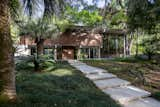
Back-to-the-land hippies they’re not: X House is filled with the trappings of a modern metropolitan existence—a red retro kitchen clock, a Fireorb in the living room, concrete bedroom floors. Inside and out, though, the home manages to disappear into the rural landscape, thanks to considered treatment of the building’s proportions.
The wooden doors in the living room practically vanish when closed. Sliding them open reveals modern bedroom suites in a lighter, brighter palette.
Designed to fit the owners’ tight budget and concerns about their ecological footprint, the house is just 1,600 square feet, but it feels much larger. The home is situated on 14 acres of Midwestern prairie and woodland, where the ambient noise sounds like a new-age relaxation CD: chirping birds, light wind, buzzing insects, and a babbling creek. So it’s ironic that Pascal and Richie chose UrbanLab, the boutique firm founded by husband-and-wife duo Martin Felsen and Sarah Dunn, to design their place. Felsen and Dunn, both professors of architecture, are widely regarded as two of Chicago’s hottest young designers for a body of work located primarily within the bounds of the city. Indeed, Felsen admits he’d probably buy a place in the Sears Tower before he’d build a house for himself in the country.
That urban-rural tension, however, was crucial to innovations that helped position the design between classic and cutting-edge. Though Dunn led the project, it was a collaboration: She and Richie were the dreamers, suggesting ideas far out of their price range; Felsen and Pascal were the realists, steering their spouses toward what made fiscal and logistical sense. The architects spent months creating prototypes. “They would’ve kept designing indefinitely if we hadn’t stopped them,” says Pascal.
Dunn’s final concept placed the house on the boundary between two natural territories, in a sort of “X marks the spot” configuration. The central living space is located at the intersection point of the X, which resembles a pair of funnel cones placed end to end. The walls spread out to create panoramic views of woodlands to the south and prairie to the north, like a pair of frameless landscape paintings. Knotty pine, chosen for its graphic quality, covers the room from floor to ceiling, with the orientation of the slats modeled on the property’s topographic lines. It lends the space the feeling of a roomy sauna, though substantial airflow keeps it cool.
To the east and west, camouflaged behind sliding wooden doors, are what Dunn calls the “quiet zones.” The master bedroom and bathroom sit on one side of the house, while a guest wing, which comprises a bedroom and bathroom, plus a small office/living area, occupies the other. These zones are radically different from the main room, resembling modern urban apartments.
The rear of the main room features floor-to-ceiling glass panels that frame a view of a shortgrass prairie and the woods behind the house. A suspended Fireorb echoes the vertical line of the trees.
The kitchen is open, simple, and small. It’s mostly functional, with a few clever touches, such as an extra-tall stainless steel backsplash and a random polka-dot arrangement of compact fluorescent lamp bulbs on the ceiling.
Elsewhere, Pascal and Richie opted for custom creations: When they couldn’t find light fixtures they liked for the living room, Felsen, whose father owned a lighting company, designed overhead lights that evoke a computer circuit board. A metalsmith fabricated the steel, and then Felsen and UrbanLab staffer Lee Greenberg wired them. To limit costs, Richie scoured the Internet and Chicago boutiques for original fixtures and furniture, such as the Keuco-made clean-white-block bathroom vanities. The walls are filled with photographs and faux-advertisement prints by Richie and other friends.
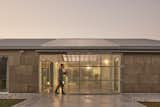
Richie feared that this modern house on the prairie might eventually find itself outdated. From the road, though, the corrugated-aluminum structure doesn’t seem out of place. It’s reminiscent of the farm buildings that dot the landscape. When the couple moved in, the movers drove past the home twice, stopping only after Pascal flagged them down.
In the kitchen, compact fluorescent lightbulbs affixed to the ceiling are a simple solution.
But the natural and full-grown state of the surrounding land is intentional. Pascal and Richie have been managing their acreage primarily on their own based on the overall outdoor plan devised by UrbanLab and landscape architect Chandra Goldsmith. The couple, who admit little prior knowledge of country living, are learning as they go. A Putnam County High School teacher brings kids from FFA (an agricultural education organization founded as Future Farmers of America) to get some hands-on science education by maintaining 1.5 acres that have been restored into a natural prairie habitat. They worked with a forester to develop a land management plan for 12 acres of forest, placing it under the Federal Conservation Reserve Program.
Now that they’ve become familiar with their new habitat, Pascal and Richie can’t help but resist the prospect of other buyers following them out to Hennepin. Richie’s native Acworth, Georgia, a once-rural Atlanta suburb where cows sometimes roamed into his yard, lost its small-town feel when that metropolitan area exploded. Already, Chicago’s sprawl has gobbled up the towns halfway down the highway to Hennepin. Though the couple knows that increased foot traffic would benefit local business, they nevertheless hope that other city dwellers will be slow to discover the town they treasure as their own little secret. “I feel selfish when I say it,” Richie says, “but I don’t want anything to change.”
To see more images, please visit the slideshow.
Advertising
Advertising
Advertising
Latest
-
02.03
Friday Finds 02.03.12
It's a balmy Friday here at Dwell's San Francisco office, and…
-
02.03
David Stark Pop-Up Shop
New York designer David Stark is the ne plus ultra of event…
-
02.03
Test Kitchen Before-and-After
In our February 2012 issue we featured the new experimental…
Follow
Dwell
-
Sofia Coppola has a nice loft for sale in Little Italy, but how 'bout those bentwood Breuer chairs? http://t.co/w4OdmvgZ #design #hubbahubba
-
Huge crowd at the sf #design center for @dwellprez and @dianabudds talking social media.
-
Getting ready for the social media and #design panel at SFDC http://t.co/gnBp543c
-
The new anteak line from @walkerzanger looks pretty good. #Design #tile


This is very cool but why have I seen the new Dwell at the airport newsstand before I get it at home? What's the advantage of subscribing?
Where did you get those ceiling lights in image #3? They're beautiful. Never seen them before.
One benefit to a subscription is that often the subscriber's rate is offered at a discount. Dwell's cover price is $6 in the store. On the site it looks like you can get 10 issues for $20.
MG, those ceiling lights were custom designed by Urban Lab, http://www.urbanlab.com, the firm that designed the house. I agree: They're beautiful!
Love the circuit board lights as well! Would anyone happen to know the Brand/Model of the shower head and arm? I just happen to be shopping for a new one right now and like the look of it.
The shower head is by Kohler.
Thanks for the tip on the showerhead. It seems very similar to this one (although maybe not identical): http://www.us.kohler.com/onlinecatalog/detail.jsp?from=thumb&frm=null&module=Showerheads&item=9660802&prod_num=14418§ion=2&category=12&resultPage=0--331009437
Any more info on the sliding door tracks?
I like the corrugated-aluminum used on the exterior. We have an off-the-grid home where the perimeter walls are straw bale covered with stucco. The colour coat of the stucco is peeling off in many places on the south-facing wall. Patching and matching colour coats is near impossible. Can anyone tell me if we could "encase" our straw house with corrugated-aluminum; this looks so clean and simple.
What a clever coffee table (pic 13) where the legs double as magazine racks!
Clicking thru the images, by around no. 20 I was thinking, Hey, no Rent-a-Mutt (this time). Then I came to pic 22!! But was relieved to read 'THEIR dog'. ;o) Love this place, all the sliding doors, and the perforated corrugated iron is stunning. How is that done?
I loved the kitchen's ceiling Fluorescent lights! I am going through excruciating pain dealing with California's Title 24 in my kitchen! That kitchen was genius for the inspector! Please cover more Title 24 solutions (good looking, feeling and not so expensive), my lighting store is just getting used to having Title 24 consultant on hand as it is the Future and since CA is the early adaptor...it's going to be something everything will have to consider~ being green.
I can't find that sofa on the ligne roset site. Is it out of production? Anyone know what its name is?
Per the resident, and our uber-helpful Assistant Managing Editor, Fida: It's the Sake Sofa by Pascal Mourgue for Ligne Roset. Apparently they bought it in 2007 at the Chicago Ligne Roset, but they were told at the time that theirs was among the last orders Ligne Roset was taking for that particular piece.
The advantage is the reduce cost per issue, and it has your name on it in case a friend our neighbor tries to steal your copy. ;-) I get my issue before I see them hit the shelf at my local mag stand.
I'm online reading this month's issue because I haven't received mine in the mail yet, either. Anticlimactic when it finally does arrive. I hope it's before November...
What is the green kitchen counter top made of? Where can I get one.
Could you provide some more information about the sliding door track and door hardware. Thank you in advance.
Are the stick-like wall hooks available in retail-land anywhere? I know I could attempt to make them myself, but...y'know..... Many thanks
To answer some of your questions- The countertop is stainless steel and is fabricated by Elkay, the sliding door hardware is from Hafele, and the stick wall hooks were made by Timber, and can be found here: http://livewirefarm.com/t_hooks_1.html Thanks to the homeowner Diane for her input!
Does anyone know how much was spent on this?
i live in Hennepin....actually my whole life and love it....you know we try to keep it a secret....
The idea that people building a second home are worried about the ecological footprint is ridiculous. Furthermore, just 1600 square feet is the barely less than the average american home.
Just wanted to say how much I absolutely love, and have drooled over this couch and chair ( sake by ligne roset ) I am devastated that we are not able to purchase any longer, and would like to see them bring it back into circulation. For now I have the magazine article, and I guess I had better laminate it... ( drooling, lol...)
LOVE the lights, but if the design company did the whole house, is there no way to find out how to reproduce the lights without getting the whole house done? I was in nyc this last week, and went to myleno or something at gramercy park hotel and they've got the same thing going....great work.....any chance i can do it in my home? help? thank you!!!
The corrugated cladding is generally screwed into battens so it is a matter of fixing battens to the straw wall securely, not sure if this can be done. Also running this cladding on a horizontal looks smart.
I am interested in more information re: perforated material used in bathroom. bedroom, etc. Thank you.
The perforated shutters are fabricated from flat aluminum that was perforated then corrugated to fit the window openings.
I'm interested in the shower walls. Is that tile or some other product? If it's tile, who's is it? Thanks.
Is this by any chance a container home?
RSS Feed
Add a Comment