Low-Tech Utopia
People who live in glass houses shouldn't throw stones, which probably isn't an issue when the glass house is a commune.
A greenhouse is generally considered to be a house for plants. But for Tokyo-based architect Hiroshi Iguchi, a greenhouse can be a very pleasant home for people, too, and he has built several such projects to prove his point.
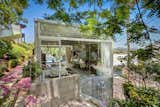
Iguchi’s latest glass development is a utopian experiment called Millennium City. On a plot of open farmland in Chiba, a two-hour drive from Tokyo, four giant greenhouses comprise an environmentally friendly commune. This eco glass village is the product of several workshops that Iguchi organized in order to come up with an innovative solution to Japan’s housing situation, which is highly polluting and socially isolating. “Millennium City allows people to live closely together, yet in privacy, and enables them to enjoy a lifestyle in harmony with nature,” Iguchi explains.
Small wooden pavilions in each of the four greenhouses function as living areas. Each features an enclosed room elevated on stilts, not unlike a tree house, with a ladder leading up to the entrance. Underneath, the open platform appears to float just above the earthen floor. There are no formal designations for these spaces; it’s left to the user to decide how to use them, from sleeping in the elevated hut to reading, relaxing, gardening, or entertaining below. A communal kitchen is built into one of the greenhouses, and a separate pavilion accommodates the shared toilet and bathing facilities.
Iguchi’s dedication to environmental conservation and an earth-conscious lifestyle is further evident in the commune’s source of power: Supplementing the electricity supply, the greenhouses use solar energy for lighting and heating. Trees help monitor the interior temperatures of living areas (see sidebar), and solar panels made from plastic bottles provide heat for the water, ensuring that residents don’t have to suffer through cold showers.
In order to bring his somewhat offbeat community to completion, Iguchi established a nonprofit organization to corral others into helping develop Millennium City. This not only created a community of like-minded people, but also helped keep costs low. The land for the project was secured as a 20-year lease through a volunteer who also happened to be the president of the Japanese Agricultural Association. Other aspects of the buildings were secured through similar means: “Through the personal connections of our members,” Iguchi elaborates, “many materials were donated or supplied at low cost. The trees were a gift, as well as all the kitchen furniture, the bathroom fixtures, and many other amenities.” Though the glass houses were built by a greenhouse manufacturer, volunteers built the wooden pavilions, thus significantly reducing the total building costs for the project. As a result, the entire complex was completed for about $470,000.
Millennium City is structured on the assumption that the pavilions will be rented out for either temporary or long-term accommodation. With rents at about $50 per month, the pavilions offer an affordable seasonal getaway or reasonable year-round lodging in the inflated Japanese real estate market. “I can imagine a family with children moving into Millennium City. The father can commute to Tokyo for work and have something peaceful to look forward to when he comes home in the evening,” says Iguchi. But the glass village assumes a community function as well. There is an art school, for example, where tea ceremony, flower arranging, and painting classes are held. A variety of classes on ecological agriculture and exchanges with agriculture students are also planned.
There are other environmentally friendly benefits of the glass village, as Iguchi explains: ”The fact that this one place facilitates so many different functions is in itself already ecological. The huts can always be recycled or reused, either by dismantling and reassembling them in a new location, or just by moving them intact.” Iguchi emphasizes that to save energy, he avoided using high-tech instruments whenever possible. It’s cheaper to do it the old-fashioned way, both by reducing to a minimum the space that requires heating and by adapting one’s daily routine to the outside light and temperature. As Iguchi says with a laugh, “Our ancestors actually lived a very environmentally friendly life.”
Advertising
Advertising
Advertising
Related Products
-
Nursery Glasses
Nursery rhyme all-stars bring their stories to…
-
Low Chair
by Jasper MorrisonInspiration is unpredictable: Thankfully, the…
-
Tech Turntable
Enjoy the smooth sound of vintage vinyl from…
Latest
-
02.05
The Scandic Grand Central, Stockholm
Greetings from Sweden! I'm traveling in Stockholm to cover the…
-
02.06
Bedrock Images's Forgotten Maps
For the architecturally inclined—especially those with a…
-
02.04
Street Furniture Your City Wishes it Had
Street furniture already catches the eye of denizens eyeing a…
Follow
Dwell
-
Each issue look out for the Take Me Home giveaway. Enter now to win the @gusmodern Timber Table from March http://t.co/9rSrie9X! #design
-
Form Us With Friends opening #design http://t.co/qeHXIRzb
-
Form Us With Friends pendants for #Design House Stockholm http://t.co/QwG8iRIW
-
Slab Vases by Form Us With Friends for Cosentino #design http://t.co/7dzi7X6F


I am so happy to see this idea be done. I'd love to see some pictures.
Precisely what's on my drawings for my own house and greenhouse; It is the deconstruction of the wall to the in-between; a case study of two thermal/activity zones coined as the cocoon-house. One would retreat into the inner sanctum with di-urnal temperature distribution management I would like to know if they have data on the thermal performance in the two zones. Perhaps this project did not go this far?
Very interesting to see that Japan also has his first greenhouses for people. In Holland Building with green and light as we called it, is now a program run by the Foundation Living Daylights for the next three years. The Floriade building by Jon Kristinsson will be the first with the revolutionary energy system to harvest heat in summer (by cooling) and using the heat in winter from an aquifer in the ground. We had the sccesfull Dutch book translated, it can be ordered from www.kiplant.com or from www.bol.com, it contains the benefits of plants for people, new energy techniques, the benefits of daylight and examples of projects in four types: schools, offices, care buildings and homes.
RSS Feed
Add a Comment