A Rational Approach
Typography guru Erik Spiekermann and his wife, designer Susanna Dulkinys, hate
clutter. That’s why they love the supersleek Berlin domicile they constructed to have
just the right lines—and a host of energy-saving features behind the scenes.
Erik Spiekermann, master typographer, is responsible for everything from the German National Railways’ iconic “DB” insignia to the typefaces used by Volkswagen, Nokia, and Audi; the entire 2001 redesign of the Economist; and a generation of designers’ ideas about type. One of his latest projects, however, involved creating something else altogether: a brand-new, environmentally conscious town house on an empty lot in Berlin.
When asked, the German-born “Father of Fonts” insists that there is nothing similar about designing a typeface and designing a house. “They’re totally different,” he says, in excellent English peppered with correctly implemented expletives. “With a typeface, you design a space. A letter is defined by the inside space, more than it is by the outside. You design for shape, but also for function.”
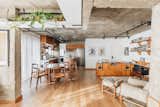
Next to the kitchen, Eames and Jacobsen chairs welcome dinner guests to the dining-room table. The back wall is covered in particleboard panels.
On his iPhone, Spiekermann pulls up a photo of their seven-story Berlin house, which was completed in 2007 with Christa Fischer of C. Fischer Innenarchitekten. Faced with a bevy of traditional choices, the home’s opaque glass facade (which lets in light and, in the winter, ample heat) has a flat, rectangular face. Sectioned off by a grid of lines that indicate the height of each level, as well as the location of the staircase, and punctuated by windows, the facade has a highly graphic quality. Particularly when seen in this two-dimensional format, it looks—well, it looks like a piece of paper.
I wonder aloud, Could Spiekermann read this facade like a page? He gives me a doleful look. “Well,” he says, “I suppose I could.” Yes, he admits, he did apply the same “rational grid” principle to building the house that he does to building a page, identifying a smallest unit (here, 45 by 45 centimeters) as the basic building block for everything else. (In the house, it applies to room size and wall heights; on a page, line spacing and caption placements.) Then he gets into the analogy, even if it wasn’t his explicit design approach, declaring that on the right-hand side of the building, where the stairwell is, “the marginal column is the staircase—for captions.” He points to the street-level entryway: “The headline, in this case, is the entrance. Because you enter a home from the bottom, that’s where you enter the ‘page.’”
The stainless steel Bulthaup kitchen “cost as much as a small house,” said Spiekermann, though he did get a discount: Bulthaup is one of his clients.
The reasoning behind this message is practical, aesthetic, and cultural. The lot is deep and narrow—something Spiekermann compares to having to work within the constraints of a certain page size. (“I hate A4 pages,” he says. “But you can’t just say, ‘Okay, I’m not going to work in [that] size.’”) But he still wanted to allow plenty of light into the building, hence the glass facade.
Directly across the street is an East German high-rise complex—a plattenbau, or prefabricated concrete apartment house. Now universally pooh-poohed, the plattenbauten were originally built for relatively privileged East Germans. “It’s not a nice view,” says Spiekermann, perhaps not entirely facetiously adding that in his opinion his neighbors are former members of the East German secret police. “They’re all these old Stasi guys who are still pissed off that we came and took their republic away,” he says, noting that his home has the added benefit of filtering out some of the local style as well as the summertime heat. “They all have these lacy curtains, really German. I say hello, and they don’t say hello back.”
Dulkinys uses the remote-controlled mountaineer’s harness to peruse the two-story bookshelf.
Inside, the house has a strikingly modern look. “There’s no lace in our house,” says Dulkinys. “Except in my underwear drawer.” Throughout, materials are left in their raw form, starting with the panels of spaghetti insulation on the walls and ceiling of the ground-floor lobby. Just outside the lobby is a drive-through for Spiekermann’s Audi: The garage space is just beyond the lobby’s back wall, which turns out, James Bond–style, to actually be a door.
Raw concrete balconies face the inner courtyard at each level. The second and third floors are rented out as office space; here, as elsewhere, raw particleboard softens some of the concrete walls and floors. The stairwell, too, is concrete—though, to Spiekermann’s chagrin, it had to be painted in places because of substandard onsite pouring work. A small Niki de Saint Phalle statue in the bright, airy stairwell signals the start of the private living space on the fourth floor, which houses the laundry–computer server–printing press room.
On the fifth floor, Spiekermann and Dulkinys have their home office, while the sixth floor is devoted to the kitchen and living area. Only the seventh-floor bedroom, with a small front terrace hidden from the street by the opaque glass exterior, has a black slate floor. All painted surfaces are a single shade of light gray.
The bedroom and bathroom make up the private zones on the top floor.
All the townhouses in the development must meet the strict energy regulations imposed on new buildings. But Spiekermann, Dulkinys, and Fischer took going green to the next level, implementing state-of-the-art technologies throughout the building. The facade itself serves a dual function as one of the building’s heating and cooling elements: Made by a Swiss start-up company called GlassX, the glass incorporates a prismatic element that allows warmth from the sun to pass through only when the sun hits at a low angle (as it does in the winter). In the summer, the prism inside the glass blocks the sun’s radiation, keeping the space cool.
Just outside the lobby is a drive-through for Spiekermann’s Audi.
In the summer, when a glass house could get too hot (even in Berlin), the concrete walls and floor retain nighttime coolness. A natural ventilation system uses the stairwell as a chimney, and a series of hand-operated bottom-hung windows ensures that plenty of cool air will circulate at night. “They use no gas to heat,” Fischer says, though they still buy electricity to run the pumps, but even some of that comes from the solar panels on the roof.
The interior is bright and charming, cool but not cold. Each floor is open, with an unencumbered view from the glass facade in front to the glass doors in back, which makes the rooms feel much larger than they are. Standing on the top back terrace provides a wide-angle peek at Berlin’s history, with glimpses of the Fernsehturm (television tower); a Schinkel church destroyed in World War II then rebuilt by the German Democratic Republic; and the Federal Foreign Office, a section of which occupies the former Reichsbank, a massive structure constructed under the National Socialists. (As Spiekermann puts it, “We live behind that big Nazi building.”)
Reflecting on how their facade compares with the surrounding town houses built in a variety of styles in the new development, Spiekermann and Dulkinys agree that their house—the first they’ve built from the ground up—is definitely different.
“It’s very modern,” says Dulkinys.
“The other houses are prettier,” Spiekermann counters.
“Ours is a table of contents.”
“All the others are covers.”
“Ours is an overview.”
“Where you know where everything is.”
“The table of contents is my favorite page.”
“Me too, actually. A good one is functional, but also appetizing.”
Advertising
Advertising
Advertising
Related Products
-
Fujiya Floor & Desk Lamp
100% Design is just kicking off in style in…
-
Cities of Tomorrow: An Intellectual History of Urban Planning and Design in the Twentieth Century
An exhaustive history of modern Western…
Latest
-
02.05
The Scandic Grand Central, Stockholm
Greetings from Sweden! I'm traveling in Stockholm to cover the…
-
02.06
Bedrock Images's Forgotten Maps
For the architecturally inclined—especially those with a…
-
02.04
Street Furniture Your City Wishes it Had
Street furniture already catches the eye of denizens eyeing a…
Follow
Dwell
Reloading tweets…


I absolutely love the beautiful pictures of the neighborhood & the house they've created in Berlin. Yeah, it's very Teutonic and that's a quality I appreciate very much. The contrast between this house & the ones next to it make the street visually interesting to look at. I think Dieter Rams would love this house, thus they should invite him over some time for some tea or coffee maybe? Spiekermann does some very cool work, I was able to pick up some of his house numbers & they're gorgeous, beautifully made stuff.
Although this house is sleeker and much larger, I like Erik's house in San Francisco a lot more. It's really tiny (supposedly San Francisco's smallest independent house) and has a lot more warmth.
I would like to find a USA source for the "spaghetti insulation" panels I note in your great article. All I find is tubes!
Randy: I was just on the same hunt for this material. Search rigid acoustic wooden fiberboard insulation panels for better results. http://www.archiexpo.com/prod/celenit-spa/rigid-high-density-wooden-fiberboard-insulation-panel-55534-126421.html
Randy & Lauren: For the most part of the world, these panels are known as "Wood Wool Cement" Boards/Panels/Slabs. In the USA, I believe they are called "Excelsior Cement Boards" and Tectum sells them for acoustical uses In Europe, where they're also used extensively for thermal insulation, you could try Heraklith, or Traullit, or Celenit, etc. They're also made in China and Korea and in my native South-East Asia.
Your design give me more inspiration to remodel or makeover my lovely home design and interior
I would like to find a USA source for the "spaghetti insulation" panels I note in your great article. All I find is tubes!
I would love to hear more about the remote control mountaineer's harness. I could use this in my home with 20 foot windows. Thank you kindly, Dave Pearce Toronto, Canada
Despite the claim of the article - east-german plattenbauten had a diverse range of inhabitants. Regular working class folks, academics and people working in governmental institutions lived there. Entire boroughs consisted of these buildings. A small country like the GDR did not have millions of privileged people. The real privileged ones owned family homes - as does Mr. Spiekermann.
RSS Feed
Add a Comment