A Narrow Victory
Living small is par for the course in New York City, but accommodating a family of four in under 700 square feet rarely looks as effortless as in this storage-smart renovation.
For a nine-year-old who loves pirates and science fiction, Jonah Finger thinks of his family’s apartment as make-believe come true. His parents, Michael Finger and Joanne Kennedy, completed the renovation of their 640-square-foot walk-up in Manhattan’s East Village in May of 2008, just a week before the birth of Jonah’s baby sister, Esther. And while changing houses and getting a new sibling can be a turbulent transition for a kid, moving into the new place provided a thrilling amount of entertainment for Jonah. He has secret compartments under the floor to fill with toys and his own Murphy bed hiding in the wall behind his dad’s desk. For Finger and Kennedy, these features are critical space-savers that allow them to live peacefully in the postage stamp–size apartment, but the inventive design is also a reminder that livability isn’t just about organization and tidiness; it’s about the joy of interacting with a space.
The day I visited the family, Hurricane Ike was rumbling across the Atlantic and the humidity in New York City was nearly 100 percent. Climbing the four flights to their door left me slightly drenched, but the apartment was a cool refuge. With ice water in hand, we took a spin around the tiny place, Jonah playing docent while his father and Scott Oliver, one of two architects for the project, filled in the blanks. Oliver’s partner, Margarita McGrath, was away that day at Virginia Tech, where she teaches architecture courses part-time.
Oliver and McGrath run the firm noroof architects, a collaboration that began in 1994. Their initial renovation plans pivoted around three existing conditions: the placement of the building’s plumbing, two skylights Finger had installed prior to the design phase, and a request from Jonah that the apartment be turned into a pirate ship. “He gave us a brief with very specific design ideas, including where lighting rigs should go,” Oliver remembers, adding that a boat was actually a logical source of inspiration in terms of designing creative solutions for compact living.
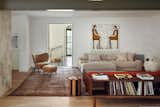
Upon entering the apartment one would never guess its total size. The front door opens onto an 11.5-by-16-foot living room—an open space that belies the density of the remaining 360 square feet. Between two tall south-facing windows, a table folds down from the wall, revealing a built-in bookcase. It’s a utility surface most of the time, but it lifts up easily on its hinge and hides away flat to make room for company. “It feels surprisingly spacious,” Finger remarks. “For Joanne’s 40th we had a party with 16 people—only three of them were children!”
Friends and kids are high on the family’s priority list, and their renovation goals revolved more around accommodating family and visitors than stashing a lot of stuff. Aside from Jonah’s impressive collection of toys, they keep possessions to a minimum. When the couple met, Finger was backpacking through the U.S. on a visit from his native Australia and Kennedy was living in a small employee room at a Catholic Worker house of hospitality for the homeless where she has worked since 1993. When the couple bought their apartment in 2004, they had no trouble adjusting to its size, but they knew it had potential to be more functional and roomy. “We felt like, for Manhattan, it was big enough,” Finger recalls. “It was just a bad layout.”
When it’s time to eat or do homework, the adults lower the tabletop, revealing a dozen book cubbies.
The new kitchen sits along one wall of the connective passage between the living room and the rear of the apartment. Finger had initially envisioned an all-black, showroom-style kitchen, but ultimately they went with CaesarStone and a gray color scheme, which kept the kitchen from dominating. Though the area is narrow, there’s still enough room for Jonah to set up a battleground for several brigades of army figurines near his father’s collection of lime green Le Creuset pots. Pantry goods are stored in a narrow sliding shelving unit that doubles as a screen when extended fully, providing some peace and quiet in the bedrooms if the kids need to go to sleep while the parents entertain. The floor slopes up at the bathroom, where existing plumbing necessitated some extra elevation.
In the found space above the original floor, recessed lighting provides a subtle night-light, partially filtered by a mahogany grill over the top. The pillbox lavatory was strategically placed so that the shower could share one of the kitchen skylights. “We believe that natural light is important in a shower,” Oliver explains. “It can transform a standard bathroom into a spa-like space.” Birch plywood and jade green stone mosaic floor tiles add to the Japanese feel.
The end of the corridor becomes a slender office/bedroom, with a tall north-facing window that looks out onto a tree and offers glimpses of Manhattan’s minimally varied wildlife. “We have a squirrel and a nesting pigeon,” Finger tells me, “but of course New Yorkers don’t like pigeons.” Jonah quickly interjects: “Excuse me, it’s a turtle dove, and there were two eggs, and two doves mean good luck.”
Clearly Jonah considers himself lucky to have had his pirate ship aspirations honored. He demonstrates the easy transformation of his sleeping berth from desk into bed, which he can do by himself. The floor hatches are also kid-friendly, he readily proves, with each section of mahogany floor lifting up to reveal cavities approximately eight inches deep for storing electronics, clothes, and toys.
All it takes is gentle downward pressure to lower the desk to the floor, bringing the kid-size mattress into position for bedtime.
In the “master” bedroom, the couple now shares their 70 square feet with baby Esther. Through their window, the spire of the Empire State Building can be vaguely made out—a vista Finger relishes despite its reliance on clear skies and sharp eyes. The bed occupies most of the room, but it’s not wasted space. The mattress rests on large rolling bins and the flooring at the foot of the bed lifts, too, though for now the baby’s crib limits access.
The foursome can live harmoniously in their modest domain, but Finger and Kennedy foresee a time when Esther’s toys will tip the balance and they’ll need more room. They often talk about moving to Australia, where Finger’s family still lives. “We are committed to raising our children to be comfortable living outside the United States,” says Kennedy. “When we do leave, it won’t be for somewhere else in the city. This is our home in New York.” Until the wind blows them in a new direction, they’re all hoping Esther develops a penchant for pirates.
To see more images of the Finger/Kennedy apartment, check out the
.
Advertising
Advertising
Advertising
Latest
-
02.05
The Scandic Grand Central, Stockholm
Greetings from Sweden! I'm traveling in Stockholm to cover the…
-
02.06
Bedrock Images's Forgotten Maps
For the architecturally inclined—especially those with a…
-
02.04
Street Furniture Your City Wishes it Had
Street furniture already catches the eye of denizens eyeing a…
Follow
Dwell
-
Each issue look out for the Take Me Home giveaway. Enter now to win the @gusmodern Timber Table from March http://t.co/9rSrie9X! #design
-
Form Us With Friends opening #design http://t.co/qeHXIRzb
-
Form Us With Friends pendants for #Design House Stockholm http://t.co/QwG8iRIW
-
Slab Vases by Form Us With Friends for Cosentino #design http://t.co/7dzi7X6F


No Roof Architects: http://noroof.net/ Architecture STRand: http://www.strandworks.com/ Cabinetry, Flooring, + Storage Units Raimund Koch: http://www.raimundkoch.com/ Photographer
wonderful design!
It's an apartment...in Dwell! I can't believe it. What a great space. Ingenuity is everywhere you look.
Nifty!
A wonderful design. But, what is the point of spending so many thousands of dollars to "design," when the same amount might have increased this family's square footage.
Really cool. The storage and lighting solutions are brilliant. The last commentor obviously doesn't know the price of real estate in Manhattan. Also, i'm sure this couple saved a lot of money as their in the design business. So it would have been a better option to spend money on design rather than paying for 10 square feet of additional floor area.
really wish that every story included a floorplan. Without it, one is left studying the pictures and attempting to figure how all the brilliance in space usage fits together.
I agree with esse owl. If Dwell included floorplans I'd enjoy their articles 80% more AND be more easily able to learn something useful.
I'm desperate to know the manufacturer(s) of the tile in the bathroom. How can I find this information?
I love the idea behind this issue and can't wait to pick up the paper copy! Growing up in Northern California, in real estate bigger is always better. I love the concept that rather than make a space bigger, the architects have made it more efficient FIRST. This is much more innovative than increasing the square footage. Besides, on a global and local (United States) scale, we are running out of room! The concept, and the relationships between the spaces and within the spaces, are illustrated quite wonderfully in the photograph. Look at how the hall-like space ("connective passage") functions as a procession of intermediate spaces. Also, I enjoy how the lengthy written segment shows us that if we LITERALLY think outside of the box, the box of the house in this case, by using Murphy beds and under-floor storage we can make the most out of the space we already have. LOVED this article!! Sometimes less really is more... @esse owl and Wellington: If Dwell does show a floor plan, there goes the designers' intellectual property! You might be able to find plans on the architects website(s) or in their other publications. @Pam: If you pick up the paper version, there are sources listed in the back.
The space efficiency would make a submariner proud, but I was curious, who made the wall-hung toilet in the bathroom? I would like to use something similar in an apartment renovation of my own (wall mounting makes it easier to clean the floor, particularly with the floor drain in the middle floor, so I can swab the dirty water down the drain without having to mop it back up). Thank you for an otherwise excellent article.
I like the bookshelves / dinning table idea and may adapt it to a personal project. No area of the apartment is left to waste. As for the floor plans, the printed copy presents the layout of the house as well as additional pictures.
Hi, Wellington and Esse, We do include floor plans in almost all of our features, including this one. You'll find the ones for this article in the print magazine of this issue and in the future we'll try to get them all online.
Thanks Michelle. Unfortunately the Resources section did not list the tile manufacturer(s) that I could see, but I'll check again.
I'd love one of these to call my own! My favorite aesthetic is the exposed brick wall from the old original structure running the length of the residence. The organization of space is so simple, but so genius. . .especialy the storage compartments in the master bedroom's floor.
For floor plans, visit the architect's site: http://www.noroof.net/work/projects/finger-apartment and click "More Images" at the bottom of the page. The floor plans are at the end of the slideshow. Or buy a print copy of Dwell. They're in there, too.
For the commenters who think they should have spent the money on more space: In Manhattan, the difference between a one-bedroom and a two-bedroom, in a comparable building and neighborhood, is about half a million dollars. Sad but true. I know MANY NYC families who raise a child in this space. I did too, until I had to leave New York altogether.
Love seeing clever small spaces. http://smallspaceresources.blogspot.com
I came across your magazine at Whole Foods tonight and the Small Spaces issue caught my attention. A little over a month ago I wrote a piece entitled "Rethinking Home Ownership and Living." I can totally relate to the theme of this month's issue. At the time I thought that people will think I have gone crazy. Your magazine at least proves there are people of similar mind sets. For me Small Spaces does not necessarily mean sacrificing functionality. It does however mean using less energy and environmental resources. See the above article at http://www.millennialliving.com/content/rethinking-home-ownership-and-living for details.
Sure this is clever and a great space saving/yet functional way of living. However this is very selfish for a family of four. They are forcing their children to live in these close quarters just because they want a great location. These people are not a single couple, they have one child that is already out growing his room and another that will be there soon enough, and where does she go if they stay here and not to Australia. I guess if you fold down the dining room table and throw a mattress on it, that would make for a comfortable bed. I grew up in a major city, not New York, and I do understand New York is very expensive, however you either chose to have children or live in a tight New York apartment if you can't afford both. A move just outside the city will give them the space, with enough left over to commute into town and design.
I want to know about where they got the bookcase/table. Was it custom made??? I could really use this in my small brooklyn apt.
@ Darryl Mitteldorf- it's Manhattan, there's only so much square footage to go around.
@ jay 06/13/2009: this is a magazine about design, not a platform for sociological criticism. Hooray for the Finger crew, the live in a metropolis, are exposing their young family to this rich experiment in diversity we call a city, foregoing the often predictable 'move out to the burbs' when you have kids all this in under 1000sq. I live in a 700sq ft london flat, so was slightly taken back at 'homes under a 1000sq ft' being seen as tiny. admittedly the Finger's apartment is small, but their kids are learning something, you dont need 3000sq ft of Mac-mansion to have a home, the city is a challenge not an obstacle to family life and a creative approach to space and storage works, and in these recessionary times isnt that what 'DWELL' is about: good design thats achievable wherever . I hope to be as clever one day when I re-do my apartment and show my kid how she can 'dwell' in 764ft with all the benefits of a family home smack bang in the centre of town.
Though I appreciate an apartment story, I am getting old, so FIRST I say: LEGALIZE small homes everywhere. I'm one person and even this apartment would be (ingeniously) too large for me. For $15,000 I could own a brilliant wee home forever, be debt free, but ahhh, that's illegal: these comments give much insight to the whole resistance to the mindset. In my 40's and that boy's bedroom would serve me very well. Regardless, it strikes me as very Modern Architecture/Japan-Urban & I love seeing it spreading more to USA. Smart and Small. Now, let us own homes such as this, oh please. Aren't I polite? You betcha! *be well
Nice design overall. It looks to me that they took a one bedroom bachelor and made it into a two bedroom. What will they do when the kids become bigger? That bed looks too small for a teenager, I wonder if you could fit a full sized bed in that space. My mother would fancy this a lot she has been looking at plans for the Micro homes that are only a few hundred square feet for a while now.
@jay 06/13/2009: One might say that burning fuels to commute into town, and power a larger home is the selfish thing to do. (If one were in the business of pointlessly judging the lifestyles of others.)
To me this kind of space is intriguing and exciting for many reasons, but one of the main ones is the potential for renovating and reusing older buildings (such as abandoned schools, industrial buildings, etc.) into dense housing with the use of creative design. I don't think this is a "selfish" parenting move at all. I grew up in a semi-rural environment with a huge yard and huge room to myself, but I was very far away from cultural activities such as plays, museums, or even a library that's open on weekends and evenings. There are definite advantages to raising a kid in a dense part of the city.
Why are we Americans so obsessed with LARGE spaces? Right now, I live in an 860 sq.ft. German chalet-style home which is basically one large room (aside from the bathroom) and I long to downsize! Smaller spaces = less clutter (you can't acquire that much junk,) easier cleanng and a smaller carbon footprint.
Only thing in this article that confuses me is the slide that talks about 3 guest rooms -- that seems odd given other features
I love this apartment. It's an inspiration to those of us living in 700 square foot in Boston and about to have our first baby -- close to all kinds of museums and green space, but with a smaller footprint. Just to put my two cents in there, plenty of the kids in the country have small bedrooms, too. Some old houses in rural Maine have VERY small rooms, not much larger than the one in this slideshow.
RSS Feed
Add a Comment