Why I Brought the Listening Bar Home
I was lonely. I was lonely in my kitchen, probably chopping onions, because I remember the sting in my eyes, and it definitely wasn’t because I was crying, from feeling alone. Everyone was hanging out in the living room, like they always do, around the corner a mere 15 or so paces from the cutting board I love to labor over. I might as well have been on a boat at sea for how far away it felt from where everyone prefers to congregate in my house. But everyone always gathers in the kitchen, you say. Nay, not in mine, where the living room’s soft surfaces, baskets of toys, and womblike layout are an idyllic venue for the kiddos to tumble and their parents to prate on about them. Not in mine.
But I’m not one to feel sorry for myself. In that moment, over the onions, sometime early summer of this year, I resolved to bring at least some of the action nearer to my habitual toiling over open flames and clattering of pots in the kitchen. I would bring the action to me, and solve my loneliness-in-the-kitchen epidemic.
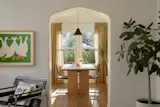
In my dining room, which connects the kitchen and living space, laid the answer. At that point, it was still a pile of raw soffritto, not yet a mothered-over ragu, since my wife and I had only moved into this Santa Barbara house a couple of years before, and a new baby’s needs were more a concern than moodboarding sheers. It had a dining table we’d custom designed with a friend, Adam Christgau, exactly two pieces of beloved art hanging on the walls, and a few cookbooks stuffed into some built-in shelves. But it had a store of potential beyond the place where we eat, I thought. And if I was going to find a way to lure guests nearer the kitchen—which itself is tricky to hang out in, given the mapping of prep and cooking surfaces, and the narrow passage into it where people pile up—I had to make the dining space more than a table and chairs. In the words of an Insta meme from "the only podcast that matters", it was time to "toss my hair in a distressed dad hat, drink some cortado, put on some NTS Radio, and handle it."
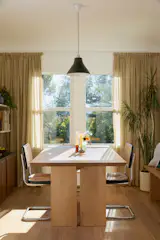
After my wife and I moved into our new-to-us, 1926 Santa Barbara home two-and-a-half years ago, one of our first purchases was a dining table and bench, custom designed by woodworker and drummer Adam Christgau. The Marcel Breuer Cesca chairs are from the Breuer Chair Company.
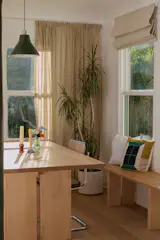
The bench adds seating around the perimeter for casual gatherings, and around the table for meals. The Window pillow is by Dusen Dusen, the Molekyl candle holder is by Gejst, and the planter and dragon tree are from Léon & George.
I likely don’t need to explain to you what a listening bar is, or a jazz kissa, if you’re in Japan—you’ve either been to one, or your friends won’t shut up about them. But this was my bright idea: whereas the tendency with many a home is to consolidate all the media in one room, instead, I would let the living area have the TV, and endeavored to give our dining space the atmosphere of a listening bar, a place with a vinyl setup that encouraged social engagement over music, nibbling, and drinking. This would also give my wife and I a chance to revive our vinyl collection: After resolving to upgrade our listening setup from a turntable, thrifted digital ’90s amplifier, and Sonos bar, but never replacing the turntable we ditched some five years ago, the vinyl had sat on display, no record player in sight—a crowning performative achievement of this millennial male.
To introduce a listening bar to our home, though, came with a massive risk. Speakers and the gear it needs to pump out the jams can cast you into a man cave quickly. But there would be no La-Z-Boys, no beer fridge, no big screen. This was not the time nor place to go full audiophile gearhead mode, Marty McFly wall of speakers dimed to eleven. There very much would be pét-nat and pâté pairings, and, in kind, the space needed a media center that could blend effortlessly with the brand of rough-and-ready elegance I envisioned for our dining space. It would be a place where our toddler could smash things into the dining table eight days a week, but between those tender moments, a social space for small plates to hit the deck, wine to flow, and music to fill chatter steps from where, before now, I masterminded apps in quiet desperation.
In a time of need, the algo provides. Scrolling Insta one day, some smart looking bookshelf speakers appeared from on high. These are slick, I thought—they could pass for midcentury furniture. And boy do I have a good eye. On his site, speaker designer Bernie Mehl describes them that way, as sculptural objects meant not as gear, but as companions for a well-loved lounge chair or custom credenza you probably scored on 1stDibs. (His first release was in fact a replica of Dieter Rams’s L2.) I got in touch, and, explaining to Mehl what I was getting up to, he told me to forget about the bookshelf set—he could do me one better: he was about to release his "Sound Painting," he calls it, a mono, 26-inch-square speaker with a cloth panel designed to blend with your space. A unit, a gift from Mehl, was soon on its way. I will have so many friends.
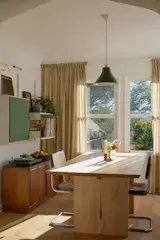
The lighting pendant is by Maria Melia Home and the sheers, in Pale Sand, were gifted by Nordic Knots. They hang on a custom-length track from Gotain. The wall with the listening setup is just around the corner from the kitchen.
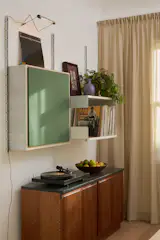
The credenza, an heirloom from my wife’s grandmother, hides a WiFi streamer gifted by WiiM. The record player, given to us by Pro-Ject Audio, is the Debut EVO 2, which I like for its no frills aesthetic and functionality. I intentionally designed the tracks for my Vitsoe 606 shelving system on the long side to fill out the wall space above the credenza and to frame the decor, and it gives me flexibility should I want to adjust the arrangement.
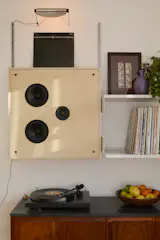
Bernie’s "Sound Painting" speaker is designed to the dimensions of the shorter of the two widths Vitsoe’s shelving and accessories come in. The Lamparaprima lamp, a gift from Santo & Cole, is deceptively flexible. I can stand it on its wire frame next to the record player, or hang it from a hook on the wall, and I can adjust its metal shield depending on how I want it to cast light. The fruit bowl is Heath, and Framebridge provided framing for the photo strips next to the vintage vase.
Ironically, for my dining room at least, the speaker is big. It might be the thing your eye gravitates toward most, after the dining table. But with its green cloth cover, which hangs from the frame via magnets at each corner, it doesn’t read as a speaker. Mehl, who’s from Germany but runs his business in Brooklyn, offers the unit starting at $3,200, but has an option to plate the sides of the sound painting to hang on Vitsoe’s famous 606 shelving system—another Rams nod; this guy knows to whom he is talking—so I designed a wall-mounted system for around $1,600 as the dining area’s "media center," fleshing it out with vinyl, of course, but also a few design objects, plants, and more decor that create visual balance. A vintage credenza, an heirloom from my wife’s side, hides a WiFi streamer and stash of wine and liquor, and a record player sits on top, joining a bowl of citrus that adds color to the scene and, often, the ceviche.
Of late, pulling out our time capsule of a record collection has been a trip down memory lane. (Helplessness Blues by Fleet Foxes? Not really holding up for me. Paul McCartney’s Ram? Love you forever.) If I can geek out a little, for a mono speaker, the Sound Painting has a surprisingly large sound field, capturing the nuance of Nick Drake’s hushed vocals and fingerpicking on Pink Moon, but also vividly casting the toothy edges of the Velvet Underground’s White Light/White Heat. I use the streamer often, too, partly because the record collection has a lot of catching up to do, but also because it makes it easy for friends to share something new.
Now that it’s November, the game is on. My recipe collection on Insta is getting deeper, and the wine bottles are stacking higher. As for my vinyl collection—it’s time to get out the duster. But that’s where you come in. If you stop by, be sure to bring a record and we can put the new listening room to the test, together, over some zuppa frantoiana bathed in olive oil or late-season pan con tomate dusted with your choice of finishing salt. I’ll just be a couple of steps away, preparing the next course within earshot. The moisture in my eyes? No, it’s definitely not the onions.
Published
Topics
How-To & GuidesGet the Dwell Newsletter
Be the first to see our latest home tours, design news, and more.